Things I Carried: Ipad & Sketchbook

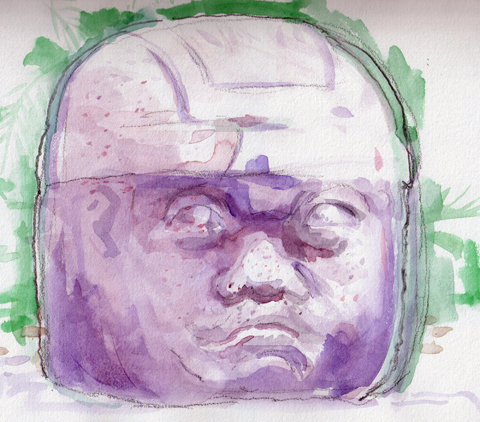
Olmec head, Parque La Venta, Villahermosa.

Back in sleepy Kutztown after 6 weeks of traveling through the Yucatan and Belize. I carried a sketchbook and an Ipad. My most recent on-the-road blog entries were done on the Ipad. WordPress for IOS worked pretty well. It doesn’t have the full toolset or versatility of the computer version of WordPress. I couldn’t manage to add links, for example. I know it is feasible, but it was beyond me working with ‘jungle-lodge’ wifi. At this point in time, a netbook or MacBook Air might be a better choice for remote blogging.

My sketchbook was a softcover Moleskine. It, too, was not the perfect choice. It wilted in the Mexican humidity, the perforated pages near the back came undone and ink from the cover bled into the edges of the interior pages. (See sketch below.) I know, it is the poor carpenter who blames his tools, and Moleskine has a devoted following. A more expensive hardcover Moleskine would have been a better choice. In the past I’ve used Cachet, Canson, and Holbein sketchbooks, all good products. Selecting a sketchbook is a very personal matter. Consider the media you use, and be realistic about the size and weight of the book you are prepared to carry.

 Hand-cranked ferry in Belize, ink and watercolor in Moleskine.Watercolors on the Go…
Back in my youth I would carry high-end watercolors on my journeys,–Schmincke watercolors. Schmincke colors are certainly extraordinary. The colors are lush, bright, and much more colorfast than Prang. But since I am an illustrator, not a “fine art” watercolorist, the Prang colors serve me well. If I get an image I like I can scan it before the colors fade. And though a watercolor purist would gag at the thought, I can also tweek the colors in Photoshop. Bottom line: The Prang set costs $1.99, a small Schmincke set can be found on sale for about $100.

I also carried a Niji waterbrush. It looks gimmicky, but I like it. It has a reservoir that holds enough water in the handle to complete a fair-sized sketch. Sakura also makes an even smaller waterbrush called the Koi. These can be found for under $8, and while they don’t compare to high-end kolinski sable brushes, they are wonderful for use in the field.

Note: Blog title today pays homage to Tim O’Brien’s Vietnam short story collection, The Things They Carried. I went on a sketch tour of Vietnam near the end of the war, in 1971.  If I find some of my old Saigon sketches I will post them in the future.

America’s Funniest Archaeologist

20110629-102558.jpg

Dr. Bill Saturno is in the news again for unearthing an ancient art studio in Guatemala. The post below is from July 2011, when I met him in Belize:

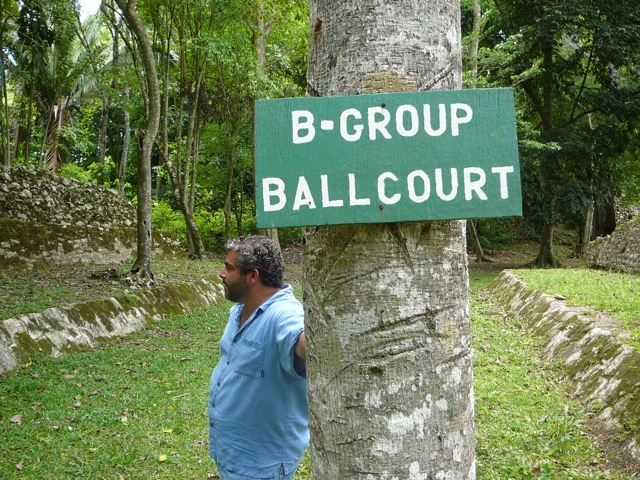
Dr. Bill Saturno has got to be America’s funniest archaeologist. His discoveries of Maya murals made page one of the New York Times. That’s him pictured above at an ancient Maya ballcourt in Caracol, Belize. He is built like John Belushi or Lou Costello, and like those great comics, he talks with more than his mouth. His eyes roll, his hands flutter, and he seems a surprised as anyone else to hear what he is saying.

I am on the road with a group of NEH fellows, most know much more about Maya art than I do. We heard Dr. Saturno tell his hair-raising story in a makeshift conference room in a funky Belizean hotel. We were supposed to meet Dr. Saturmo in the Peten, Guatemala, but a US State Dept. warning prompted by a recent massacre there led to a change of venue.

Currently at Boston University, Saturmo was an adjunct professor at University of New Hampshire in 2001. His life changed that March when he flew to Guatemala to do a brief project over Spring Break. He went into the Peten, the dense jungle territory near the borders of Mexico and Belize. His original Spring Break plan, Plan A, didn’t pan out, nor did Plan B.

A Guatemalan guide named Bernie Middlestadt suggested a Plan C. He told Saturno he might find upright monuments, Maya stela, at a looted site north of the famed ‘lost city’ of Tikal. Bernie was no ordinary guide. A steely-eyed Guatemalan of German descent, he was recommended by Saturno’s mentor, the British explorer Ian Graham. Graham’s autobiography is aptly titled, The Road to Ruins. According to Saturno, it is a ripping yarn, as the Brits say. Graham played parlor games at Rudyard Kipling’s house, served tea to the Grand Pasha at age 11, and cavorted with Picasso in Paris. All this, before dedicating himself to Maya studies.

Bernie led young Dr. Saturno and a crew of four on jungle journey that was supposed to be the proverbial ‘three hour tour.” The last road sign Saturno saw was an unhinged arrow pointing straight to hell. Felled trees forced the six to abandon their two vehicles. Saturno began to have doubts when Bernie’s men needed machetes to clear the path. He had a GPS, so he was never really lost. But it occured to him that knowing where you are is far less important than knowing where the hell you are going. They drank the last of their water. Bernie assured Saturno the Peten was full of shower vines. Cut the right way shower vines provide plenty of drinkable water, or so said Bernie.

Perhaps Saturno asked Bernie too many questions as they hacked their way forward. Bernie told a little jungle parable. Once upon a time, he was guiding a gringo, and the man stepped on a plant. Bernie informed his client that this plant was a very rare orchid. The man stepped on another orchid, and Bernie warned him politely not to do it again. When the gringo stepped on a third orchid, Bernie took out his pistol and shot him in the face. End of story. So, Saturno followed Bernie in silence and stepped exactly where Bernie stepped.

Zig-zagging north they encountered no shower vines, but Bernie promised  to break out the emergency rations when they reached the site. The jungle is quick to cover ancient pyramids, so a Maya temple covered with trees and moss looks much like a hill. They found the site eventually, an overgrown hill with a looters’ tunnel. Saturno looked around. If there were stelea here, they were long gone.

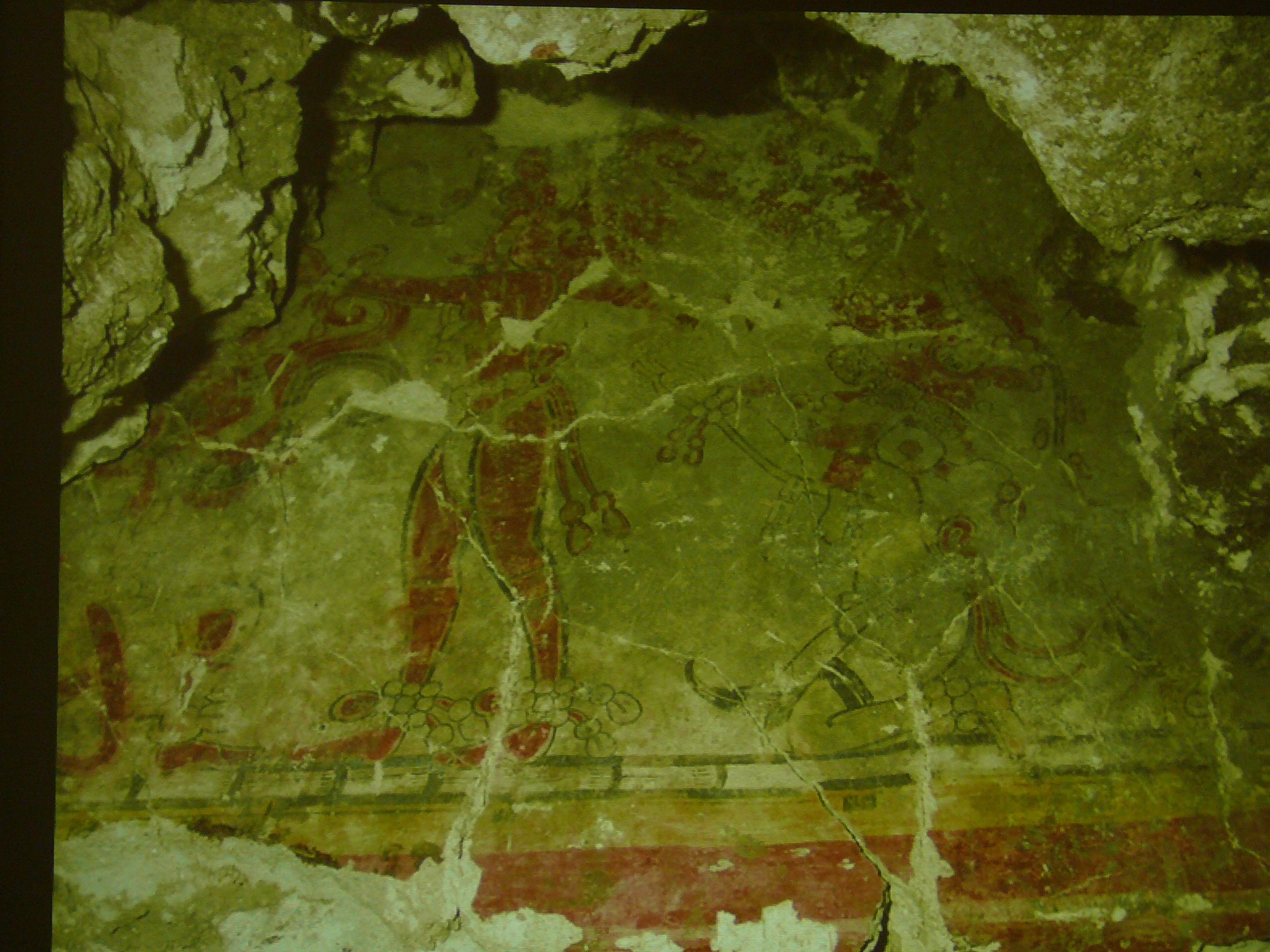
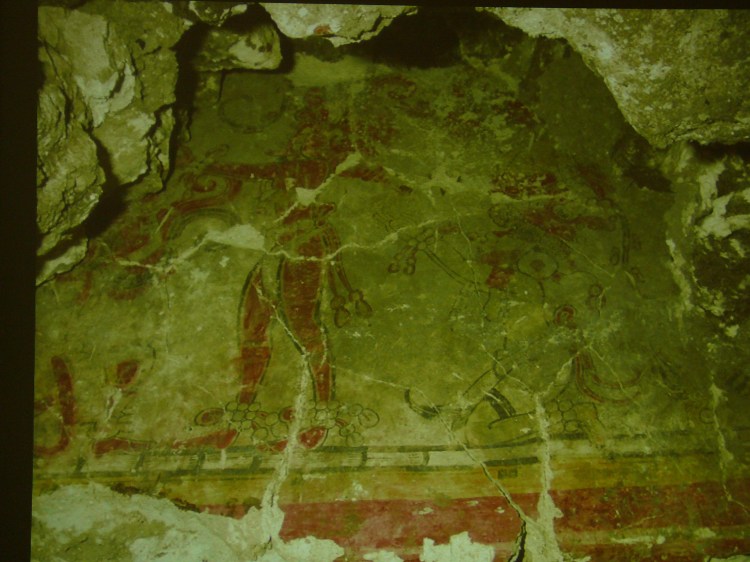
Bernie and his men went looking for water vines. Saturno took refuge from the heat in the looters’ tunnel. It smelled of bat droppings. He pointed his flashlight up and found the first Maya murals in over half a century. He took a photo. He said he was so tired and dehydrated that he felt no elation. Just thirst. When Bernie and crew returned Saturno said nothing about the murals. It had occurred to him that perhaps Bernie was a looter. 20110704-062339.jpg

Above is a painting by artist Heather Hurst, done over images scanned directly from the wall at San Bartolo.
20110708-021803.jpg

Bernie broke out the emergency rations, a single serving of crab flavored Cup o’ Noodles for six men. They found a few ounces of muddy water. Bernie told Saturno they needed his shirt to strain the goopey liquid. Saturno thought, why my shirt? But then looking a the dirty, raggedy shirts of the others’ backs, he saw the wisdom in Bernie’s decision. 

Retracing their steps through the jungle two of the men collapsed unconscious on the ground. Saturno said to himself – I don’t want to die on the jungle floor, so he strung his hammock between two trees and passed out. Sometime later Antonio, the eldest guide, returned with foraged bitter roots, and got Saturno and crew back to the vehicles. He made it home, and the rest is history.

Micheal Coe in his classic book The Maya, put it this way, “One of the great archaeological finds of all time took place in 2001, when Dr. William Saturno stumbled across San Bartolo…taking refuge from the intense sun in the shade of a looter’s tunnel.” Coe and I can’t tell it like Saturno. If you are at Boston University, sign up for his course.

Learn more, in Spanish or English at the San Bartolo project web site.

Note: Originally posted from my Ipad in Merida, Yucatan.  Updated links a bit since.

Jean Charlot, an illustrator worth knowing.

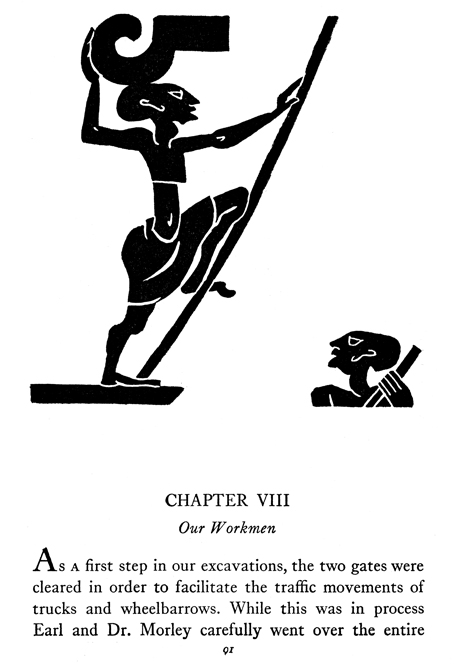
Illustration from Digging the Yucatan


Jean Charlot was born in Paris in 1898. His name is pronounced in the French manner, something like “Jahn Sharlow.” Oddly enough, Charlot was a great Mexican illustrator. His mother was from Mexico and after World War I, she returned to Mexico with her son, Jean. By that point he was a young man, having served in the French Army during the war and studied art in Paris. In Mexico City he began teaching printmaking and writing about Mexican art history. He sought out the great muralists and befriended artists who sometimes didn’t get along with each other, Siqueiros and Rivera, for example. He worked with Diego Rivera on several monumental mural projects. He spoke and wrote in fluent French, Spanish, English. He also spoke Nahuatl, one of Mexico’s many indigenous languages.

Illustration from Digging the Yucatan

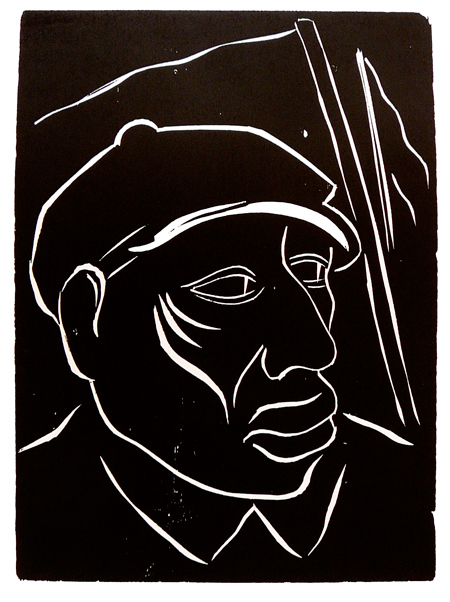
Charlot was an influential member of the Taller Grafica Popular. The TGP, or Taller de Grafica Popular (Workshop of the Peoples’ Graphics) printmaking collective was founded in Mexico City in 1937. The TGP still exists today and is well worth a visit. I wrote about my 2009 pilgrimage to the TGP here in the webzine, Commonsense2.com. There I held original prints by Charlot in my hands, including the one below. Like most TGP prints it is unsigned, but I have little doubt this is his work.

Worker: unsigned woodblock print attributed to Charlot photo: K.McCloskey, 2009

20th Century Mexican artists, Charlot included, did not look down on illustration, the way most North American painters did. Until Andy Warhol, many U.S. fine artists denied ever doing illustration, even when they had done it well. Edward Hopper, for example, was a notorious denier.

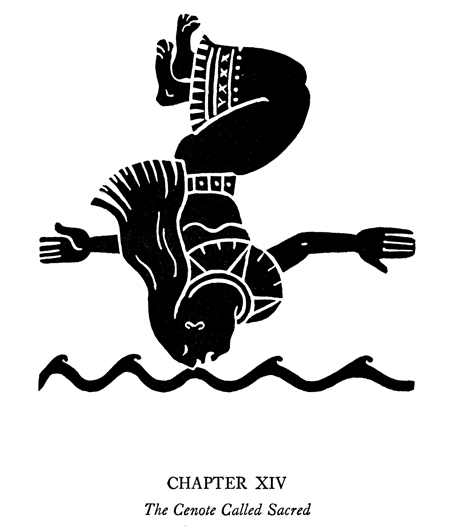
In 1926, Charlot was one of the official artists hired by the Carnegie Institute’s Maya Expedition to document the excavations at Chichen Itza. He later illustrated Ann Axtell Morris’s bestselling book for young adults about that expedition, Digging the Yucatan. The bold silhouette-style illustrations reproduced here are examples of his extraordinary genius. Clearly, the two years he spent in the Yucatan drawing copies of Maya murals and relief sculptures made him the ideal candidate for this assignment. These images are remarkable for their unusual use of white space. I’ve reproduced a few with the text included to give a sense of the book’s dramatic page design.

Illustration from Digging the Yucatan

Charlot’s life was so eventful I can’t even scratch the surface of his accomplishments in this note. I hope to write more about him soon. Interested readers should visit the web site of the Jean Charlot Collection at the University of Hawaii.

Credits: Art from Digging in Yucatan came the Jean Charlot Collection web site. Copyright statement from that site: This material is copyrighted 2001 by John Charlot, the Dorothy Z. Charlot Trust, and the Jean Charlot Estate. The text of these web pages may be reproduced in whole or in part provided that proper credit is given and reproduction is not for commercial purposes.

20110714-092656.jpg
Above: Watercolor of Jean Charlot’s quarters at Hacienda Chichen Itza by Kevin McCloskey, July 14, 2011.

Catherwood, illustrator in the Yucatan

20110707-112926.jpg
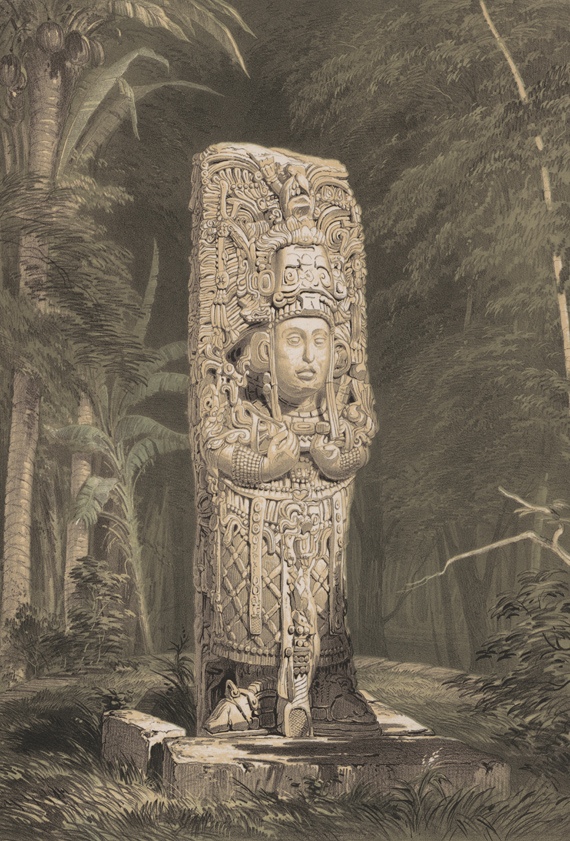
Above: Maya stela at Copan by Frederick Catherwood.
Blogging on an Ipad on a bus racing through the Yucatan can be difficult. For one thing, I can’t insert links. Also, I haven’t been in WiFi range for a day. Last night I slept at the Hacienda Uxmal, the same hacienda where the great English illustrator Frederick Catherwood stayed when he drew the Uxmal ruins in 1839. There is a bilingual plaque on the hacienda’s wall saying Catherwood ‘died at the height of his career in a sink on the steamship Artic’ traveling from Liverpool to New York. Imagine that! Reading the Spanish version I understood the entire ‘barca de vapor’ or steamship did sink, so his death was slightly less proposterous than I originally thought.

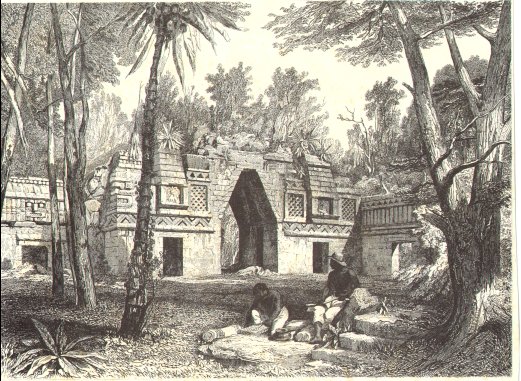
Catherwood braved disease, insects, snakes, and insurrections to complete his illustrations for John Stephen’s “Incidents of Travels in Central America, Chiapas, and the Yucatan.” With the help of native guides Catherwood would hack away foliage to cast light on ruins. Catherwood rigged a field camera lucida, a tracing machine with a prism, that works something like a pinhole camera. This device made for precise copies, but meant the artist had to work in a dark tent during the hottest, sunniest hours of the day. ‘Incidents of Travels’ was published with 77 stunning illustrations in New York in 1841. An instant bestseller, Edgar Allan Poe called it, “perhaps the most interesting book of travel ever published.”

Arch at Labna, by Frederick Catherwood.

Update: Back on campus, I’ve added links to Smith College’s splendid online gallery of his artwork. Here is more from  Casa Catherwood, in Merida. The stela at the top of the page is a chromolithograph. His black and white work is also worth checking out. Much of the Maya art and architecture Catherwood drew in 1839 has since been looted, vandalized, or otherwise destroyed. Fortunately, his drawings are so precise that epigraphers, folks who read Maya glyphs, can decipher much of what he documented. With today’s upswing in interest in all things Maya, Catherwood’s work is collectable again.

First editions of the 2-volume ‘Incidents’ originally sold for $5. Today an early edition in fair condition might be had for under $300. Print dealers buy the volumes then rip out the prints and sell them for $30 apiece. 77 prints X 30 = $2421, so by destroying these rare books these dealers can gain over $2000. I admit I have purchased the occassional page of incunabula, early printing, to share with students in Historical Survey of Graphic Design. I have a single page from Owen Jones’ ” Language of Ornament,” published around Catherwood’s time which I purchased online for $20. The Ebay dealers I buy from assure me they only remove pages for sale from ” unrepairable books.”

20110709-093947.jpg
Above: my sketchbook page showing the church at Mani and its bookstore.

Speaking of Books and the Yucatan….

Yesterday we were at the 16th century Franciscan Church at Mani. It is a massive structure with a fresh coat of burnt orange paint on its simple face. I knelt in church and said a quick prayer, asking for the impossible. Then I went into the little bookstore attached to the church. They had framed Virgens de Guadalupe printed on silver foil. Hecho en China, made in China, they cost 30 pesos, under 3 dollars. Somewhere between the Ipad factory and the bobble-head ballplayer plant, there must be a blessed printing press reproducing Mexico’s protectress. There was a colonial-era portrait mural of a Franciscan friar on the wall above the rosaries. Below the rosaries rested a horizontal fridge full of ice cold Coca-Cola.

There was a large selection of little books. Even though Maya language radio could be heard in the village, all the books were in Spanish. These seemed to be printed in Mexico. Some of the titles were fascinating, like The Seven Fortresses of Sobriety, and Que Falte Nadie en Cielo, roughly translated, In Heaven, You’ll Miss Nothing! I resisted the temptation to buy any book in this particular bookshop. This is where Friar Diego de Landa burned every Maya book he could find in 1562. Nobody knows how much science, history, and art de Landa’s bonfire destroyed. Amara Solari, Penn State art historian, estimates the friar burned between one and two hundred books at Mani. She says the book burning didn’t end there. It continued into the 17th century. De Landa reported Maya elders appeared ‘distraught’ to see their sacred books go up in flames.

Only 4 Maya books survived, some because they had been shipped to Europe prior to this book burning of 1562. The Maya codices were not like our books, exactly. They were hand-painted manuscripts, one-of-a-kind objects. While the Maya may have reproduced images on fabric and pottery with simple printing devices like rubber stamps, they never made the leap to printing on paper. On the other hand, Catherwood’s books on the Maya were printed in runs of 10,000 at a time. His illustrations appeared in the bestselling travel book of his day. Still, it seems to me, collecting individual leaves resulting from the destruction of a rare book, is a terrible thing. Dear God, thank you for the fact I have no WiFi, at this moment, when I am tempted to buy a print by Frederick Catherwood.

Something Craig Frazier taught me.

Craig Frazier has a great illustration studio website.

art © C. Frazier from 36pages.com

Beyond that, he also has a wonderful blog about children’s picture books called 36 pages. I heard him speak at an illustration conference in Philadelphia, PA, around 2003. He is an interesting artist. The art shown at right, lifted from his blog, demonstrates that he is at the designerly end of the illustration spectrum. You probably have used one of the postage stamps he’s illustrated. I do admire how Frazier manages to convey complex concepts with deceptively simple figures and sparse landscapes.

I often use one of the exercises he shared in Philadelphia in my Visual Thinking class. He is the guy who came up with the idea of taking four inches of black drafting tape and cutting it up and placing it down on a white rectangle to make graphic representations. The paper should be roughly twice the size of the tape’s total area. Use all the tape!

I find 3 X 5″ index cards work well for a surface. This is a nifty exercise in composition and balancing black and white.

I’ve done three examples below. Actually, I did six this morning; these are the best of the lot. Craig Frazier gives much better examples in his book, The Illustrated Voice. It is worth looking for.

Black Tape Exercise #1, K. McCloskey 2011
Black Tape Exercise #2, K. McCloskey 2011
Black Tape Exercise #3, K. McCloskey, 2011

Thanks to Craig Frazier for letting me share this exercise!

Lewis and Clark and Houdini

I loved the graphic novel Houdini, The Handcuff King written by Jason Lutes, drawn by Nick Bertozzi. My only criticism: I wanted the story to go on longer! I was thankful for the introduction and the fascinating and detailed end notes. The added text helped flesh out the historical and social context of Houdini’s enduring story.

Houdini, The Handcuff King, artwork © Nick Bertozzi

A part of my wish for more came true. Nick Bertozzi created a larger, longer graphic novel, also based on U.S. history, Lewis and Clark. Published by First Second, a division of MacMillan, this book weighs in at 144 pages. This is a great read for reluctant readers, myself included. Lately publishers have been producing movie style trailers for books. In the case of graphic novels, trailers do make sense, giving a quick overview of the visual style and pace of the story. The trailer for Lewis and Clark is just over a minute and worth a look.

from Lewis and Clark © 2011 Nick Bertozzi

There is an interesting interview with Bertozzi at the Comics Reporter. At one point he talks about his study of the art movement, Cubism, for another graphic novel project, The Salon. “I wasn’t passionate about (Cubism), but I was passionate about understanding why it was important. …One of the great things about comics for me is that it’s this wonderful catch-all for learning.” That’s something like what I say about illustration, illustration is fascinating because it can be about anything. An aspiring graphic novelist, or illustrator, is rewarded for being curious about everything in the world.

Gateway Arch, St. Louis, photo © 2011 Kevin McCloskey

I was in St. Louis in March and walked to the arch at the Mississippi riverfront. Much of the underground museum there, The Jefferson National Expansion Memorial, is devoted to telling the story of Lewis and Clark’s expedition to “expand the nation.” Awe-inspiring mural-sized photographic prints line the walls depicting the locations where the expedition paused. The photos are accompanied by descriptive quotations from the Lewis and Clark journals. I am not a historian, but I found the displays quite attractive and informative.

Spoiler Alert: There were parts of the Lewis and Clark story that I didn’t see in the National Expansion Museum. Maybe I had looked harder I would have learned about Captain Meriwether Lewis’s binge drinking, his bouts of depression, and his eventual suicide. Bertozzi tells the whole story, warts and all. I found Bertozzi’s narrative complex and thoughtful, and even the tragic ramifications of the expedition were handled with grace. I looked for his book at the Arch’s museum bookstore; it wasn’t there in March. It belongs there, there is a need for quality nonfiction illustrated books to keep young readers hooked on reading. We all need to consider U.S history and its remarkable ramifications.

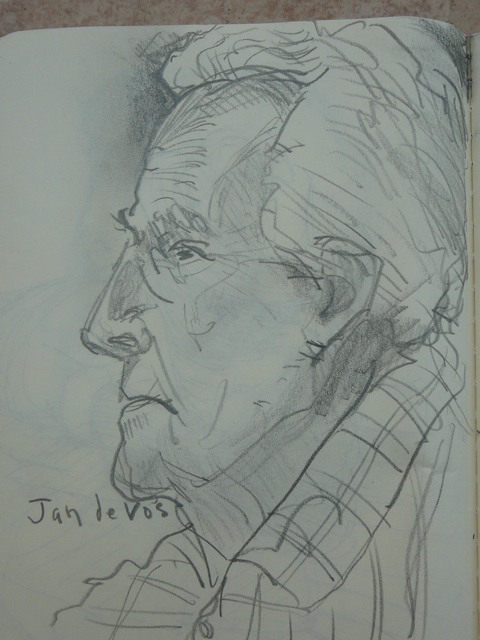
Jan de Vos: In the flesh.

Update: July 25, 2011, Jan de Vos died yesterday morning in Mexico City. Below is my sketch from last month in Chiapas, Mexico.

20110624-111903.jpg

We met a holy man in Chiapas. Jan de Vos is 75 years old. He was born and educated in Belgium, He studied philosophy and theology with Prof. Ratzinger, who is now Pope Benedict XVI. He earned his Phd in humanities and was ordained as a Jesuit priest in the Roman Catholic Church. In 1973 he was sent to Chiapas, Mexico, as a missionary.

His task was to teach the indigenous Maya about God. It dawned on him that the Maya had things to teach him about God and life. I drew the pencil sketch portrait above as he began his informal lecture in a hotel room in Palenque, Chiapas. He began by declaring we were in a sacred place. Not only sacred because of Lord Pakal’s tomb in the Temple of the Inscriptions, but also because of the work of a humble missionary, a Spanish friar named Pedro.

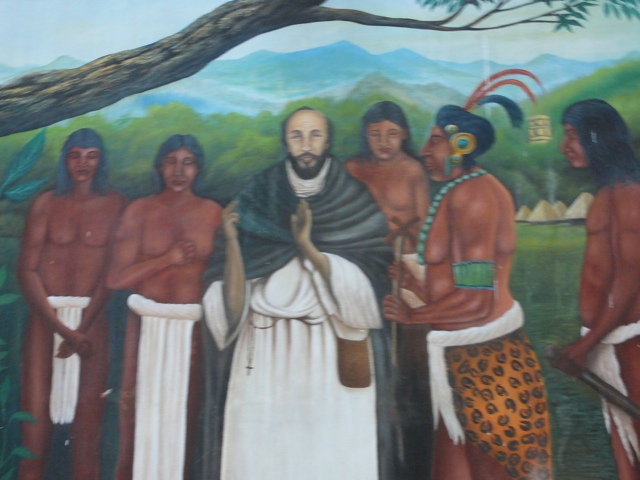
Friar Pedro de Lorenzo de Nada came to Mexico in the mid-1500’s. “De Nada” means “of nothing”, something he added to the name the church gave him. Jan de Vos considers Friar Pedro more significant than Bartolome de La Casas, Bishop of Chiapas. Like Jan de Vos, Friar Pedro was a linguist; he learned four Maya languages. Friar Pedro tried to live the gospel among the Indians, but to do so he had to “cut his relations with his superiors.” He climbed over the wall to escape the monastery and lived the rest of his life among the Maya of Chiapas.

De Vos lamented that few visitors to Palengue are interested in Friar Pedro’s story. De Vos wrote his first of many books of Chiapas history about the runaway priest. Father de Vos could relate to the difficulty of “de Nada” and the early missionaries. He imagines them teaching the Our Father. “Our Father?” They must mean Our Mother, think the Indians. “Who art in Heaven?” But, She is in the Earth, say the Indians.

The Indians hid Friar Pedro from the authorities, both the church and civil authorities in Guatemala wanted to catch and discipline him. In that time, Chiapas was ruled from Antigua, Guatemala. Today, Chiapas is governed (to the degree that it can be governed) by Mexico.

20110624-121111.jpg

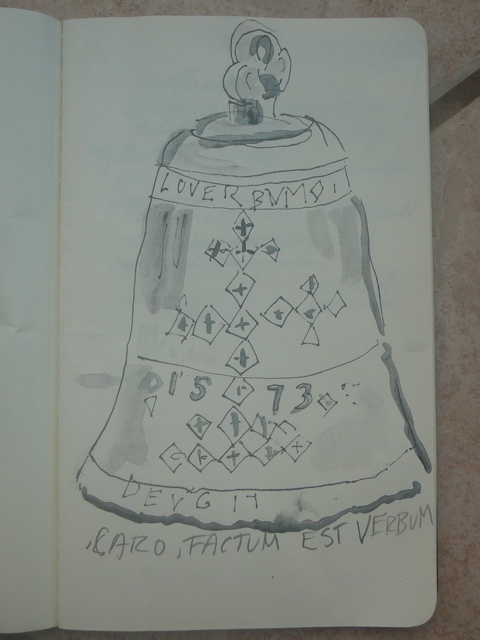
In 1571, Friar Pedro gave three bells to Indians. Jan de Vos told us one of the bells was still in the Palenque village church. The next day I walked to the yellow church at the center of the small town. I found the painting of Friar Pedro on the wall in the left chapel. Below, painted on the wall, was a caption written by “Jan de Vos, historian.” I saw no bell. There was one Indian man, his straw hat at his feet, lighting candles and intently praying in a Maya language. I did not disturb him.

On the right side, in a chapel near the confessionals, I found a caretaker sweeping. His name is Manuel, I asked him about the bell. I wasn’t sure he understood my Spanish. After a moment, he asked who told me there was a bell. When I answered Jan de Vos, Manuel led me to a long storage room filled with brooms and half-used candles. We were directly behind the sacresty and altar. He moved some furniture and lifted the bronze bell. It was much larger than I had expected, nearly three feet tall. I asked if I could spend a minute there, drawing the bell. Manuel asked why. I told him it was a sacred object and that I had heard the story of Friar Pedro. Manuel told me that made his heart feel good.

Manuel went back to work. I sat on a wooden box. It was 95 degrees outside and humid beyond metaphors. It was much hotter in the church. As I sketched the bell, sweat fell from my brow onto the bell and my sketchbook.

20110624-125005.jpg

In our digital age, one might ask what is the point of keeping a sketchbook? I have two thoughts on that. Drawing forces observation. Surely great photographers are great observers. Personally, I find drawing connects me with people and places in a better way. Secondly, I am in Mexico, a land of living arts, where work done by hand is deeply respected.

Back to Jan de Vos. All during his talk about Chiapas history he had a single red file folder in front of him. At one point he opened the folder to reveal its contents: nada. De Vos, like Friar de Nada, went “over the wall.” In 1995 he was invited into the Lacondon jungle by the Zapatistas. That is another story.

Yachitlan

20110620-102301.jpg

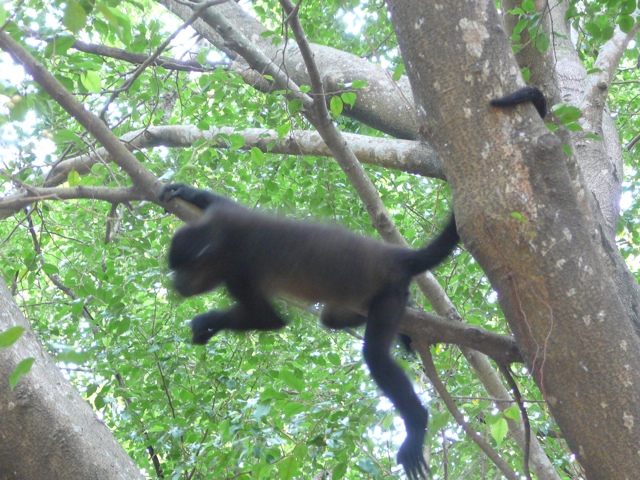
An hour from Bonampak we reach the frontier town, Frontera Corozal. We descend across two springy, cablebound causeways to the banks of the Umumacinta River. The Umumacinta has been called the River of Ruins. According to Dr. Alfonso Morales one of our guides, and one of Mexico’s great archaeologists, Umumacinta can be translated as River of Howler Monkeys. Howlers roar so loud you expect them to be ten times their actual size. When they burst out of the jungle, one is relieved that they are gangly black haired creatures not much larger than chimps. It would be a mistake to get to close though, they enjoy flinging feces at visitors.

At the river bank we are met by Ch’ol Maya boatman who pilot launches upriver to Yaxchilan. The launches are narrow boats, perhaps 35 feet long, powered by a single outboard motor. Nine others are already on the boat. The moment I step aboard our pilot pushes off, drops the propellor into the river and we are off. After a long bus ride from Palenque we are giddy to be on the river.

As we head upriver the pilot stands erect gazing over our heads. He sees things we can’t, plotting a course that moves us rapidly forward. Sometimes we come quite close to the right bank, the starboard side. The two banks look the same, but one side is Guatemala. This right bank is part of the northernmost area of Guatemala, the territory known as the Peten. A few weeks back there was a massacre in the Peten. According to press reports the Zeta drug cartel murdered 30 Guatemalan farmers, and painted messages in blood on the cinderblock walls of the village.

20110620-105801.jpg

On the Guatemalan side I notice crude shelters, palm frond lean-tos. These might be picnic grounds, but more likely a final shelter before migrants attempt the crossing into Mexico.

Yaxchilan has a remarkable ancient ballcourt, I will get to it in a future post.

Maya Murals at Bonampak

20110619-060359.jpg

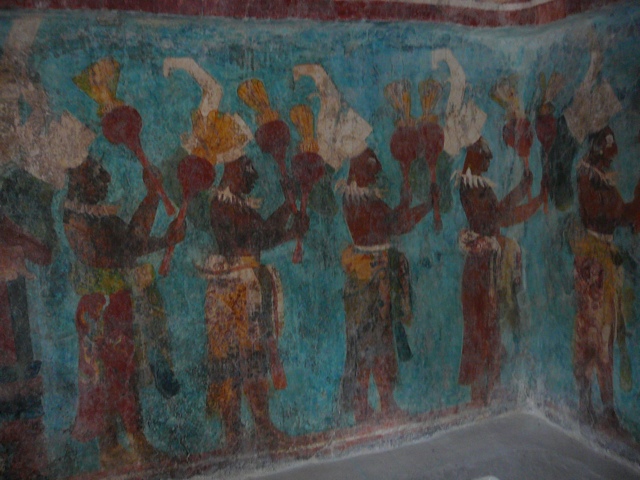
Above is a photo I took yesterday of the Maya murals at Bonampak. Picture a small vaulted room atop a great stone structure in the state of Chiapas, Mexico, not far from the border with Guatemala. This detail is from a section called The Musicians. It was painted close to the year 800 A.D. These musician figures are rather large, about 40 inches tall. Even after 1200 years it is clear the Maya artists had remarkable skill with figurative art. They are also masters of color. The background blue is a favorite, even today, among the Maya.

Mary Ellen Miller, a Yale art historian, has compared these figures to Eadweard Muybridge’s pioneering photographic works documenting the human figure in motion. Each of the maraca players is frozen in motion, a split second after his neighbor. This gives this panel a remarkable sense of motion, a sense of dance. Unlike other ancient cultures the Maya often permit the artists to sign the work. In the case of the murals at Bonampak, I did not see a signature mark.

There are two other adjacent vaults at this site that come as a shock after the beauty and musicality of this room. The next vault is filled with scenes of torture, the third with graphic depictions of ritual bloodletting.

The Lacandon Maya guards at the vault are very insistent that no flash photos be taken. Visitors, like myself, are allowed in in groups of three. There is little room to turn around. I held my digital camera at arm’s length and shot blind. Considering there is only diffused and blocked sunlight, I am pleased with the results. This is my first blog post via Ipad. Apologies in advance, for brevity and odd formatting. The photo is dark and does not do justice to the wonderful ancient image. I will be able to edit my photos when I return and will add more then.

The murals are in a denses jungle region, the site is now a national park. The Lacandons made a deal with INAH, the Mexican office that oversees archaeological sites. They gave up any claim to the plazas, altars, and temples of the ancient Maya, but insisted on control of the last five kilometers of road to the site. My group disembarked from our bus and piled into 10-passenger vans with taciturn Lacandon drivers. This system creates jobs for the Lacandon and also makes looting unlikely.

At one time the Lacandon were even more protective of the murals at Bonampak. One of the first North American visitors to the site was shot dead for looking at these same murals without tribal permission. This event was not exactly ancient history; it took place in 1946.
-K.McCloskey, Chiapas, Mexico.

20110619-071832.jpg

20110619-111531.jpg

In the Maya World

Maya sculpture, photo by Kevin McCloskey

I’m off campus at the moment, far off-campus, on the Yucatan Peninsula of Mexico. I am participating in an NEH Institute along with 23 other professors of various topics from across the U.S. The NEH (National Endowment for the Humanities) and CCHA (Community College Humanities Association) are co-sponsoring a five-week study tour of the Maya world. We will be met at archeological sites by some of the foremost scholars in the field. I’ve read six books on the Maya in recent weeks; that’s less than half of my assigned readings. I’ve learned that I have a lot to learn. When I get back to Kutztown University I will have new insights on the art and iconography of the Maya to share with my Historical Survey of Graphic Design Class. I will also be giving a public lecture on this scholarly adventure at Rohbrach Library in October.

I’ve long been interested in this part of the world. In the mid-1970’s I drove a Toyota Corolla from New Jersey to the “Lost City” of Tikal in Guatemala. That was some hard traveling. This time we will be traveling by bus and river boats. It may not be possible for me to get access to the internet. I know I pledged to update the blog weekly, and I will do my best. If you send comments, be patient, I may not be able to reply in a timely manner.

Lately the popular media has been filled with a sensational misinformation about the Maya, especially in regard to their calendar. As a letter from the project directors, Dr. George Scheper and Dr. Laraine Fletcher, points out, “Maya culture does not need exoticizing or sensationalizing to command our attention. What we actually do know about the Maya from responsible scholarship places them in a sufficiently exceptional category of study.”