Lewis and Clark and Houdini

I loved the graphic novel Houdini, The Handcuff King written by Jason Lutes, drawn by Nick Bertozzi. My only criticism: I wanted the story to go on longer! I was thankful for the introduction and the fascinating and detailed end notes. The added text helped flesh out the historical and social context of Houdini’s enduring story.

Houdini, The Handcuff King, artwork © Nick Bertozzi

A part of my wish for more came true. Nick Bertozzi created a larger, longer graphic novel, also based on U.S. history, Lewis and Clark. Published by First Second, a division of MacMillan, this book weighs in at 144 pages. This is a great read for reluctant readers, myself included. Lately publishers have been producing movie style trailers for books. In the case of graphic novels, trailers do make sense, giving a quick overview of the visual style and pace of the story. The trailer for Lewis and Clark is just over a minute and worth a look.

from Lewis and Clark © 2011 Nick Bertozzi

There is an interesting interview with Bertozzi at the Comics Reporter. At one point he talks about his study of the art movement, Cubism, for another graphic novel project, The Salon. “I wasn’t passionate about (Cubism), but I was passionate about understanding why it was important. …One of the great things about comics for me is that it’s this wonderful catch-all for learning.” That’s something like what I say about illustration, illustration is fascinating because it can be about anything. An aspiring graphic novelist, or illustrator, is rewarded for being curious about everything in the world.

Gateway Arch, St. Louis, photo © 2011 Kevin McCloskey

I was in St. Louis in March and walked to the arch at the Mississippi riverfront. Much of the underground museum there, The Jefferson National Expansion Memorial, is devoted to telling the story of Lewis and Clark’s expedition to “expand the nation.” Awe-inspiring mural-sized photographic prints line the walls depicting the locations where the expedition paused. The photos are accompanied by descriptive quotations from the Lewis and Clark journals. I am not a historian, but I found the displays quite attractive and informative.

Spoiler Alert: There were parts of the Lewis and Clark story that I didn’t see in the National Expansion Museum. Maybe I had looked harder I would have learned about Captain Meriwether Lewis’s binge drinking, his bouts of depression, and his eventual suicide. Bertozzi tells the whole story, warts and all. I found Bertozzi’s narrative complex and thoughtful, and even the tragic ramifications of the expedition were handled with grace. I looked for his book at the Arch’s museum bookstore; it wasn’t there in March. It belongs there, there is a need for quality nonfiction illustrated books to keep young readers hooked on reading. We all need to consider U.S history and its remarkable ramifications.

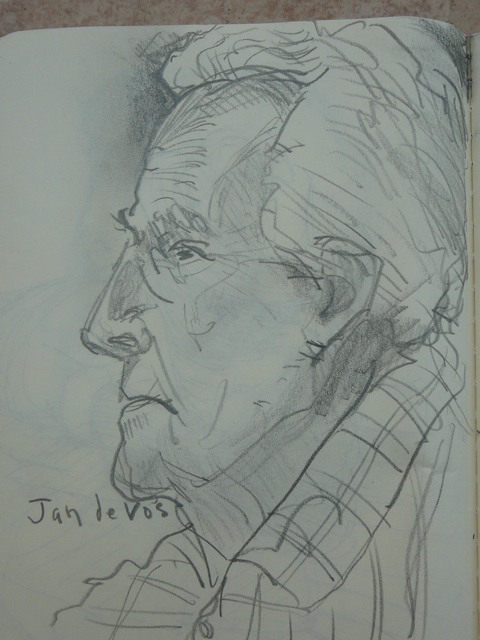
Jan de Vos: In the flesh.

Update: July 25, 2011, Jan de Vos died yesterday morning in Mexico City. Below is my sketch from last month in Chiapas, Mexico.

20110624-111903.jpg

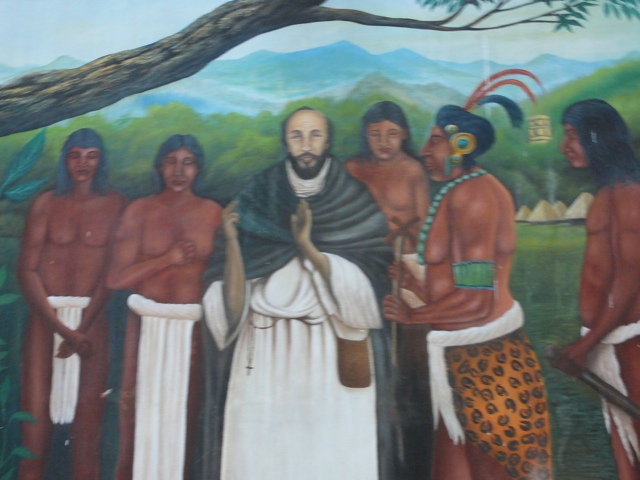
We met a holy man in Chiapas. Jan de Vos is 75 years old. He was born and educated in Belgium, He studied philosophy and theology with Prof. Ratzinger, who is now Pope Benedict XVI. He earned his Phd in humanities and was ordained as a Jesuit priest in the Roman Catholic Church. In 1973 he was sent to Chiapas, Mexico, as a missionary.

His task was to teach the indigenous Maya about God. It dawned on him that the Maya had things to teach him about God and life. I drew the pencil sketch portrait above as he began his informal lecture in a hotel room in Palenque, Chiapas. He began by declaring we were in a sacred place. Not only sacred because of Lord Pakal’s tomb in the Temple of the Inscriptions, but also because of the work of a humble missionary, a Spanish friar named Pedro.

Friar Pedro de Lorenzo de Nada came to Mexico in the mid-1500’s. “De Nada” means “of nothing”, something he added to the name the church gave him. Jan de Vos considers Friar Pedro more significant than Bartolome de La Casas, Bishop of Chiapas. Like Jan de Vos, Friar Pedro was a linguist; he learned four Maya languages. Friar Pedro tried to live the gospel among the Indians, but to do so he had to “cut his relations with his superiors.” He climbed over the wall to escape the monastery and lived the rest of his life among the Maya of Chiapas.

De Vos lamented that few visitors to Palengue are interested in Friar Pedro’s story. De Vos wrote his first of many books of Chiapas history about the runaway priest. Father de Vos could relate to the difficulty of “de Nada” and the early missionaries. He imagines them teaching the Our Father. “Our Father?” They must mean Our Mother, think the Indians. “Who art in Heaven?” But, She is in the Earth, say the Indians.

The Indians hid Friar Pedro from the authorities, both the church and civil authorities in Guatemala wanted to catch and discipline him. In that time, Chiapas was ruled from Antigua, Guatemala. Today, Chiapas is governed (to the degree that it can be governed) by Mexico.

20110624-121111.jpg

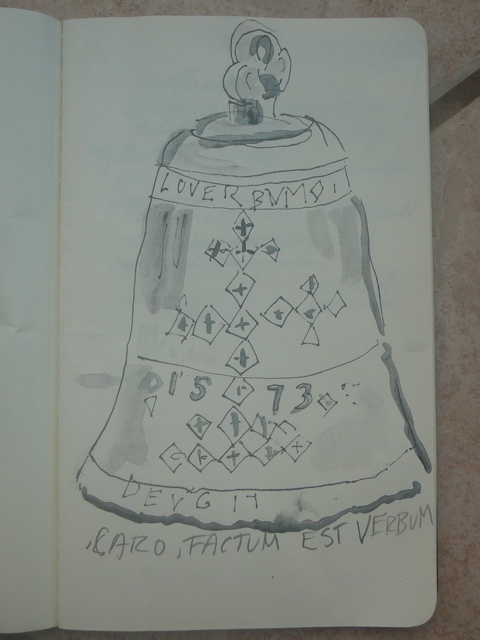
In 1571, Friar Pedro gave three bells to Indians. Jan de Vos told us one of the bells was still in the Palenque village church. The next day I walked to the yellow church at the center of the small town. I found the painting of Friar Pedro on the wall in the left chapel. Below, painted on the wall, was a caption written by “Jan de Vos, historian.” I saw no bell. There was one Indian man, his straw hat at his feet, lighting candles and intently praying in a Maya language. I did not disturb him.

On the right side, in a chapel near the confessionals, I found a caretaker sweeping. His name is Manuel, I asked him about the bell. I wasn’t sure he understood my Spanish. After a moment, he asked who told me there was a bell. When I answered Jan de Vos, Manuel led me to a long storage room filled with brooms and half-used candles. We were directly behind the sacresty and altar. He moved some furniture and lifted the bronze bell. It was much larger than I had expected, nearly three feet tall. I asked if I could spend a minute there, drawing the bell. Manuel asked why. I told him it was a sacred object and that I had heard the story of Friar Pedro. Manuel told me that made his heart feel good.

Manuel went back to work. I sat on a wooden box. It was 95 degrees outside and humid beyond metaphors. It was much hotter in the church. As I sketched the bell, sweat fell from my brow onto the bell and my sketchbook.

20110624-125005.jpg

In our digital age, one might ask what is the point of keeping a sketchbook? I have two thoughts on that. Drawing forces observation. Surely great photographers are great observers. Personally, I find drawing connects me with people and places in a better way. Secondly, I am in Mexico, a land of living arts, where work done by hand is deeply respected.

Back to Jan de Vos. All during his talk about Chiapas history he had a single red file folder in front of him. At one point he opened the folder to reveal its contents: nada. De Vos, like Friar de Nada, went “over the wall.” In 1995 he was invited into the Lacondon jungle by the Zapatistas. That is another story.

Yachitlan

20110620-102301.jpg

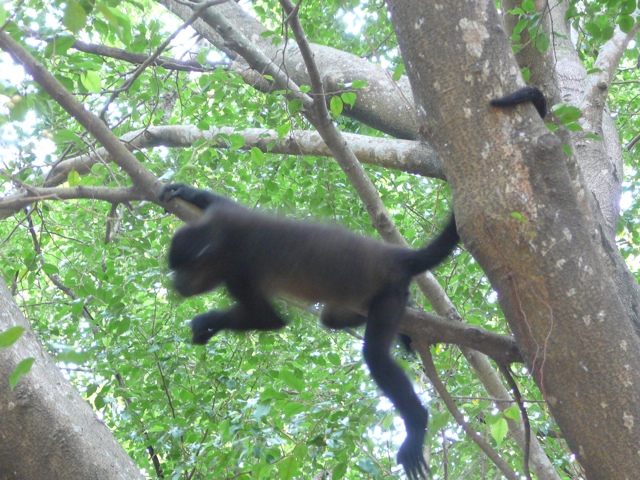
An hour from Bonampak we reach the frontier town, Frontera Corozal. We descend across two springy, cablebound causeways to the banks of the Umumacinta River. The Umumacinta has been called the River of Ruins. According to Dr. Alfonso Morales one of our guides, and one of Mexico’s great archaeologists, Umumacinta can be translated as River of Howler Monkeys. Howlers roar so loud you expect them to be ten times their actual size. When they burst out of the jungle, one is relieved that they are gangly black haired creatures not much larger than chimps. It would be a mistake to get to close though, they enjoy flinging feces at visitors.

At the river bank we are met by Ch’ol Maya boatman who pilot launches upriver to Yaxchilan. The launches are narrow boats, perhaps 35 feet long, powered by a single outboard motor. Nine others are already on the boat. The moment I step aboard our pilot pushes off, drops the propellor into the river and we are off. After a long bus ride from Palenque we are giddy to be on the river.

As we head upriver the pilot stands erect gazing over our heads. He sees things we can’t, plotting a course that moves us rapidly forward. Sometimes we come quite close to the right bank, the starboard side. The two banks look the same, but one side is Guatemala. This right bank is part of the northernmost area of Guatemala, the territory known as the Peten. A few weeks back there was a massacre in the Peten. According to press reports the Zeta drug cartel murdered 30 Guatemalan farmers, and painted messages in blood on the cinderblock walls of the village.

20110620-105801.jpg

On the Guatemalan side I notice crude shelters, palm frond lean-tos. These might be picnic grounds, but more likely a final shelter before migrants attempt the crossing into Mexico.

Yaxchilan has a remarkable ancient ballcourt, I will get to it in a future post.

Maya Murals at Bonampak

20110619-060359.jpg

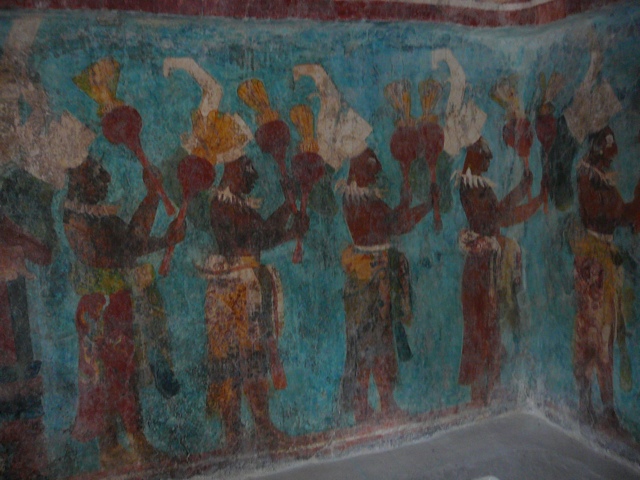
Above is a photo I took yesterday of the Maya murals at Bonampak. Picture a small vaulted room atop a great stone structure in the state of Chiapas, Mexico, not far from the border with Guatemala. This detail is from a section called The Musicians. It was painted close to the year 800 A.D. These musician figures are rather large, about 40 inches tall. Even after 1200 years it is clear the Maya artists had remarkable skill with figurative art. They are also masters of color. The background blue is a favorite, even today, among the Maya.

Mary Ellen Miller, a Yale art historian, has compared these figures to Eadweard Muybridge’s pioneering photographic works documenting the human figure in motion. Each of the maraca players is frozen in motion, a split second after his neighbor. This gives this panel a remarkable sense of motion, a sense of dance. Unlike other ancient cultures the Maya often permit the artists to sign the work. In the case of the murals at Bonampak, I did not see a signature mark.

There are two other adjacent vaults at this site that come as a shock after the beauty and musicality of this room. The next vault is filled with scenes of torture, the third with graphic depictions of ritual bloodletting.

The Lacandon Maya guards at the vault are very insistent that no flash photos be taken. Visitors, like myself, are allowed in in groups of three. There is little room to turn around. I held my digital camera at arm’s length and shot blind. Considering there is only diffused and blocked sunlight, I am pleased with the results. This is my first blog post via Ipad. Apologies in advance, for brevity and odd formatting. The photo is dark and does not do justice to the wonderful ancient image. I will be able to edit my photos when I return and will add more then.

The murals are in a denses jungle region, the site is now a national park. The Lacandons made a deal with INAH, the Mexican office that oversees archaeological sites. They gave up any claim to the plazas, altars, and temples of the ancient Maya, but insisted on control of the last five kilometers of road to the site. My group disembarked from our bus and piled into 10-passenger vans with taciturn Lacandon drivers. This system creates jobs for the Lacandon and also makes looting unlikely.

At one time the Lacandon were even more protective of the murals at Bonampak. One of the first North American visitors to the site was shot dead for looking at these same murals without tribal permission. This event was not exactly ancient history; it took place in 1946.
-K.McCloskey, Chiapas, Mexico.

20110619-071832.jpg

20110619-111531.jpg

In the Maya World

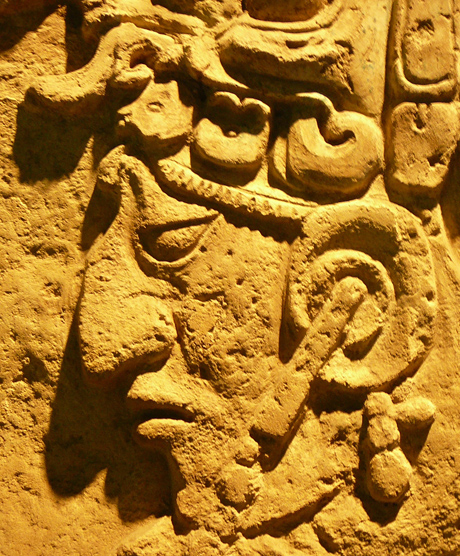
Maya sculpture, photo by Kevin McCloskey

I’m off campus at the moment, far off-campus, on the Yucatan Peninsula of Mexico. I am participating in an NEH Institute along with 23 other professors of various topics from across the U.S. The NEH (National Endowment for the Humanities) and CCHA (Community College Humanities Association) are co-sponsoring a five-week study tour of the Maya world. We will be met at archeological sites by some of the foremost scholars in the field. I’ve read six books on the Maya in recent weeks; that’s less than half of my assigned readings. I’ve learned that I have a lot to learn. When I get back to Kutztown University I will have new insights on the art and iconography of the Maya to share with my Historical Survey of Graphic Design Class. I will also be giving a public lecture on this scholarly adventure at Rohbrach Library in October.

I’ve long been interested in this part of the world. In the mid-1970’s I drove a Toyota Corolla from New Jersey to the “Lost City” of Tikal in Guatemala. That was some hard traveling. This time we will be traveling by bus and river boats. It may not be possible for me to get access to the internet. I know I pledged to update the blog weekly, and I will do my best. If you send comments, be patient, I may not be able to reply in a timely manner.

Lately the popular media has been filled with a sensational misinformation about the Maya, especially in regard to their calendar. As a letter from the project directors, Dr. George Scheper and Dr. Laraine Fletcher, points out, “Maya culture does not need exoticizing or sensationalizing to command our attention. What we actually do know about the Maya from responsible scholarship places them in a sufficiently exceptional category of study.”

Get Creative: Try a Cool-Off!

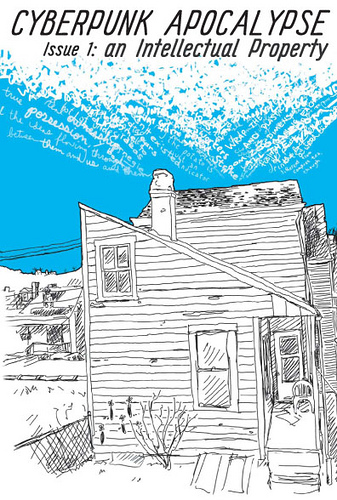
Drawing of Cyberpunk Apocalypse by Danny Mac

It might sound like a refreshing summer drink, but a Cool-Off  is summertime institution at the Cyberpunk Apocalypse in Pittsburgh. This is something you and your illustrator artists friends might try. You know how you get more artwork done when you have a real publication date? The Cool-Off acts as a pre-publication debut, a chance to share WIPs, Works-in-Progress.

It is like TV show with no TV. In May, there were about twenty young writers/artists in attendance. Each guest is asked to put a 2 to 4 bucks into a box. Everyone sits in a big circle. They show and tell about their most recent creative endeavors. At the end of the presentations there is a vote and the winner takes home a trophy and half the kitty. Even though there is a winner, the evening’s tone is largely nonjudgmental. Some mild suggestions are made. Everyone gets applause.

May 2011 Cool Off Trophy (Wow, neat shadow! )

The Cool-Off Trophy is different for each month. May’s trophy was assembled from items that Grandpa, the house’s visiting dog, collected.

Nearly half the of group I met were into comics and they shared unbound pages of works in progress. Nate McDonough showed his latest Grixly zine. Danny Mac passed around pages he was submitting to Kindlin’Quarterly  magazine. Sarah (a.k.a Gunner) read a new short story. One guy totally surprised me when he pulled his project out of a bag. He made quilts from his old pajamas inspired by the master quilters of Gee’s Bend. artnoose, who I wrote about recently, read from the latest issue of her letterpress zine, Ker-bloom!

Unbuilding A Wall, cover, © 2011 Jessica Heberle

The winner was a first-time visitor, Jessica Heberle. She won for her book, Unbuilding a Wall, an elaborate artist’s book, a meditation on the metaphor of the walls we build around us, between us. There is a lot of handwork involved in her project. One page had an envelope full of miniature printed bricks that might be assembled on the facing page, for example. She promises to treasure her Cool-Off trophy forever.

There is another Cool-Off at the Cyberpunk Apocalypse this weekend, Sat, June 11 at 7.  Calendar and directions can be found here.  You aren’t near Pittsburgh?  O.K. The point is, you should try this concept with your own circle of creative friends. It is guaranteed to boost your creative output! Let me know how it works out.

Want to get a feel for the Pittsburgh Zine Scene? Join The Cyberpunk Apocalypse Zine of the Month Club. Get a new zine every month made by the Cyberpunk Apocalites and our friends. Like the Andromeda Comic Anthology, or Kerbloom!  Plus bonuses in your mailbox: letters, drawings, or letterpress cards! One year subscription is just $35.

artnoose & her Underground Press

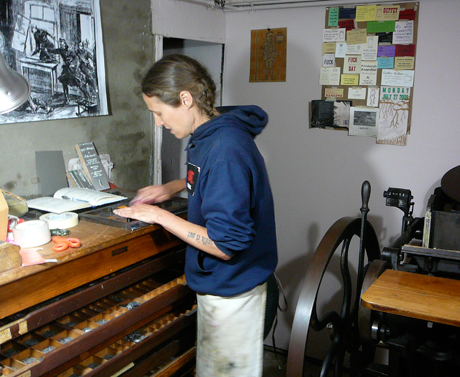
In the “letterpress/zine” circle artnoose is a superstar. Admittedly, this is a smallish orbit, but lately interest in zines and letterpress is exploding. I ran into her the other day when she was printing in the damp basement of the Cyberpunk Apocalypse. Cyberpunk Apocalypse is a two-house writer’s colony in Pittsburgh. It is where my son Dan McCloskey lives and works, too.

artnoose printing on her Chandler & Price press, May, 2011, photo by Kevin McCloskey

I asked artnoose how she describes herself. She said, “Sometimes people ask, ‘–Are you some kinda’ artist?’ I tell them I’m a printer. That’s what I am, a printer.”

She reveals a few more details on her Etsy page bio: artnoose began letterpress printing the zine Ker-bloom! in the summer of 1996 and has been making it every other month since then, never late, never missing one. After 14 years in the Bay Area, artnoose moved to Pittsburgh in the hopes of transforming a derelict old house into a loving and productive home. While the city home buying process takes its own sweet time, artnoose is a writing resident at the Cyberpunk Apocalypse Writers’ Collective.

A decade ago, artnoose started a letterpress studio called Crafty Cards in Alameda, California. The name was inspired by the Beasty Boy’s song, ‘She’s Crafty.’ One day in 2004, Crafty Cards got a small commission to print an engagement announcement. The bride-to-be wrote for a trendsetting blog called The Daily Candy. The day The Daily Candy wrote about artnoose, her phone rang off the hook. She got a year’s worth of work, and quit her day job as a substitute teacher. She has been a printer ever since.

Ker-bloom! #85 & Attack of the Zombie Soy Bot! © artnoose 2010

artnoose tends to be a philosophical and careful writer. Letterpress does that to you, individual pieces of type for each letter or comma must be set by hand, before the hand-cranked press can ink and print it. Here are a few lines from Ker-bloom! #85, about storytelling:

“I never have a day without a story. The void gets filled if not by us… ‘Enough of their lies; its time for OUR lies!’ A friend said this to me a year ago at a crowded dance party when I asked him for words to live by. It stuck with me, not as a modus operandi but as a rather catchy deconstruction of truth. Is all narrative really propaganda? Is there such a thing as non-fiction?”

Last year artnoose launched a successful Kickstarter campaign to create a Letterpress House in Pittsburgh’s Upper Lawrenceville neighborhood near the Cyberpunk Apocalypse. Kickstarter is becoming a popular way for artists, among others, to raise funds to realize their dream projects. Her Kickstarter pitch is worth looking at, she raised $4620. Daniel McCloskey did the illustrations for that Kickstarter video. artnoose says the secret of Kickstarter success is “to tell a compelling story.” Her years of Ker-bloom! have clearly honed that skill. $4620, believe it or not, is enough to buy an abandoned fixer-upper from the city of Pittsburgh. For the price of a Williamsburg loft you could buy a Lawrenceville block. Pittsburgh artists are quick to point out, however, the buzz is not about cheap real estate, it is about the human energy and synergy of the arts community there.

The morning I watched artnoose printing she had just been stood up by a “key guy” who was supposed to give her a walk-through of her future Letterpress House. Yes, maybe you can get a house in Pittsburgh for a song, but there is a lot of bureaucracy, red tape, and waiting. Working the press keeps artnoose sane and fit.

artnoose’s most recent Ker-bloom! (#89) is in the form of a Mad-libs autobiography. You and your friends pick the nouns and verbs to round out the story of her life. It is available for just $3 on Etsy. Wanna buy Dad a unique Father’s Day card? artnoose has this and other hand-set goodies for as little as $1. She also still does custom wedding, shower, engagement, birth announcements, and business cards.

I would love to be in Pittsburgh to witness the massive cast iron Chandler and Price press moving to its new home. The machine weighs nearly 1500 pounds. A friend of artnoose’s who makes bike messenger bags is rigging canvas harnesses. artnoose plans to enlist a crew of ten to dress as draft animals. Clydesdales, reindeer, and oxen will ever so slowly heave the press over rollers made of steel gas pipes. They will proceed down the back alley, Dresden Street, then take a left at 53rd Street. It should be a sight to see and a story to tell. Ker-bloom!

Call for Entries KUTZTOWN B’day logo.

The Borough of Kutztown is gearing up for its bicentennial. There is a $200 prize for a logo to commemorate the town’s 200th birthday. Deadline: July 23, 2011. Prof. Emeritus John Landis made the flyer below which contains all the details. He purposely designed a typographic flyer so as not to suggest a particular visual style for the logo. It can be illustrative, graphic, folkloric, digital, retro, you name it. You are welcome to enter multiple entries and there is no entry fee.

If you are in Kutztown you can get your own flyer, or drop your completed entry off at the Kutztown Community Development Office. (Next door to DeTurk’s Hardware.) You can mail your entry if you prefer, as long as it arrives before July 23.

Opportunities Knock.

Mara Rockliff, is a talented and prolific children’s book author who lives here in Kutztown, PA. She sent me a note to share with illustration students about a scholarship opportunity from SCBWI. That is the Society of Childrens Book Writers and Illustrators. They have grants for students to attend their NYC or L.A. conferences. Details on the SCBWI student scholarships are here. Next deadline is Nov.1.

Mara Rockliff’s most recent book is Get Real: What Kind of World Are You Buying.  -“This frank, teen-friendly manifesto reveals what you’re really buying when you spend your money on a burger, a cheap t-shirt, or a cell phone–and points the way to better choices, both for people and the planet.”

By the way, a number of Mara Rockliff’s chapter books (written under the pseudonym Lewis B. Montgomery) have been illustrated by a Kutztown U grad, Amy Wummer. A portfolio of Amy’s artwork can be seen here.

artwork by Amy Wummer ©2011, from her online portfolio, link above.

Beth Krommes recommended joining SCBWI when she was on campus last month. I must admit I am no longer a dues-paying member of SCBWI. I did attend their NYC conference one year, and I’ve also participated in the portfolio day SCBWI holds at the Society of Illustrators. Personally, I found the Society of Illustrators event more worthwhile. The conference I attended was at the Roosevelt Hotel and for an added fee I was able to set up an easel on a table. I felt it was overcrowded and claustrophobic, like a science fair on steroids. At the Society of Illustrators a limited number of artists participated. Illustrators could leave a portfolio, cards and other promotional material on a table. Then artists leave the premises for a couple of hours. When you come back, you count your promo cards to see how many have been taken and look. Ideally, an art director has left an encouraging word or requested a meeting.

A nice thing about SCBWI is that they have an active Eastern PA chapter. Here is a page  where you can check out local member/illustrator’s work. SCBWI has much info, (like market tips) that is password protected for members only, but they do also have useful info for interested visitors on their main site.

Another valuable site for anyone interested in illustrating children’s books is the Children’s Book Council. They are a trade group composed of many of the best and most reputable publishers. I find their members list page is especially worthwhile. That’s where you will find if publishers are even considering submissions. Like SCBWI some of the CBC site is password protected, but much of the info is freely available.

Illustration Biz: Billing for Beginners

Original illustration from The Gangster Series by © Brandon Malone, 2011 KU grad.

Let people know you are an illustrator. Do not be shy. Somebody you know will ask you to create a picture for their business, band, or website. When it happens for the first time students often contact me with this seemingly simple question: How much should I charge?

Here are my thoughts: First ask the client: “What is your budget?” If they know, that helps a lot. They may toss it back to you again asking, what is your rate? Rule of thumb, even as a student, you should charge at least 3 times minimum wage at the start of your career. Remember, you have a skill set and tools that most people don’t. Pennyslvania’s 2011 minimum wage is $7.25, so around here, that would be about $22 dollars per hour.

In my opinion once the work is done to the satisfaction of the client, billing should end. For example, you show the client the artwork that took you five hours; they love it. Bill them $110, and look for the next job. You, however, might have a higher standard and work another five hours tweeking the art. I’d argue the clock stops at five hours because that earlier image, even if it is somewhat inferior, satisfied the client. Again, this is just my opinion, to be used as you see fit.

Obviously, if you are doing artwork for a family member, or a favorite charity you might charge less. However, even if you work for free, (sometimes called “pro bono ” meaning for the public good) it is reasonable to bill for your materials. Also if you work for free, you ought to get a clear printed credit,  and copies for your portfolio.

On a practical note, below you will find the info you need for simple illustrator’s invoice. I hope it comes in handy sometime soon. The illustrations on this blog are by recent KU grad Brandon Malone, winner of the 2011 Terry Boyle Award for most improved illustrator. Brandon shoots his own photo-reference and is meticulous in his inking. To see more of his work visit his site.

Another image from The Gangster series © 2011 Brandon Malone

…………

SAMPLE, SIMPLE, ILLUSTRATION INVOICE:

Artist Name: (Studio Name if applicable.) Address, telephone, email, web address. (Most of this can be on your letterhead.)

Invoice # 301 (Don’t use single digits, start at 101 or higher.) Maybe use a code based on the date, like # 050511 for May 5 2011.

Date:

To: Rodale Press      Attn: Jane Smith, Art Director

Backpacker Magazine, 111 Main St, Emmaus, PA

From:  J. Artist                          

Social Security/taxpayer I.D: 000-00-0000 (Always include S.S. number, or payment may be delayed, buyer needs this for tax records.)

For services rendered as described below:

Three (3) pen and ink illustrations on the subject of sports medicine.

One time use only. Reprint and other rights revert to the artist. (If possible, do this to retain future rights.)

Total due: $350.Three hundred and fifty dollars. (Use numerals and words)

Payable to: Important! Best to use your given name. If you call yourself  “AJAX Illustration Studio,” but haven’t really got a checking account and a DBA (Doing Business As) form filed with the state, you may have trouble cashing the check.

Terms: Return of original artwork and payment due within 30 days of delivery.

…………

If you live in PA, look at this website  which will help you with the forms to get your “Doing Business As”, so you can get a really cool name for your studio. In other states you might have to Google the agency. Some states call it a “fictitious” business name. You should not need a lawyer to do this. Someone at your local bank can explain the process, since the bank needs the state registration in order to open an account under a fictitious business name.