Austin Carlson graduated from KU in May, 2012 with a BFA in Communication Design. He won the Don Breter Illustration Award. Lately he has been working at a supermarket near his home in Hanover, PA. That will all change in a few weeks when he flies to Denmark to start his new job as a designer for LEGO. I wrote to him to ask him to share some of the portfolio pieces that helped him land his dream job.
What is your new job title?
“I will be first working as a Junior Graphic Designer for LEGO and hopefully work up from there.”
“All I can say about the interview is that I doubt I will ever have a better job interview in my life! The LEGO Company paid for everything and I’m not overselling that statement.”
“They paid for my plane tickets there and back, my taxi rides, all my meals, two tickets for LEGO Land, plus about 150 dollars worth of LEGO sets. Also all the nine candidates that came for the job interview became quick friends. I still keep in touch with them and I will see two of them again real soon since they were hired also.”
“I’ve always wanted to work for the LEGO Company!” says Austin. “This is really a dream come true for me! Since I started building when I was 4, I always wanted a position at LEGO. I just had no clue what Graphic Design was as a kid. I thought you had to be a starving artist if you wanted a career in art.”
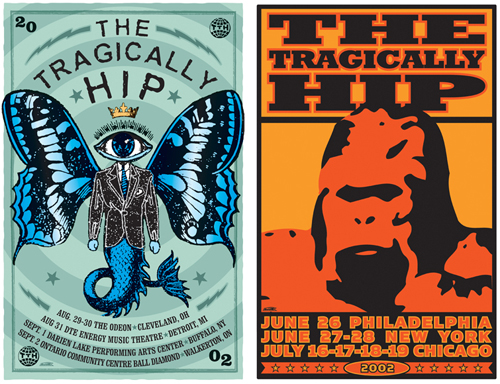
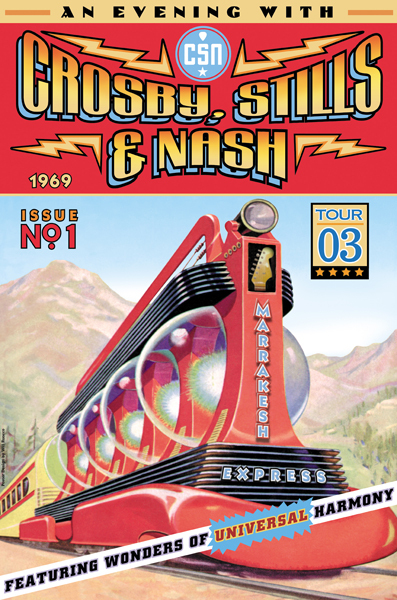
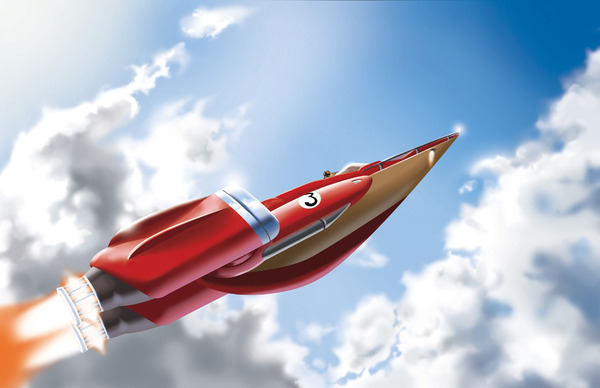
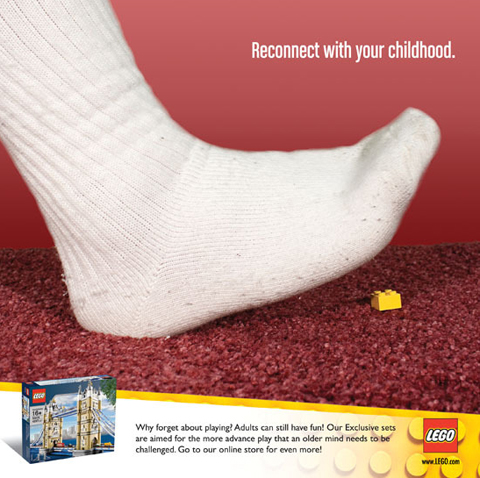
LEGO ad design by Austin Carlson, KU project, 2012
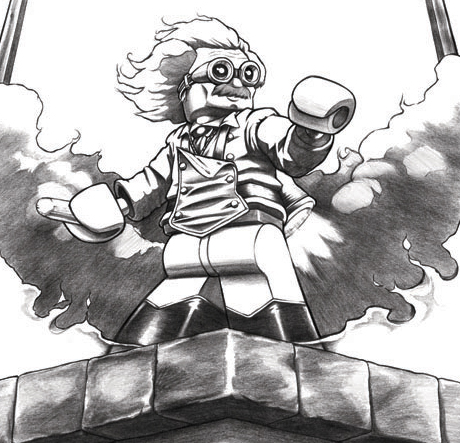
Austin shared a couple more curious images that look like two of his illustration classmates transformed into LEGO characters. He calls them Mini-Joe and Mini-Laura, see below. To view more of the artwork that impressed LEGO visit Austin Carlson’s portfolio site.
I was sorry to hear of MoCCA’s near-death experience. I’ve met some interesting people at the Museum of Comic & Cartoon Art in lower Manhattan. I ran into Prof. Bill Foster there, the expert on the portrayal of African-Americans in comics. He came to Kutztown to share his presentation, “Looking for a Face Like Mine.”
Last summer MoCCA went broke and closed its doors overnight. MoCCA scrambled for a refuge to “transfer their assets” and keep the name alive. The call was answered by the venerable Society of Illustrators. The MoCCA collection moved uptown to the townhouse walls at the Society of Illustrators, 128 E.63rd St.
Anelle Miller & Dennis Dittrich of the Society of Illustrators.
I was at the 2012 Educator’s Symposium at the Society and met Dennis Dittrich, President, and Anelle Miller, Executive Director, and asked about the MoCCA adoption process. Dennis, whose own humorous illustration style leans toward the cartoony, loves the new acquisitions. He told me the merger happened so fast, “it turned on a dime” and he felt like “a blacksmith on the freeway entrance.”
Dennis and Anelle consulted attorneys to make sure MoCCA’s liabilities would not haunt their organization. The merger still needs final approval from the NY Board of Regents. I knew the NY State Board or Regents was responsible for universities, but Anelle explained the Regents’ mandate also includes museums and other non-profits.
What’s in it for the Society? Wonderful original artwork from comic books, comics strips, and gag cartoons. Dennis says an unexpected benefit is the new blood of MoCCA’s passionate fan base. The Society is now hosting “Dare to Draw” and Super Hero Sketch classes. Pros are teaching Penciling and Anatomy for Cartoonists. Anelle confirmed that MoCCA fest, the hip NY indy comics con, will happen April 6 & 7, 2013 at the Fighting 69th’s Armory on Lexington Ave. Unlike ComicCon, which is slick and leans toward shameless film promotion, MoCCA fest is the real deal. At MoCCA fest you can still find diamonds in the rough, from Norse graphic novels and Pittsburgh zines to thesis projects from the Center for Cartoon Studies.
The MoCCA Gallery area at Society of Illustrators
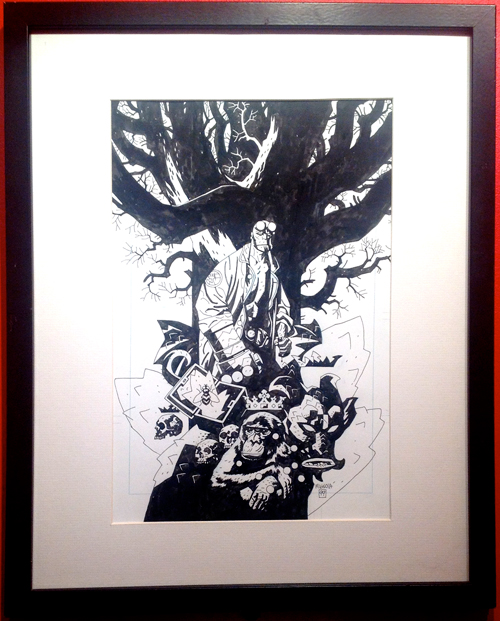
The New York Times called the Society of Illustrators one of NY’s five hidden gems. Now they have Batman, Wolverine, and Hellboy originals on the wall. The Society’s Museum of American Illustration may be one of NY’s last free-admission museums. Hours and directions can be found here. I was delighted to see the crackpot strips of my old Hoboken neighbor, Kaz, on the wall. His artwork reminded me of the first time I saw original illustration with my own eyes at the Society of Illustrators. I was so relieved to see eraser marks and retouching with white paint that I was able to get back to the drawing board.
Photo courtesy Society of Illustrators.
Find more info on MoCCA and The Society of Illustrators here.
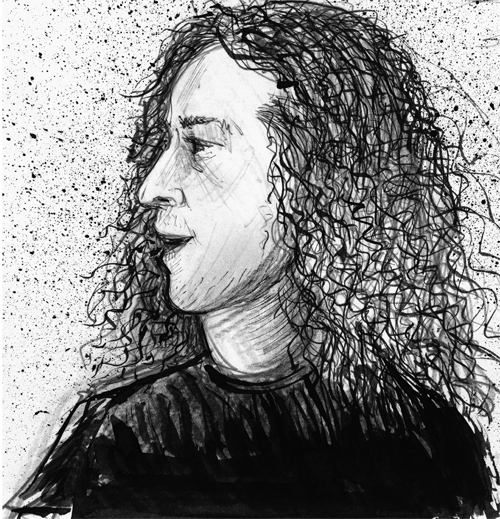
Rostislav “Russ” Spitkovsky by Kevin McCloskey 2012
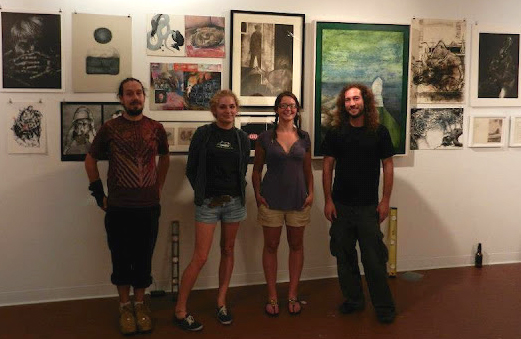
Russ Spitkovsky makes things happen. He came to Kutztown as one of the 9 artists in the 2012 Print Invitational at the Miller Gallery. The founder of the cutting edge art magazine Carrier Pigeon hung artwork from the latest issue at the Eckhaus Gallery on Main St. He circled back this week as a visiting artist to spend time with students.
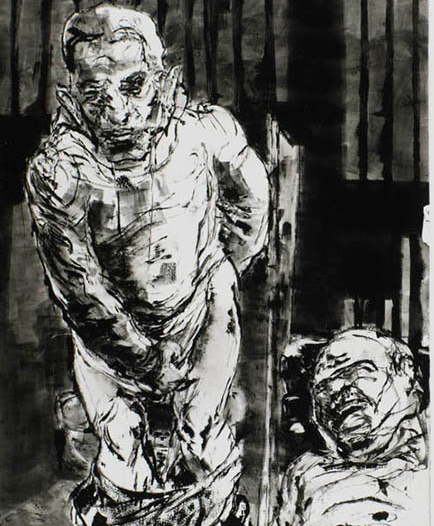
oil monotype illustration by Russ Spitkovsky for “Hall of Mirrors”
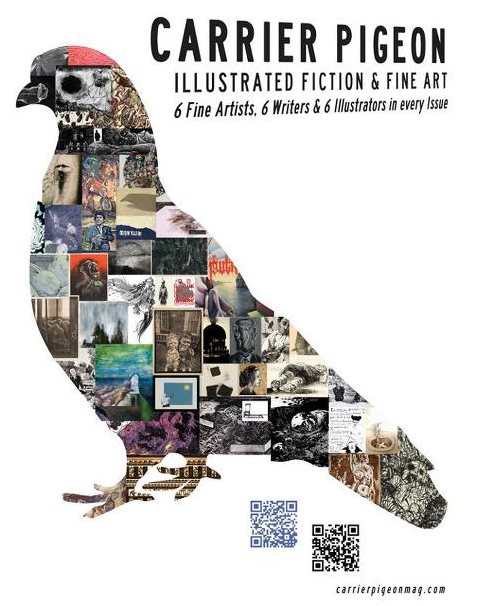
Carrier Pigeon is an artist-driven publication. Russ and friends began it after grad school at SVA’s Illustration as Visual Essay MFA Program. Each issue has works by six fine artists, plus six writers, and six illustrators.
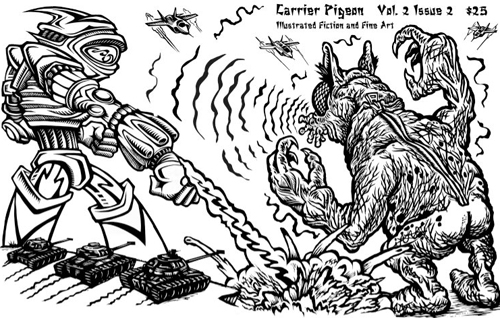
Carrier Pigeon cover by Cannonball Press, Martin Mazorra & Mike Houston
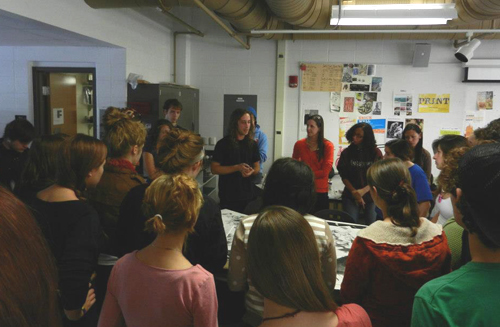
Russ speaking to overflow crowd in KU Print studio. Photo by Evan Summer
Russ shared some mind-boggling stories. Like the one about a meth addict who tells his wife he’s spending their life savings importing alpacas, but the alpacas are being held up in customs. There are no alpacas; he’s building a giant meth factory. The factory bursts into flames and meth maker gets encased in glass and, well, I don’t want to ruin the ending. The full story by Ryan Scamehorn called “Hall of Mirrors” can be found in Carrier Pigeon #3. It is fiction; I hope.
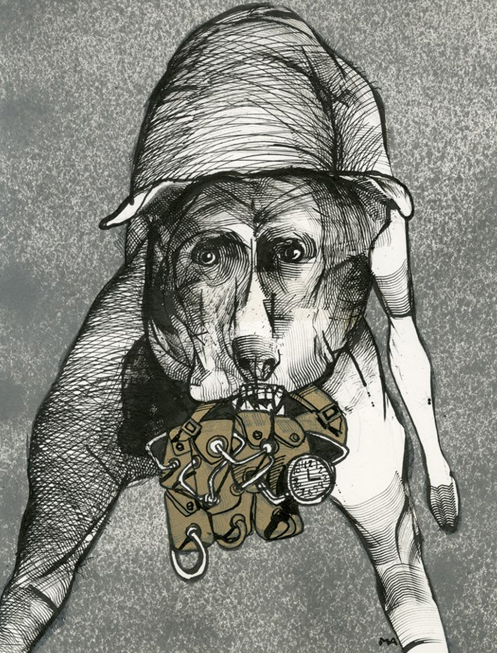
Illustration by Marshall Arisman for “Good Dog” by Erin Browne, Carrier Pigeon #7
Digression: Many years ago I sent a book idea to Lawrence Ferlenghetti’s City Lights Press. A few weeks later I got the best rejection letter ever. It said, ‘Your project is so interesting, you should publish it yourself. We are swamped publishing our own friends. Start your own press. Here are some resources…‘ Russ Spitkovsky never got that memo from City Lights, but certainly he embodies the D.I.Y. publishing spirit.
Kevin McCloskey, Moe Tierney, Russ Spitkovsky. Photo by Evan Summer
Russ was born in the Ukraine. Why do so many amazing printmakers come from Eastern Europe? KU’s Print Invitational includes Michael Goro from Russia, Ivanco Talevski from Macedonia, Endi Poskovic from Sarajevo, and Russ. It occurred to me perhaps these artists find core concepts difficult to express in English and are therefore driven to excel at graphic communication. Russ provided a better insight into why so many extraordinary artists come from places once under the Soviet sphere of influence. Growing up in the Ukraine he showed a precocious talent for art. He was plucked from preschool and put in an art academy. He was drawing the human figure from plaster casts at the age of four.
Illustration by Russ Spitkovsky from Central Booking, his self-published visual essay.
On the night of January 3, 2009, Russ was walking down a Brooklyn street. The police stopped and searched him and found he was carrying a knife. It was an ordinary knife purchased at Home Depot. The NYPD decided it was a lethal weapon, “a gravity knife,” and threw him in jail. He spent the next 32 hours in an overcrowded holding cell at Brooklyn’s Central Booking. Charges were dropped, but Russ made art from the experience. Upon his release, drawing from memory, he transformed that grotesque night into a visual essay in book form. He published “Central Booking” via the print-on-demand publisher Blurb. The book was not a financial success, but led him to explore other self-publishing options.
Russ loves working with the likes of Martin Mazorra and Mike Houston of Brooklyn’s Cannonball Press. Russ calls Cannonball Press the pioneers of the indy press and affordable art movements. Russ advises art and illustration students not to hole up in their studios after graduation. “Find a co-op print shop; work among other artists.” He said the community of Robert Blackburn’s NYC printmaking studio saved his sanity. He was able to get instant feedback on his art and stay in a creative loop.
Today, Russ works not only with graphic artists, but an ever-expanding community of playwrights, jugglers, Coney Island sideshow performers and puppeteers. Strange doors keep opening for Russ. Recently someone gifted Carrier Pigeon with a building in Gutenberg, NJ. To keep up with Carrier Pigeon news and events visit their Facebook page.
If you are fortunate enough to be in Kutztown, PA, get to Eckhaus to see the original art from Carrier Pigeon. There are copies of the latest issues for sale. Each issue costs $25. Twenty-five bucks is a lot of money for a magazine, but not a lot for a work of art.
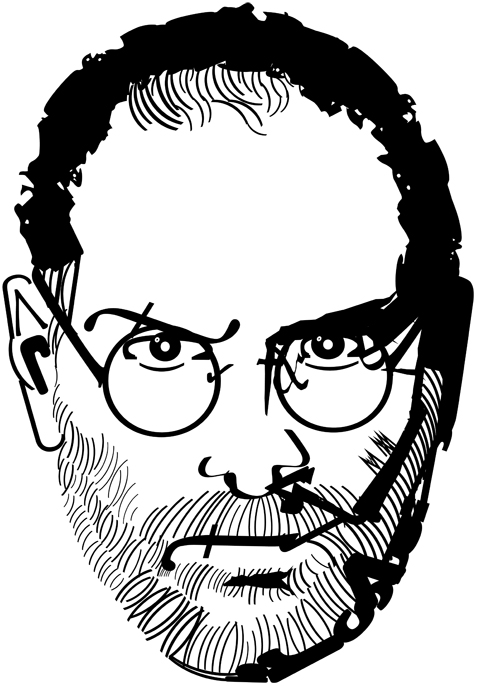
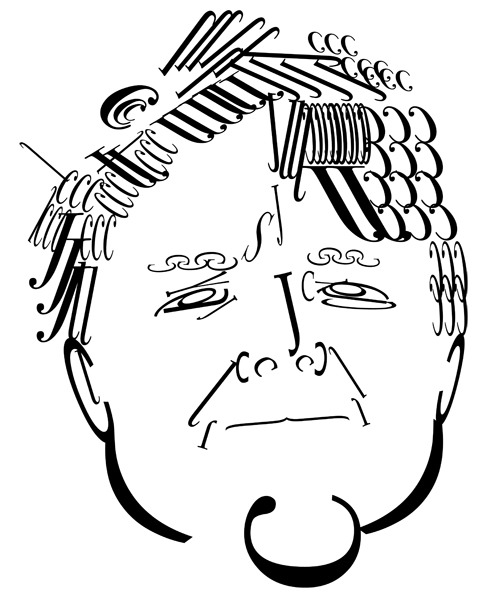
Prof. Josh Miller asked his students to create faces from type. Some of the results were quite fine. He’s hung a selection up outside the CD print lab. I asked him if I could share a few of the best here.
Steve Jobs by Caleb Oshefsky
The class is called Intro to Digital Design II. The exercise is meant to familiarize students with type-handling in Adobe Illustrator.
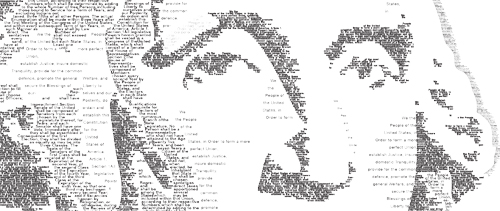
George Washington (detail) by Caleb Oshefsky
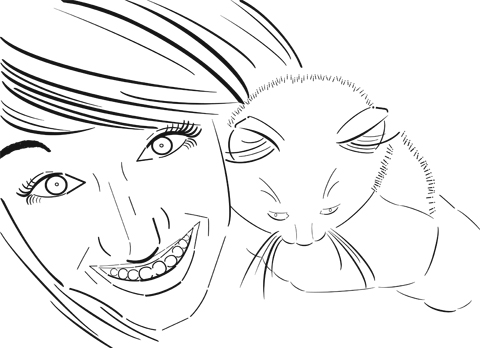
Here is the assignment brief: Create 3 portraits using the Illustrator’s type tools. The first portrait will emulate line. The line can be expressive, descriptive, implied, or directional. You can use contour or gesture. The second portrait represents Shape and Form. Try using negative and positive space in this portrait. The last portrait is Value. Use pattern, emphasis, and space to help create the tones.
Elizabeth Cane’s Portrait
These were the additional ground rules:
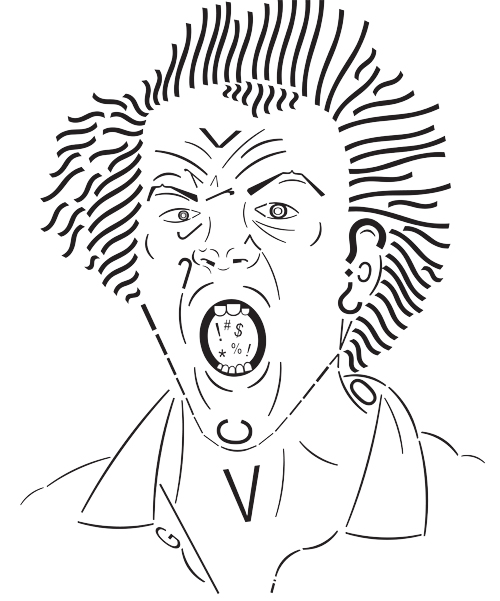
Students could the change text to outlines and manipulate the letterform, but it still had to resemble the original letter. They could rotate, change the leading, kerning, tracking, or change the direction of the text.
Heather JohnsonScreamer by Nick Stover
Interestingly, this week Printeresting.org had a link in their notebook section to the work of Italian artist Frederico Pietella. He does something similar with rubber stamps, but he takes it to a level approaching obsession. See Pietella’s work at This is Colossal.
Patrick McCloskey was born in Killycolman, County Donegal, Ireland. He was my grandfather. He immigrated to the US around 1915. His family in Ireland called him “Paddy the Yank.” He celebrated his birthday on St. Patrick’s Day. My middle name is Patrick, after him. There are many Pat McCloskeys. I’ve got a wife named Patt, an Uncle Pat, and cousins Pat.
My parents were born in the USA, but St. Patrick’s Day was a big deal growing up in our Irish-American household in Elizabeth, NJ. Each spring, the family would fast for the 40 days of Lent. We didn’t stop eating, but we ate less. One pious year, maybe 1961, I went to Lenten mass every morning, meaning nothing but water for breakfast. We’d have a very small lunch. I remember my Dad eating dry saltines. At dinner there was no meat, not even hot dogs, as the days stretched toward Easter. There was no dessert, either.
March 17th, St. Patrick’s Day, generally falls in the middle of Lent. In early March the parish priests at St. Gen’s would announce that Archbishop Boland was prepared to bless us with a dispensation from Lenten observances for St. Patrick’s Day. There was a catch. First, there would be an extra collection for a very worthy project, and if the collection was robust we got a one-day free pass. We always won the St. Patrick’s Day pass!
After three weeks of fasting, we had a smashing big dinner of beef brisket and boiled potatoes with baby pearl onions in the peas. There was butter on everything. We had Irish soda bread made from cousin Kitty Gallagher’s recipe. Dessert was Mom’s Dundee pound cake filled with walnuts and cherries. Dad would have a Scotch, Mom sipped a Rye and Ginger. The four kids got a dash of ginger ale to toast the glory of St. Patrick.
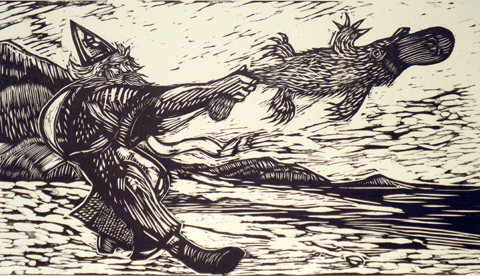
Years later, a priest told me my memory of this dispensation proclamation was “absolute rubbish.” Archbishop Boland wouldn’t do such a thing. Next, some theologians decreed that St. Patrick never existed, or, at best, he’s an amalgam of Gaelic-speaking missionaries. The heck with them. In my mind, St. Patrick will always be a beloved symbol of my heritage. I see him as a canny and powerful man who out-wizarded the druids at their own game.
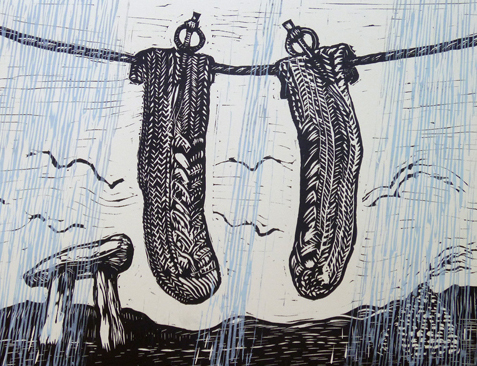
My St. Patrick print series started in 2010 in St. Louis, Mo. I went to study woodblock printing with the great artist Tom Huck at Evil Prints. Huck has a diabolical persona. His printing press is named for the British Satanist Aleister Crowley. My fellow students were carving Huckish prints of devils and demons, fiends and phalluses. Being a contrarian by nature, I decided to make my print about my favorite saint, blessed St. Patrick.
Now I have these six St. Patrick prints done. I’ve got ideas for many more. Folks seems to like them. These will be on exhibit at Firefly Books, 230 W. Main St, Kutztown, PA. Show runs Sept. 6 to Sept.30. The prices range from $50 to $150. I hope to make enough to cover my frames and paper. My definition of an artist is simple. An artist is anyone who can increase the value of art supplies. After the Firefly exhibition I will print proper editions of 30 or 40. I will put them up for sale on my Moonpenny Press website when they are ready.
Illustrators rejoice over the resurgence of interest in prints. Some illustrators are also fine printmakers. Some printmakers are illustrators. Above is a print by an artist who manages to live in both worlds, Frances Jetter. We will see her artwork in Kutztown soon.
Kutztown University’s Invitational Print Exhibition opens Thurs., Sept. 6. Professor Evan Summer is curator. He told me he had space for eight to ten exceptional contemporary printmakers and so made a list of 30 great artists to invite.
In conjunction with the Print Invitational at KU’s Miller Gallery there will be a printmaking themed Art Walk on campus and along Main Street in Kutztown. On campus there will be artwork by KU alums in the SUB. There will be a display of new prints from Oaxaca, Mexico on the 2nd floor of Rohrbach Library.
Silkscreen by ASARO, Rohrbach Library
Main Street venues include: Uptown Expresso, The Independent Space, New Arts Program, Firefly Books, Kutztown’s Main St. Bed & Breakfast, Dunkleberger’s Jewelers, Paisley & Co, Global Libations and more.
Art by Russ Spitkovsky for Carrier Pigeon Magazine
Carrier Pigeon Magazine Volume 7 will have its launch party and contributor’s exhibition at Eckhaus. I’ve only managed to peek through the windows so far, but it looks brilliant.
An Art Walk map with times and addresses can be downloaded here. Maps will be available at the Miller Gallery’s opening reception, 4pm, 9/6/12. With apologies to the map designer, Wyatt Glennon, I have truncated his lovely map to make the version below:
As a pedestrian and a printmaker, I am really looking forward to this. It is wonderful that the town of Kutztown and campus can partner on such a fantastic project. Miller Gallery Director Karen Stanford should be applauded for this town-gown interaction. The opening begins at 4 pm 8/6/12 in the Miller Gallery in Sharadin Art Building. Most of the Art Walk spaces are open 5-9pm.
I am showing prints from my new series, The Lesser-Known Miracles of St. Patrick, at Firefly Books, conveniently located at 230 W. Main St.
Woodcuts by Kevin McCloskey. Sept 6-30, Firelfly Books, Kutztown
Out of the blue I got a note about Ryan and Audrey Durney’s “Birds of Lore” Kickstarterproject. I was impressed enough by this couple’s fantasy illustration project to become a low-level backer. I emailed them a few questions and asked to share some of their art here.
Q. Other than Leo and Diane Dillon I can’t think of many husband/wife illustration teams. What are the rewards of this creative partnership?
Ryan: My favorite thing about it, is that we speak the same language, even if we don’t always agree on things about the field. And, we sit right beside each other, sipping coffee and sketching and riffing off of each other’s direction and discovered influences. Sometimes, critiques get precarious-they can be given too early, or too late! But, it’s really rewarding to be in the same boat. …we’ve rarely ever gotten to work on a complete idea together, which is one reason for the Kickstarter.
Q: Where did you two meet, the Kickstarter video says art school, but what art school?
Ryan: We met and fell in love at Columbus College of Art & Design.Back then CCAD was like “military art school” they purposely overloaded you-so I don’t know how we even had time to date!? CCAD did a lot to prepare me for a career as an illustrator. However, at the time about half of the staff was anti-digital art, and I have a lot of bitter memories of instructors knocking my grade down just because I did assignments on the computer-meanwhile, I had been up all night at KINKOS trying to get one stupid final to print correctly!
Q: Can you tell me something about the CCAD illustration program, maybe a favorite prof, or most important class?
Ryan: Mr. Stewart McKissick was probably the most influential instructor for me. He really cared about preparing us for the real world, and he even forged a class where we competed against each other for real, paying assignments. I remember winning 2 of the 3. That was the kind of confidence boost I sorely needed so near to graduation. Audrey’s favorite was Ms. Tam Peterson for her energy and enthusiasm.
Q. Have you had some success freelancing illustration?
Ryan: Both Audry and I have won some awards and earned some respectable commissions. I make a modest living, with some good years -feast and famine, I suppose, but I’ve been happy doing it for over a decade. It’s really true that you just keep getting better and evolving. Audrey has taken a more stable road, working as a technical illustrator by day and freelancing via an agency at night, -tough but way more practical. My one complaint about making a living this way is the level at which freelancers are taxed. Also, illustration agents take the highest % of any creative endeavor, including music, acting, etc. at 25%, and art is one of the lowest in compensation.
Q. Why Kickstarter vs. traditional publishing?
We can keep and manage the rights to our own work, and we get to finish a creative endeavor without corporate edits. I believe this brings the book much closer to an actual work of art. It’s being written and illustrated by unfettered artists, from start to finish. This is what the storytellers of olde did.
Ryan: I did both the “Captive Harpy” and the “Wila.” I’m pleased with both. The Harpy is the more popular of those two (based on viewer feedback.) With the Wila, I tried to integrate pen-and-ink within the 3D. Sometimes that meant actually sculpting “ink-like” lines into the mesh, and sometimes that meant adding ink touches. That’s why you can see me using pens in the video. I’m 3D, but definitely experimental. I love mixing hand and digital media. The other thing about the Wila is that I was completely taken by an old etching. The Wila is homage to a very old engraving by Anton Eisenhoit (see below). Before anyone thinks it, yes-I agree that his original is better!
Q. Who did the little yellow bird blowing the horn, the Hercina?
Ryan: Audrey did the “Hercinia” bird, which is equally enjoyed by all. She is a master of vector work and using Painter with vectors. Audrey and I are tilting our illustration styles in a few different directions, depending on what there is to say about each bird. The Hercinia is a direct homage to medieval bestiary art.
Dr. Lakra’s art often appears in Juxtapoz magazine.
Dr. Lakra is not a real doctor. He is a tattoo artist and collector of classic porn. He is, of course, more than this. The cutting-edge magazine Juxtapoz often features his art. I met Dr. Lakra late one night last week in a warehouse across the main highway from the center of Oaxaca.
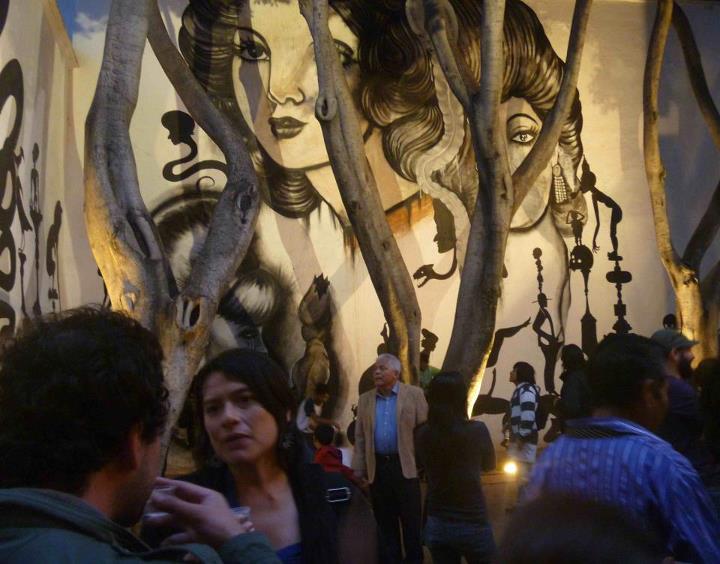
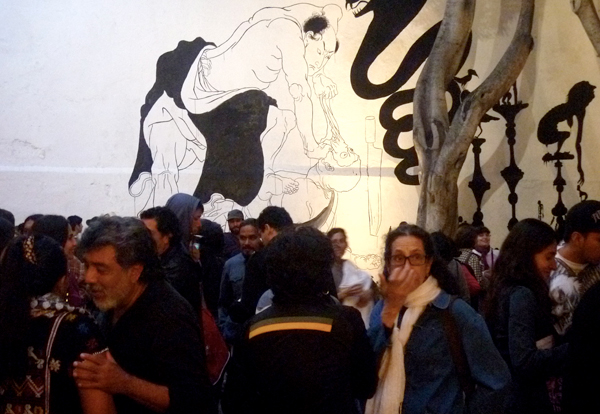
Dr. Lakra’s MACO mural, opening night, July 13, 2012, photo: KMc
The warehouse encounter was the second of Lakra’s two art openings within a week. The first was the inauguration of an enormous temporary mural at MACO, el Museo Arte Contemporáneo de Oaxaca. Packed with artists, journalists, and photographers, the MACO opening was so crowded I didn’t even realize Dr. Lakra was in attendance.
Dr. Lakra’s formal MACO opening showing Samurai section of his mural. Photo: KMc
The MACO mural, which he completed in a few weeks with three assistants, covered two high walls. It included a two-story illustration of a Japanese warrior tearing the face off an opponent, clearly appropriated from a Ukiyo-e print. There were monumental sepia-toned portraits of mid-20th century Mexican glamour girls. A troupe of black silhouettes danced along the foreground, bringing to mind Kara Walker’s work. At sunset the shadows of the trees in MACO’s Patio C played across Lakra’s mural lending the artwork an eerie sense of motion.
Dr. Lakra’s warehouse mural on canvas, left panels. Photo: KMcDr. Lakra’s warehouse reception. Right panels in background.
The second opening, at the warehouse, was quite different. Dr. Lakra greeted everyone cordially, even gatecrashers like me. He wasn’t drinking, but offered us mescal and beer. A woman asked him if he had a bottle opener for her beer. Dr. Lakra took a plastic Gatorade bottle and wedged its orange plastic cap under the beer bottle cap. With a deft flick of the wrist he popped open the beer bottle. The Gatorade bottle was still sealed. Seems Dr. Lakra is a master of many arcane skills.
I was told this warehouse is the studio of another internationally known Oaxacan artist, Demian Flores. The murals at MACO were painted directly on the walls. These murals filled two giant stretched canvases, one on each side of the room. Done in the same mix of sepia and gray washes, these images were more grotesque than the museum piece.
A gory detail from Dr Lakra’s canvas mural.
Bits of ancient maps and medical anomalies jostled against genies in bottles and high-heeled shoes. Dr. Lakra told me he and his crew had also completed this project quickly. I wondered if the opening wasn’t a tad premature. Some collage elements on the canvas, old duotone magazine photos, fluttered in the breeze each time the warehouse door swung open.
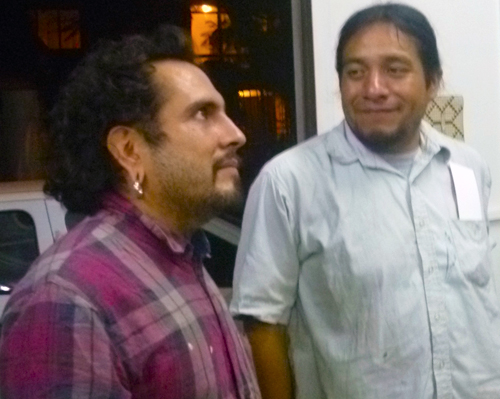
Dr. Lakra looking at his mural with Cesar Chavez. Photo: Kevin McCloskey
In 2007, Dr. Lakra contributed an artwork to my friends of the ASARO collective, a large cubist painting of a man tied to a chair, being tortured. I found his new work even more disturbing than that painting, but I expect this is his artistic intention. Bottom line: I may not like all his imagery, but I do like Dr. Lakra.
NOTE: A very short video of Dr. Lakra’s MACO mural can be seen here .
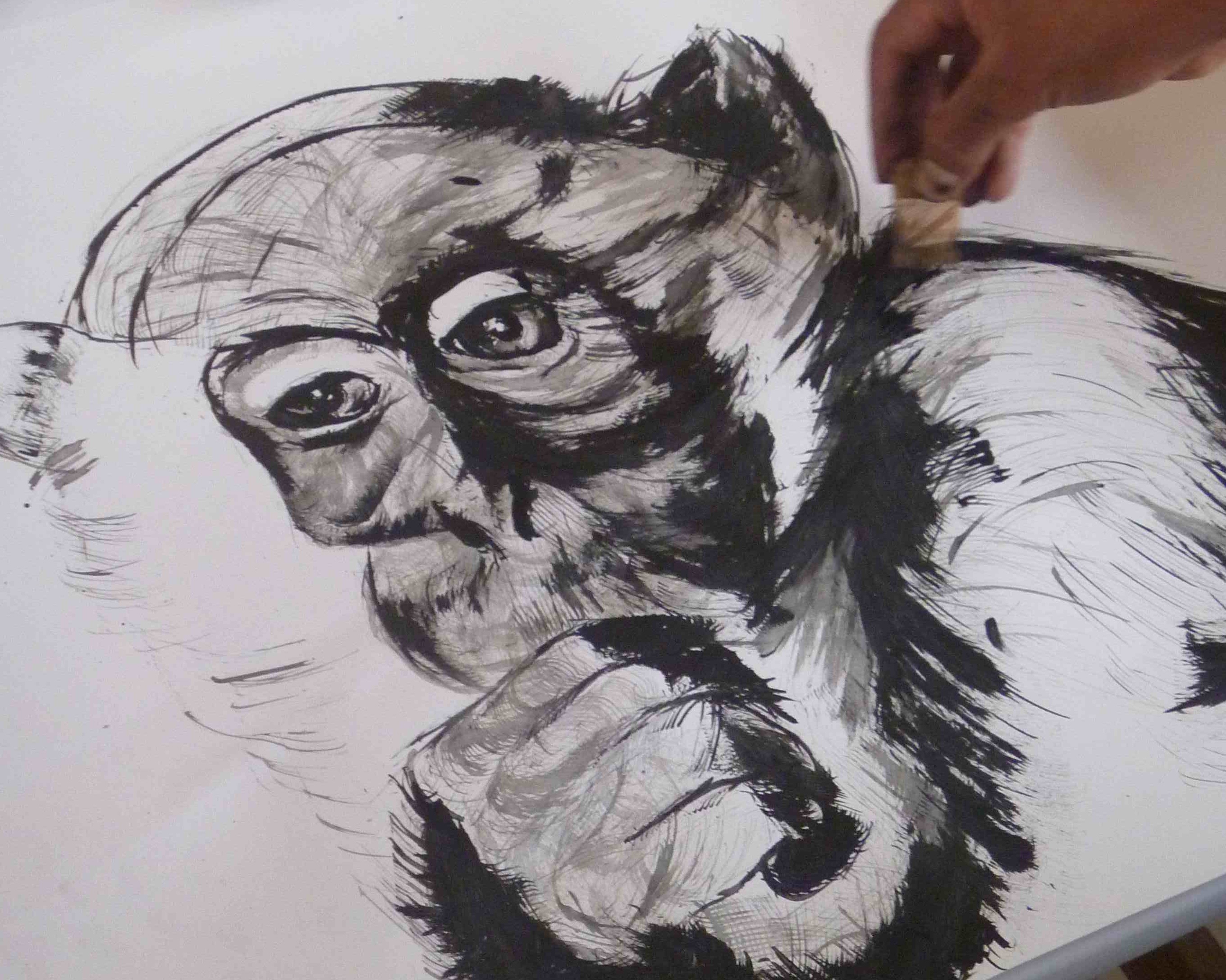
Monkey face drawn with a comb and diluted acrylic by Lazaro.
This week I taught a 3-day experimental drawing workshop at UABJO, University Benito Juarez, Oaxaca. I love the rainy season here in the mountains of southern Mexico. The workshop was in conjunction with the Kutztown Print exhibit that opened with much fanfare and mescal.
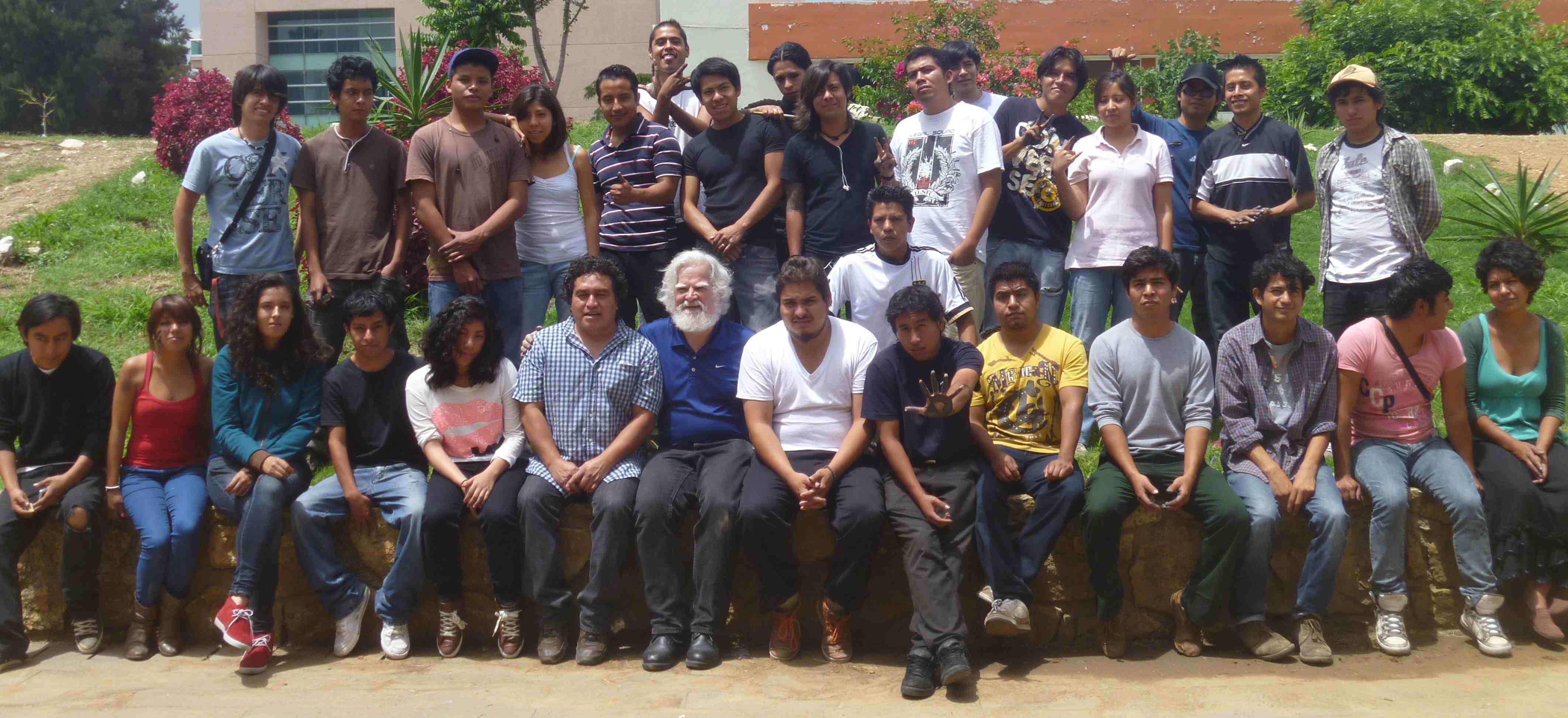
Students at UABJO. Left of me is my co-teacher, Maestro Memo Rito.
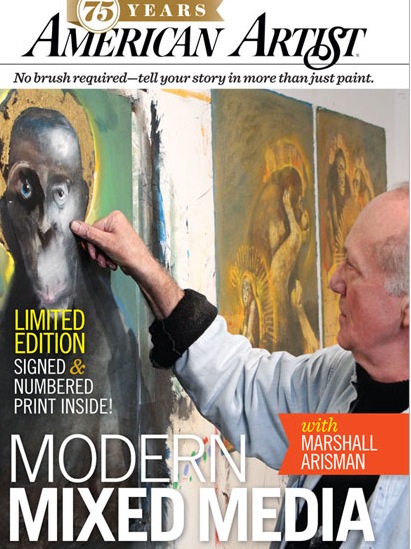
Fortunately, I got help from my old Maestro from the School of Visual Arts, Marshall Arisman, chair of SVA’s MFA Illustration program. Months ago, during a busy Spring semester Maestro Miguel Angel Ojeda at UABO asked me to teach a summer workshop. Without much thought, I picked a topic: Experimental Drawing. Thank heavens, I recently bought Marshall’s DVD, Modern Mixed Media.
The video is far superior to most how-to paint or draw videos. Marshall shows his process of internalizing his subject matter through sculpture, drawing, and painting. I must say I had to improvise with materials. Marshall uses paper-mache, india ink applied with bits of cut comb, and oil paints. He even uses gold leaf and a powdered pastel painting product that comes from a Kutztown-based business, PanPastels.
Oaxacan student at work using a piece of comb to draw.
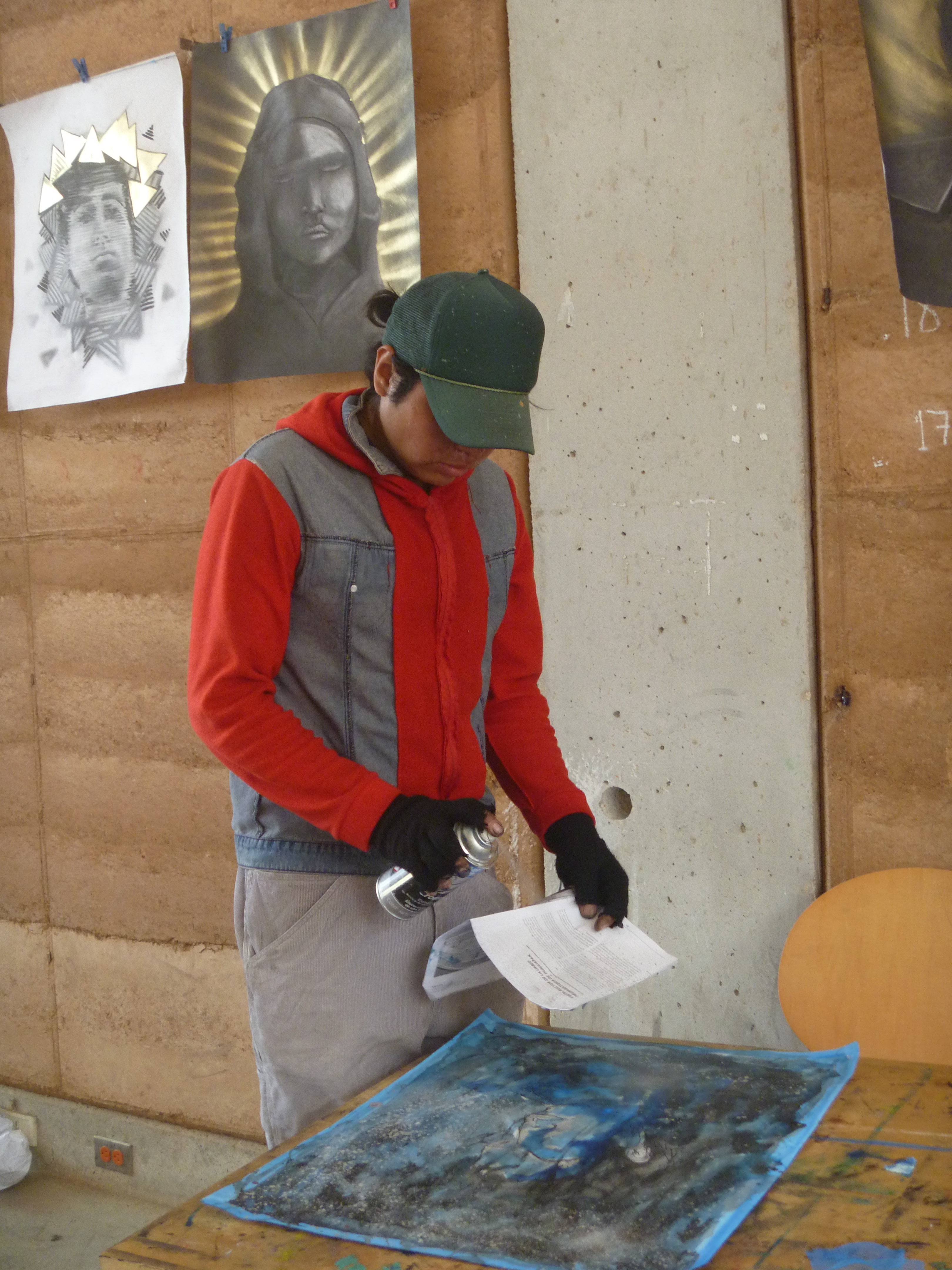
I had one sample of PanPastel to share. Paper-mache, -they got plenty, but gold leaf is out of the question. Here in Mexico, even india ink is a luxury item for art students. The india ink I carried down leaked in my luggage on the plane (stuff happens), so we substituted diluted acrylic paint. The class was over-enrolled, so I went to the Oaxaca’s central market to get some more combs.
Carter at work.
The Oaxacan students watched portions of Marshall’s sacred monkey drawing demos each morning with rapt attention. Then we adjourned to the gallery for our drawing workshop. We substituted powdered graphite for PanPastels to recreate Marshall’s subtractive drawing exercise. The results were, of course, far less colorful, but we managed to explore the process. For our gold leaf halos, Cesar Chavez lent a can of gold spray paint from his graffiti supplies.
We had a great mix of students, from teaching assistants to street artists, and the results were amazing. For me, it was a wonderful experience. Artists and teachers are held in high regard here in Mexico. Oaxaca, in particular, is a mecca for the graphic arts. I was interviewed on radio, TV, and both daily newspapers. If you read Spanish or want to view a slide show of the workshop check this story in Noticias.
By the way, this is not the first time Marshall Arisman saved me. Long ago, when I applied to SVA’s MFA program I didn’t have my Bachelor’s degree. Marshall let me in on one condition: that I complete my Bachelor’s pronto. He changed my life, for the better.
Good news from Mexico! Our shipment of 28 prints arrived safely in Oaxaca, Mexico from Kutztown, PA. The self-portraits in a wide variety of media (including woodblock, etching, serigraphy, and lithography) will be exhibited at Benito Juarez University in the month of July. The prints are by Kutztown University faculty, students, alumni, and friends.
Self-portrait, a Lithograph, by Prof. James Rose
Sending prints to Oaxaca seems odd, like sending flowers to Longwood Gardens. Oaxaca has a great tradition of printmakers from Rufino Tamayo to Rodolfo Morales. Living artists Damian Flores, Shinzaburo Takeda and the ASARO collective continue the tradition. Oaxaca’s best known printmaker is Francisco Toledo. His IAGO, Institute of Graphic Arts of Oaxaca, is the largest public print collection in all Latin America, and a mecca for printmakers.
The Resurgence of Printmaking in the U.S.
Kutztown’s printmaking studio is part of a bigger picture. In recent years many U.S. universities tossed their printing presses to make way for computer labs. Today there is growing interest in traditional printmaking. Young artists are rediscovering the pride and joy of working with their hands. By the way, for dispatches from the trenches of contemporary printmaking there is no better source than Printeresting, and a Kutztown grad, Jason Urban, is one of the creators of that site.
Fortunately, Kutztown University’s printmaking studio thrives under the leadership of Prof. Evan Summer. Evan has won international acclaim for his etchings. The studio is also equipped for lithography taught by Prof. James Rose. Evan opens the studio to visiting artists whenever he can. In 2011, Cesar Chavez of Oaxaca came to demonstrate Oaxaca-style woodblock printing. Cesar was impressed by the artwork he saw and suggested this exhibition to continue the artistic exchange.
This slideshow requires JavaScript.
There are prints by KU Professors Evan Summer, James Rose, Miles DeCoster, Kevin McCloskey, and Elaine Cunfer. More are by grads and current students. Pennsylvania is not that different from Oaxaca in one respect. Rare is the artist fortunate enough to make a living from her art. Some KU printmakers are teachers. Others work in shops or offices. Our most recent grads may still be looking for meaningful work. However, all maintain a passion for self-expression through the enduring medium of printmaking. And we are grateful to Cesar Chavez and the Escuela de Bellas Artes, UABJO, for this opportunity to share our art with the people of Oaxaca.
Near Oaxaca? Visit the exhibition at UABJO, University of Benito Juarez Centro Cultural on Avenida Universidad. Opening Reception: Friday July 6, 7pm. Free and open to the public. The exhibition runs to the 19th of July. If you are not in Oaxaca, you can get an idea of the variety and quality of KU prints from the slide show above.