In Jeff Gum’sPIONEERS, two shipwreck salvagers from the year 3861 P.G.B. get more than they bargain for when they uncover the remains of an “ancient” NASA space vessel. Jeff and his classmates in illustration II are all pioneers of sorts. They all are making individual zines, or mini-comics to share at MOCCAfest 2013 in New York City, a first for KU.
Kutztown will be among a select group of colleges at the indie comic showcase at the historic Lexington Ave. Armory. SVA, MICA, and the Center for Cartoon Studies will be there, but most MOCCA exhibitors are publishers and established artists. Darby Minter’s 8-pager, above, has a working title – Dreaming in Botulism. It is the story a young girl’s nightmare, the result of food poisoning. Darby plans to customize her zine with a post-it note from Mom on the fridge on page 6.
The panel above is from “Isaiah Arpino’s Most Amazing Story With Both Panties And An Ostrich. As Isaiah says, “It’s crazy what you can find in a basement and where it will take you.”
Awkward Bunnies by Nathan Hurst will be a 12-page project. The caption to the drawing above is “Do you still wear acid wash jeans?” More of Nathan’s art can be seen at: Thesuburbanpilgrim.tumblr.com
Another artist who can be found on tumblr is Lauren Gillespie. She is working on a project called Scallywaggin’ –“the heartwarming tale of a rowdy gang of cutthroat space pirates and their bungling captain that scour the universe for fortunes untold….sort of.”
MOCCA, by the way, stands for Museum of Comic and Cartoon Art. MOCCAfest will be April 6 & 7 this year. It is New York’s largest indie comics showcase, featuring hundreds of creators and publishers for two days of educational panel discussions, slide shows, and interviews. It is open to the public for just $10 a day, details can be found here. We will be showing more highlights of our Kutztown illustration student projects real soon.
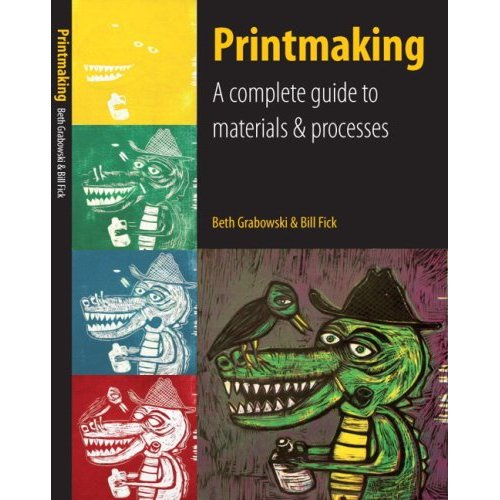
Bill Fick wrote the book on printmaking. Actually, he co-wrote the book, with Beth Grabowski, Printmaking: A Complete Guide to Materials & Processes. He is a part of the group known as the Outlaw Printmakers.
Bill Fick draws monsters. He is a nice guy. I met him one rainy night at the Atomic Cowboy bar in St. Louis. Tom Huck was throwing a party and Bill Fick was among the invited Outlaws. I remember a protester outside the bar carrying a sign saying, “STRIPPERS ARE BAD.” The bar was so crowded that I never saw the strippers; maybe they were bad.
Fick’s Printmaking textbook, cover image by Sean Starwars
Bill Fick teaches printmaking, drawing, and comics at Duke University. He has set his mind to building something off-campus in Durham, N.C. He has a vision of a self-supporting printmaking studio/work space/ exhibition space, with artist access to equipment, workshops, and classes. There is nothing like it in the area. It will be super and it will be called SUPERGRAPHIC!
YOU CAN OWN A BILL FICK MONSTER!
Bill Fick’s art has been exhibited all over the world. He’s won a National Endowment for the Arts award. His monsters are included in famous collections such as Harvard’s Fogg Museum. His art can fetch thousands of dollars. But his SUPERGRAPHIC dream is your opportunity to own an original Bill Fick artwork for a donation of as little as $35.
The details of the SUPERGRAPHIC project can be found here. If you want to learn more, or donate, check that out. Also check out billfick.com where, oddly enough, there is a photo of Kutztown printmaking grad Josh Dannin working on a monster print project.
Jim Haverkamp made a charming 7-minute documentary of Bill Fick at work, Anatomy of a Linocut. Another video by Frith Gowan and Ayanna Seals lets Bill Fick speak his mind. It is called Controlling the Monster. He admits, “I am fascinated with the idea of the monster… ugliness… misunderstanding… For me, making the monster may be some kind of response to the constant drone of bad news.”
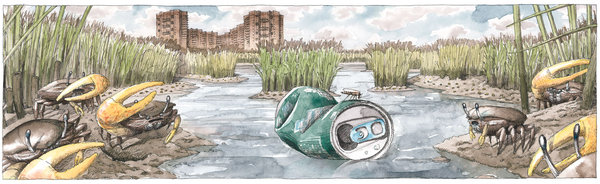
I visited Hoboken, my old hometown, for the opening of an art show from Meadowlands, Thomas Yezerski’s beautiful children’s book. His book is about the battered, but amazingly resilient, ecosystem that exists just a few miles from Hoboken and it’s better-known neighbor, New York City. The exhibit runs to March 10 at the Hoboken Historical Museum, my favorite small museum.
I met Thomas last year when he came to Kutztown University Children’s Literature Conference. Raised in Allentown, PA, he now lives in Hoboken. He is a graduate of Syracuse University’s famed illustration program. Thomas has illustrated a variety of kid’s books, but Meadowlands: A Wetland’s Survival Story is his masterpiece.
His ten years of research began by reading everything he could find about the natural history of the area. Then he got into a canoe so he could observe the North Jersey wetlands firsthand.
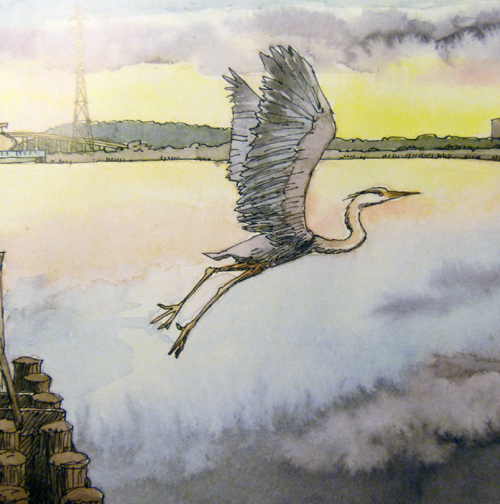
Thomas found some remarkable wildlife thriving beside some of our nation’s noisiest, and ugliest highways. His watercolor washes and finely detailed pen and ink drawings are perfect for depicting this strange world. The New York Times gave the book a glowing review: “Meadowlands is tremendously (but not intimidatingly) informative, fun to read and gorgeous to look at.”
The book is a generous 40 pages, more than the typical children’s picture book. Nearly all of the panoramic two-page spreads are framed by multiple vignettes, like those appearing here. Thomas includes dozens of these supporting images in the current exhibition.
The artist custom matted his illustrations to include the supporting details.
Thomas Yezerski will return to the Hoboken Historical Museum on Sun. Feb 10 at 4pm to describe his research, writing, and illustration process. (And sign books!) More info on the event can be found here. Admission to the Museum is $2 for adults, free to children and members.
Thomas Yezerski at Kutztown’s Children’s Lit Conference in 2012
If you can’t get to the Hoboken Museum, Thomas’s publisher has a nice page about the book with more pictures. To see the wide range of his illustration work, visit thomasfyezerski.com.
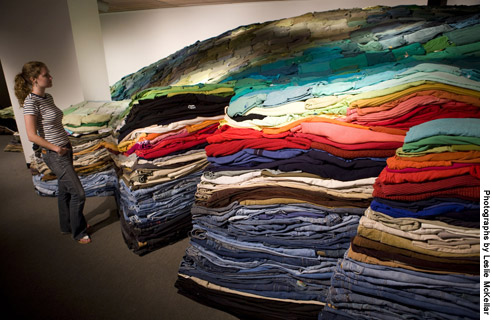
“SCARP” A prior clothing installation from jarodchazewski.com
Kutztown University will host Canadian artist Jarod Charzewskias he transforms the Miller Gallery into a “site-specific installation based on the consumer culture of Kutztown shoppers.” What’s that mean? Come find out. Based on his past installations, Charzewski’s work is likely to be colorful and eye-pleasing, yet also thought-provoking.
Charzewski’s winning artist residency proposal was one of nearly 125 that came from all over the world. His Kutztown U gallery installation will be in progress from Jan 21 – Feb 7. Artists (students or not) who would like to assist him in the project can contact Karen Stanford via the Miller Gallery webpage. The exhibition will be up until St. Patrick’s Day.
Detail showing Books about War.
Born in Winnipeg, Charzewski graduated with a BFA from University of Manitoba. He got his MFA at U on Minnesota. He is currently teaching at College of Charleston, S.C. I emailed him a few questions:
Q. How important is drawing to your process of visualizing an installation?
Jarod Charzewski: Drawing has always been an important part of what I do. I have always drawn. It’s the first creative thing I did when I was growing up. I don’t really think I was very good at it. I could blow my friends away with drawing, but that was only copying things from photographs. I wasn’t very spontaneous with my subject matter.
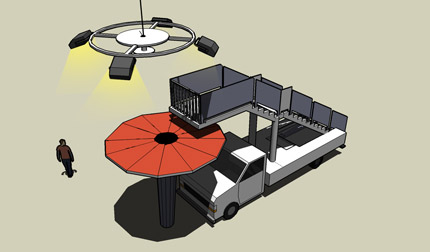
Many of the drawings I do today are schematics for planning my installations. My wife is an architect so I frequently bounce ideas off her as far a traffic flow and the height of things.
J.C: Right now I am using Sketchup to do drawings of all forms. Everything from detailed schematics with dimensions, vegetation and pedestrians to doodles and scribbles. It’s a very fun tool to play with.
Q. What is the best advice you got in art school? From whom?
J.C: The best advice I got was from Alex Bruning. He taught advanced drawing in my BFA program at the University of Manitoba. It was one class when he gave us some instruction and then turned us loose to work. I sat in front of my drawing board with a blank piece of white paper on it for – I guess – ten minutes, wondering what to draw. Meanwhile, my buddy Richard Wlodarczak just jumped right in, without hesitation or evidence of a single thought and started drawing.
I was amazed. Alex Bruning came by and said to me. “Richard trusts himself…. You must trust yourself”. I think about that a lot. I can’t say I remember what I did at that moment but I recognize now the things I trust myself with. It’s also fun to see students in my classes that trust themselves. By the way, Richard Wlodarczak is an accomplished painter living in Vancouver, B.C.
Jarod Charzewski borrows, then returns, clothing from Goodwill for installions like this.
Q. Is Canada more supportive of the visual arts than the US?
J.C: It is and it isn’t. It’s common for anyone with BFA to get provincial and federal artists grants as soon as they graduate. There are many that make a living doing just that. What is rare is a chance to exhibit the work you make with the grant money, as there are so few galleries, compared to the US. I feel it’s the opposite here in the US. Even before students of mine graduate they have shows in commercial spaces and are selling their art in one way or another. It’s the grants that are few and far between.
Jarod Charzewski’s artist statement and many more images of his artwork can be found at jarodcharzewski.com. If you are near Kutztown, visit the Miller Gallery. The artist will be talk about his work, free and open to the public, Feb 7 at 7pm. The official installation opening is the same day, 2/7/13, from 4-6pm. Details here.
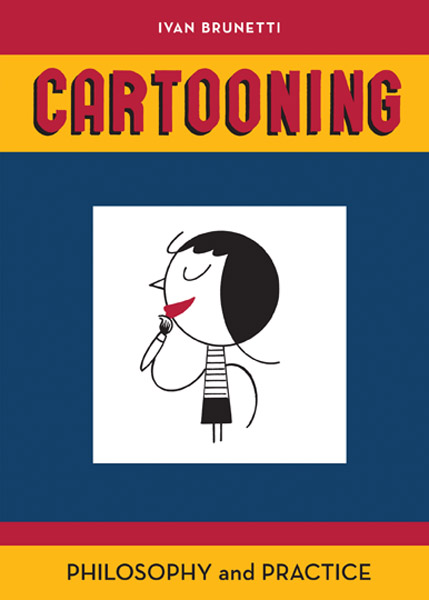
Ivan Brunetti’s Cartooning Philosophy and Practice is published by Yale University Press. Brunetti combines a lovely spare drawing style with an occasionally overwrought writing style. I do dearly love this little book, but at times find his writing style infuriating.
Brunetti’s prose slips into and out of quotation marks, parenthesis, often for no clear reason. I felt I was hearing a “sermon” and the minister (randomly) switched to a parrot’s “voice” every now and “then.” I am exaggerating slightly. Here is an actual sentence from Brunetti’s introduction:
With writing, I do not give the “form” any thought at all, since writing comes more naturally then drawing for me (I am a windbag by nature) and I could not a adopt a “style” even if I tried; however, with drawing, I still feel that I am confusedly “building” something by trial and error.
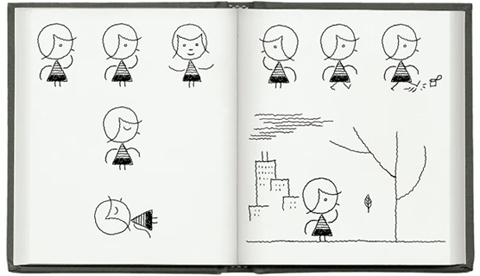
Brunetti’s illustrations, on the other hand, are a clean and spare. He has drawn for the New York Times,The New Yorker, and even for Scooby-Doo. He edited a “scholarly” (now, he’s got me doing it!) two-volume anthology of the modern masters of comics for Yale Press.
Cartooning Philosophy and Practice is a worthwhile text for a comics class at the high school or college level. It is the winner of the 2012 Will Eisner Award in the best book in the Academic category.
The text reviewed here last week Drawing Words/Writing Pictures is a much bigger, more comprehensive book and includes work from lots of artists. Brunetti’s Cartooning is a pocket-sized book that is illustrated exclusively with his own drawings. Comparing the two volumes is like comparing a Hummer limo to a Fiat.
If I had to pick one cartooning book to smuggle into a prison or carry on a road trip it would be Brunetti’s. His idiosyncratic voice either grows on you, or it doesn’t. (Ok, it grew on me.) His lessons are clear and good. To get a better idea of his style visit the Yale Press page where Brunetti shares one of his cartooning exercises in a brief video.
There are a handful of good books that will help the motivated student succeed at becoming a cartoonist. Drawing Words and Writing Pictures may be the best of the lot. This is an ideal text for a 15-week class in comics. It also has guidance for starting an informal collective class. It includes DIY suggestions for the stereotypical solitary artist, who the authors are gracious enough to refer to as ronin. There is a wealth of info on the narrative process, page design, lettering, pens, and even Photoshop scanning advice.
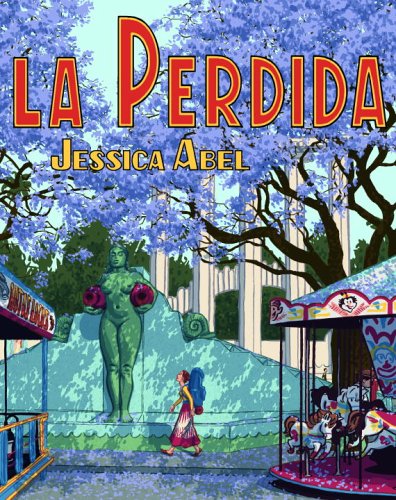
The book contains the perspectives from two remarkable artists, a gifted husband and wife team. Matt Madden is into “formalist” styles, working within Houdini-like constraints. Jessica Abel‘s La Perdida is one of the great masterpieces of the long-form graphic novel. From George Herriman to Robert Crumb, Charles Burns, to Kaz and John Porcillino, the book is crammed with a diversity of styles. Wide-ranging and inclusive, no matter what one’s preferred comics style, from manga to superhero to alternative, you will find something to like here.
In 2012 Abel and Madden created a second book: Mastering Comics. It has more info on color and web comics and up-to-date information about publishing and professional practices. The authors, who have both taught at SVA, have created a super web site: dw-wp.com, that serves as a resource for teachers and students. The site is especially valuable if you live in a part of world where can’t get your hands on their books. For an example of its riches, check out their instructions on how to make the mini-mini-comic they call a “foldy.”
Scott McCloud’s Making Comics came before the above books. McCloud’s 1994 Understanding Comicswas groundbreaking, a thoughtful overview of the field. McCloud’s books are also useful texts for serious students who have some background in thinking critically about the art form. Right now (Jan. 2013) Amazon has special deal, you can get both of the Drawing Words/ Writing Picture books plus a copy of McCloud’s Making Comics for $61.49. The set would make a good core for any comics creator’s library. That’s 3 books for less than I paid for my used Spanish textbook. There are a few more good books on comics that I will get to next week.
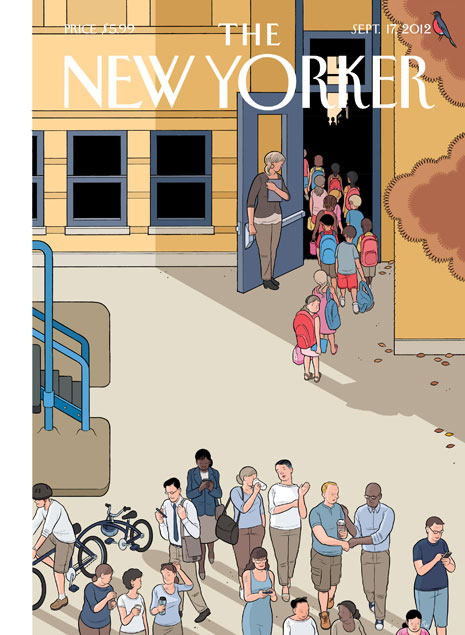
Chris Ware illustrated September’s back-to-school New Yorker cover with a scene of parents turning their backs on their children, immersed in their own digital devices. This week he did another cover that brilliantly reflects how the Sandy Hook Elementary School shootings changed the dynamic between parents and children.
On this 2013 cover our point of view is 180 degrees different. It is dark inside the school. We see the children’s dazed expressions. The parents outside are trying to stay connected as long as they can. Ware shares his thought process about these powerful images on the New Yorker’s culture blog.
“In September, I pictured, more or less, my daughter’s teacher and her class on a back to school cover that jokingly pointed to the free time parents would have now that their kids were back in class…something I saw every morning, and I thought it would make a sort of funny picture. In the wake of Newtown, it didn’t seem so funny anymore.”
Happy New Year. The WordPress.com stats helper monkeys prepared a 2012 annual report for the illustration concentration blog.
We had 39,000 views in 2012. The post that got the most views was a 2010 story about KU grad illustrator Amanda Geisinger working with Spongebob Squarepants. Next is a story about the folk art tradition of Kolam. That story gets a lot of traffic from India, presumably from artists who know more about it than I do. The post features Prof. Josh Miller before he came to Kutztown University.
The surprise search term that bring folks to this blog is “pigeon sketch.” I wrote about my project drawing pigeons at Vinnie Torre’s loft in Hoboken. Vinnie helped me refine the sketch above; he thought it looked too much like a street bird. Every day a couple of people arrive at the blog by googling “pigeon sketch.” I guess art teachers are asking students to sketch pigeons, but instead of going out to the park, these students are copying mine. I can upload more pigeon sketches, but kids, pigeons are not that rare a bird.
The detailed 2012 stat report for the blog can be found here.
Back in the ’80’s, when I told my pal Putka I was getting an MFA in illustration, he laughed, “What’s next? -a Phd in Wallpaper Hanging?” What’s Next?Looks like the answer is Advanced Comics…
Stanford is a great university with one respected graphic novel class. But suddenly, universities across the country are offering complete advanced degrees in comics. CCS, the Center for Cartoon Studies, in Vermont has offered a Comics MFA for several years. CCS is not to be confused with CCA, California College of the Arts in San Francisco which is launching a new low-residency MFA in Comics in 2013.
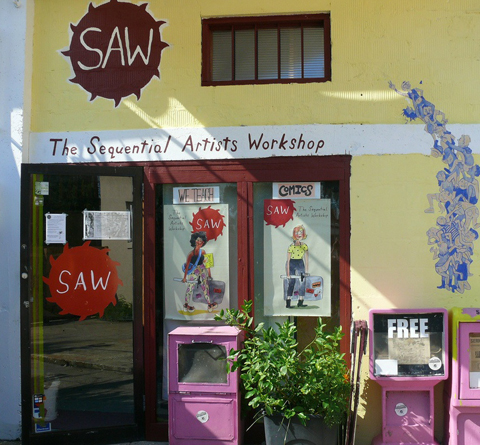
A curious new educational option has sprung up in Florida. It is called SAW for Sequential Art Workshop. Cartoonist Tom Hart who taught for a decade at SVA in NYC has relocated to a storefront on So. Main St. in Gainesville. There, with a group of dedicated faculty and students, he has begun an intensive comics course. SAW’s one-year intensive program is not an accredited MFA, but it cost far less, $3600.
Student show at Saw, August, 2012, used with permission.
A student told me this, “Another reason I chose SAW over a degree program is that SAW is very inexpensive, but provides the opportunity to work with really amazing faculty. And though there’s no degree, I believe that in the art world your portfolio is more important than having a degree. So the quality of the education is more important than the diploma.”
Any advice for young artists interested in making zines and comics?
Same student, who now wishes to be anonymous: “Do just that – make zines and comics! Make them and get them out into the world. Trade them with other creators, go to conventions, put them online – get your work out there. And, even more importantly, keep making work. It can get discouraging when it feels like no one is listening, but you just have to keep on going. Don’t get too hung up on your early work, either – your first comics probably won’t be great, so finish them and move on. Set goals by the project. If you make a mistake or don’t like the way it’s turning out, finish the project and then try not to make that mistake in your next one – but don’t get discouraged. Also, even if you think you are going to draw in the most flat, cartoony style, still take the time to learn traditional art skills because your drawing can always benefit from them. If you don’t want to go to a traditional art school, look for local figure drawing sessions or evening classes taught by local artists. Or, better yet, apply to SAW! “
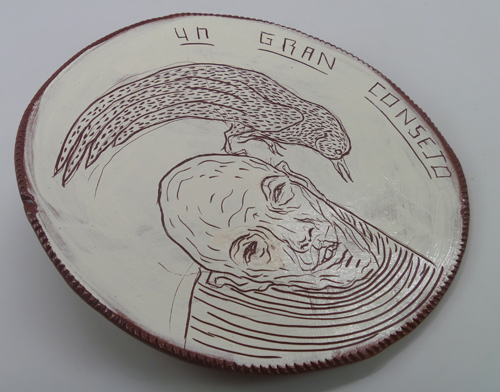
“Un Gran Consejo” or “Great Advice,” César Chávez, 2011
Our 2011 visiting artist César Chávez of Oaxaca, Mexico left a great impression on Kutztown University. He also left a number of plates.
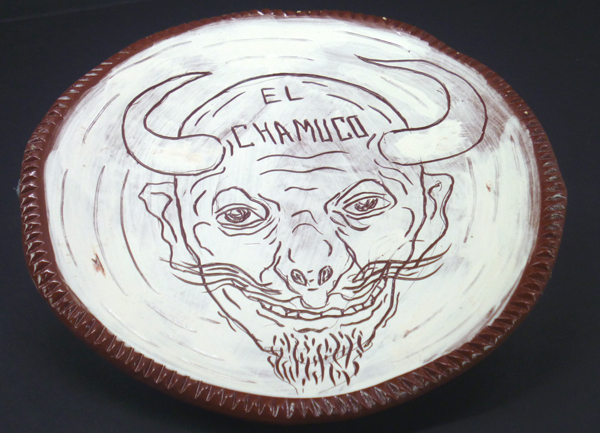
“El Chamuco” by César Chávez, 2011.
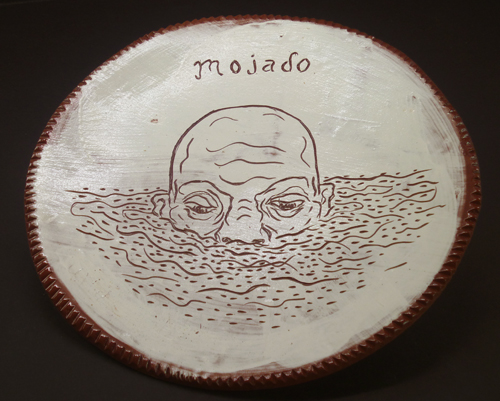
Ceramics Prof Jim Chaney formed a half-dozen red clay plates, then iced them with a coat of white slip, or diluted clay. He invited César to the ceramics studio to draw. Prof Chaney speaks some Spanish and once did a ceramics workshop at the University of Azuay in Ecuador. Even though César spent most of his time at Kutztown in the printmaking studio, he was happy to spend one very productive afternoon in the ceramics studio.
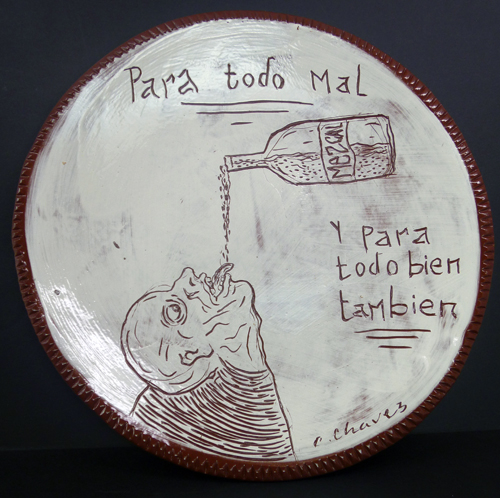
“Mescal” César Chávez, 2011
César is a happy fellow who often draws moody, morbid sketches of the human condition. The plate above suggests mescal, Oaxaca’s agave-based alcohol is “Good for Nothing and Good for Everything.”
“Mojado” by César Chávez, 2011
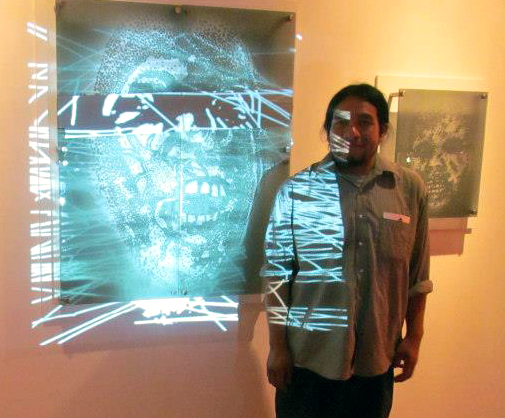
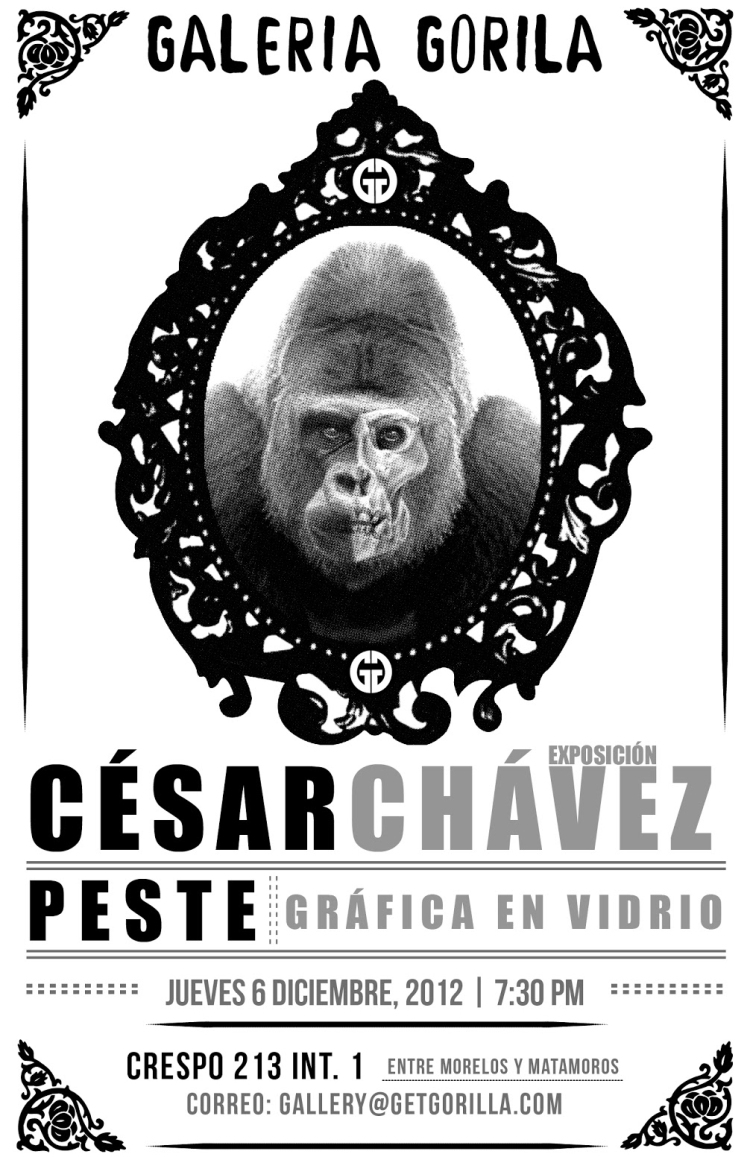
Interestingly enough, César is back in Mexico and working in another new material, glass. He has been working with artist Jason Pfohl who founded the international art glass and jewelry studio, Gorilla Glass, in Oaxaca. César’s one-man show “Peste” (Pestilence) opened at Gorilla Gallery this week. He is printing multiple impressions from etched and melted glass. I’ve never seen anything quite like it. César is also continuing his ongoing experiments in computer animation and image projection.
César Chávez, photo courtesy of Gorilla Gallery, Oaxaca, Mexico
César told Gena Mejia of the Imparcial newspaper that he is excited by the infinite possibilities of working in glass. It appears fragile, but can be a strong and very versatile material. If you can read Spanish the full story can be found here. César Chávez is an inspiring artist, a 21st century renaissance man, always searching for new materials in pursuit of his artistic vision.


 MOCCA, by the way, stands for Museum of Comic and Cartoon Art. MOCCAfest will be April 6 & 7 this year. It is New York’s largest indie comics showcase, featuring hundreds of creators and publishers for two days of educational panel discussions, slide shows, and interviews. It is open to the public for just $10 a day, details can be found here. We will be showing more highlights of our Kutztown illustration student projects real soon.