Once and Future Prints

“4 a.m” linocut print © 2008 Frances Jetter

Illustrators rejoice over the resurgence of interest in prints. Some illustrators are also fine printmakers. Some printmakers are illustrators. Above is a print by an artist who manages to live in both worlds, Frances Jetter. We will see her artwork in Kutztown soon.

Portrait, etching ©2009, Ivanco Talevski

Kutztown University’s Invitational Print Exhibition opens Thurs., Sept. 6. Professor Evan Summer is curator. He told me he had space for eight to ten exceptional contemporary printmakers and so made a list of 30 great artists to invite.

Woodblock print © 2012 Endi Poskovic

Nearly everyone said yes, so he didn’t even get halfway through his list. He’s hoping to do it again. Exhibiting artists: Michael Goro, Richard Hricko, Frances Jetter, Endi Poskovic, Rosalyn Richards, Rostislav Spitkovsky, Ivanco Talevski, Rochelle Toner, and Bruce Waldman.
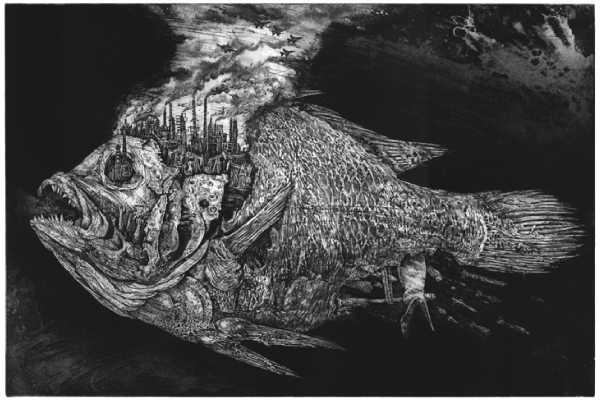
A Fish Rots from the Head Down, etching © Michael Goro

ARTWALK,  Sept 6, Kutztown, PA

In conjunction with the Print Invitational at KU’s Miller Gallery there will be a printmaking themed Art Walk on campus and along Main Street in Kutztown. On campus there will be artwork by KU alums in the SUB. There will be a display of new prints from Oaxaca, Mexico on the 2nd floor of Rohrbach Library.

Silkscreen by ASARO, Rohrbach Library

Main Street venues include: Uptown Expresso, The Independent Space, New Arts Program, Firefly Books, Kutztown’s Main St. Bed & Breakfast, Dunkleberger’s Jewelers, Paisley & Co, Global Libations and more.

Art by Russ Spitkovsky for Carrier Pigeon Magazine

Carrier Pigeon Magazine Volume 7 will have its launch party and contributor’s exhibition at Eckhaus. I’ve only managed to peek through the windows so far, but it looks brilliant.

An Art Walk map with times and addresses can be downloaded here.  Maps will be available at the Miller Gallery’s opening reception, 4pm, 9/6/12. With apologies to the map designer, Wyatt Glennon, I have truncated his lovely map to make the version below:

As a pedestrian and a printmaker, I am really looking forward to this. It is wonderful that the town of Kutztown and campus can partner on such a fantastic project. Miller Gallery Director Karen Stanford should be applauded for this town-gown interaction. The opening begins at 4 pm 8/6/12 in the Miller Gallery in Sharadin Art Building. Most of the Art Walk spaces are open 5-9pm.

I am showing prints from my new series, The Lesser-Known Miracles of St. Patrick, at Firefly Books, conveniently located at 230 W. Main St.

Woodcuts by Kevin McCloskey. Sept 6-30, Firelfly Books, Kutztown

Rare Birds of Lore

Out of the blue I got a note about Ryan and Audrey Durney’s Birds of Lore” Kickstarter project. I was impressed enough by this couple’s fantasy illustration project to become a low-level backer. I emailed them a few questions and asked to share some of their art here. 

Q. Other than Leo and Diane Dillon I can’t think of many husband/wife illustration teams.  What are the rewards of this creative partnership?

Ryan: My favorite thing about it, is that we speak the same language, even if we don’t always agree on things about the field. And, we sit right beside each other, sipping coffee and sketching and riffing off of each other’s direction and discovered influences. Sometimes, critiques get precarious-they can be given too early, or too late! But, it’s really rewarding to be in the same boat.  …we’ve rarely ever gotten to work on a complete idea together, which is one reason for the Kickstarter.

Mexican CU bird sketch © 2012 Audrey Durney

Q: Where did you two meet, the Kickstarter video says art school, but what art school?

Ryan: We met and fell in love at Columbus College of Art & Design. Back then CCAD  was like “military art school” they purposely overloaded you-so I don’t know how we even had time to date!? CCAD did a lot to prepare me for a career as an illustrator. However, at the time about half of the staff was anti-digital art, and I have a lot of bitter memories of instructors knocking my grade down just because I did assignments on the computer-meanwhile, I had been up all night at KINKOS trying to get one stupid final to print correctly!

Q: Can you tell me something about the CCAD illustration program, maybe a favorite prof, or most important class?

Ryan: Mr. Stewart McKissick was probably the most influential instructor for me. He really cared about preparing us for the real world, and he even forged a class where we competed against each other for real, paying assignments. I remember winning 2 of the 3. That was the kind of confidence boost I sorely needed so near to graduation. Audrey’s favorite was Ms. Tam Peterson for her energy and enthusiasm.

Q. Have you had some success freelancing illustration?

Ryan: Both Audry and I have won some awards and earned some respectable commissions. I make a modest living, with some good years -feast and famine, I suppose, but I’ve been happy doing it for over a decade. It’s really true that you just keep getting better and evolving. Audrey has taken a more stable road, working as a technical illustrator by day and freelancing via an agency at night, -tough but way more practical. My one complaint about making a living this way is the level at which freelancers are taxed. Also, illustration agents take the highest % of any creative endeavor, including music, acting, etc. at 25%, and art is one of the lowest in compensation. 

Q. Why Kickstarter vs. traditional publishing?

We can keep and manage the rights to our own work, and we get to finish a creative endeavor without corporate edits. I believe this brings the book much closer to an actual work of art. It’s being written and illustrated by unfettered artists, from start to finish. This is what the storytellers of olde did.

The Wila, or Vila, or Veela of Polish folklore. © 2012 Ryan Durney

Q. Who drew the Harpy (top image) and the Wila?

Ryan:  I did both the “Captive Harpy” and the “Wila.” I’m pleased with both. The Harpy is the more popular of those two (based on viewer feedback.) With the Wila, I tried to integrate pen-and-ink within the 3D. Sometimes that meant actually sculpting “ink-like” lines into the mesh, and sometimes that meant adding ink touches. That’s why you can see me using pens in the video. I’m 3D, but definitely experimental. I love mixing hand and digital media. The other thing about the Wila is that I was completely taken by an old etching. The Wila is homage to a very old engraving by Anton Eisenhoit (see below). Before anyone thinks it, yes-I agree that his original is better!

Q. Who did the little yellow bird blowing the horn, the Hercina?

Ryan: Audrey did the “Hercinia” bird, which is equally enjoyed by all. She  is a master of vector work and using Painter with vectors. Audrey and I are tilting our illustration styles in a few different directions, depending on what there is to say about each bird. The Hercinia is a direct homage to medieval bestiary art.

Note: As always: all art © the original artists. See a more Birds of Lore on the Kickstarter site. I have a hunch this project will fly.

Dr. Lakra’s Grand Canvas

Dr. Lakra’s art often appears in Juxtapoz magazine.

Dr. Lakra is not a real doctor. He is a tattoo artist and collector of classic porn. He is, of course, more than this. The cutting-edge magazine Juxtapoz often features his art. I met Dr. Lakra late one night last week in a warehouse across the main highway from the center of Oaxaca.

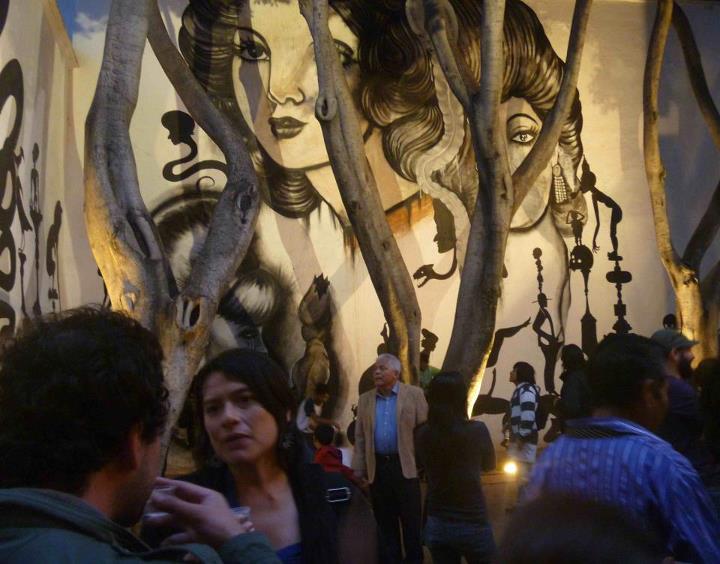
Dr. Lakra’s MACO mural, opening night, July 13, 2012, photo: KMc

The warehouse encounter was the second of Lakra’s two art openings within a week. The first was the inauguration of an enormous temporary mural at MACO, el Museo Arte Contemporáneo de Oaxaca. Packed with artists, journalists, and photographers, the MACO opening was so crowded I didn’t even realize Dr. Lakra was in attendance.

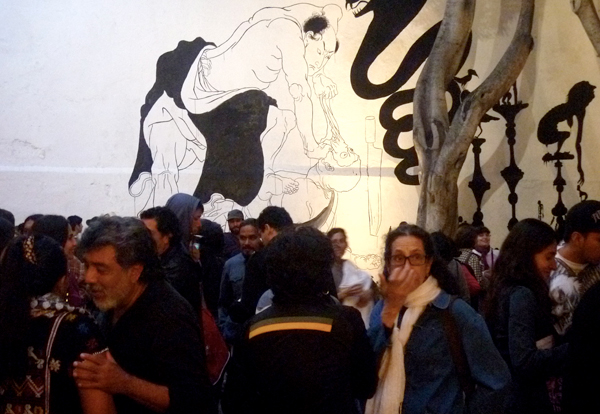
Dr. Lakra’s formal MACO opening showing Samurai section of his mural. Photo: KMc

The MACO mural, which he completed in a few weeks with three assistants, covered two high walls. It included a two-story illustration of a Japanese warrior tearing the face off an opponent, clearly appropriated from a Ukiyo-e print. There were monumental sepia-toned portraits of mid-20th century Mexican glamour girls. A troupe of black silhouettes danced along the foreground, bringing to mind Kara Walker’s work.  At sunset the shadows of the trees in MACO’s Patio C played across Lakra’s mural lending the artwork an eerie sense of motion.

Dr. Lakra's canvas mural. photo: KMc
Dr. Lakra’s warehouse mural on canvas, left panels. Photo: KMc
Dr. Lakra’s warehouse reception. Right panels in background.

The second opening, at the warehouse, was quite different. Dr. Lakra greeted everyone cordially, even gatecrashers like me. He wasn’t drinking, but offered us mescal and beer. A woman asked him if he had a bottle opener for her beer. Dr. Lakra took a plastic Gatorade bottle and wedged its orange plastic cap under the beer bottle cap. With a deft flick of the wrist he popped open the beer bottle. The Gatorade bottle was still sealed. Seems Dr. Lakra is a master of many arcane skills.

I was told this warehouse is the studio of another internationally known Oaxacan artist, Demian Flores.  The murals at MACO were painted directly on the walls. These murals filled two giant stretched canvases, one on each side of the room. Done in the same mix of sepia and gray washes, these images were more grotesque than the museum piece.

A gory detail from Dr Lakra’s canvas mural.

Bits of ancient maps and medical anomalies jostled against genies in bottles and high-heeled shoes. Dr. Lakra told me he and his crew had also completed this project quickly. I wondered if the opening wasn’t a tad premature. Some collage elements on the canvas, old duotone magazine photos, fluttered in the breeze each time the warehouse door swung open.

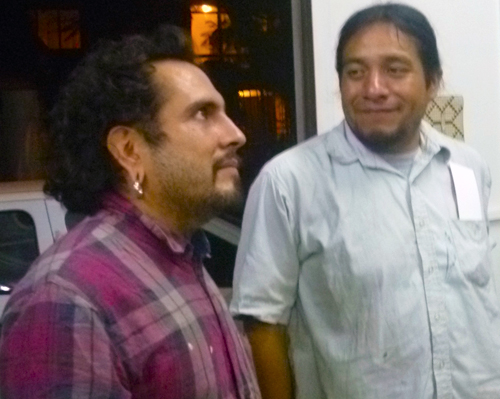
Dr. Lakra looking at his mural with Cesar Chavez. Photo: Kevin McCloskey

In 2007, Dr. Lakra contributed an artwork to my friends of the ASARO collective, a large cubist painting of a man tied to a chair, being tortured. I found his new work even more disturbing than that painting, but I expect this is his artistic intention. Bottom line: I may not like all his imagery, but I do like Dr. Lakra.

NOTE: A very short video of Dr. Lakra’s MACO mural can be seen here .

Experimental Drawing: or How Marshall Arisman Saved My Life in Mexico

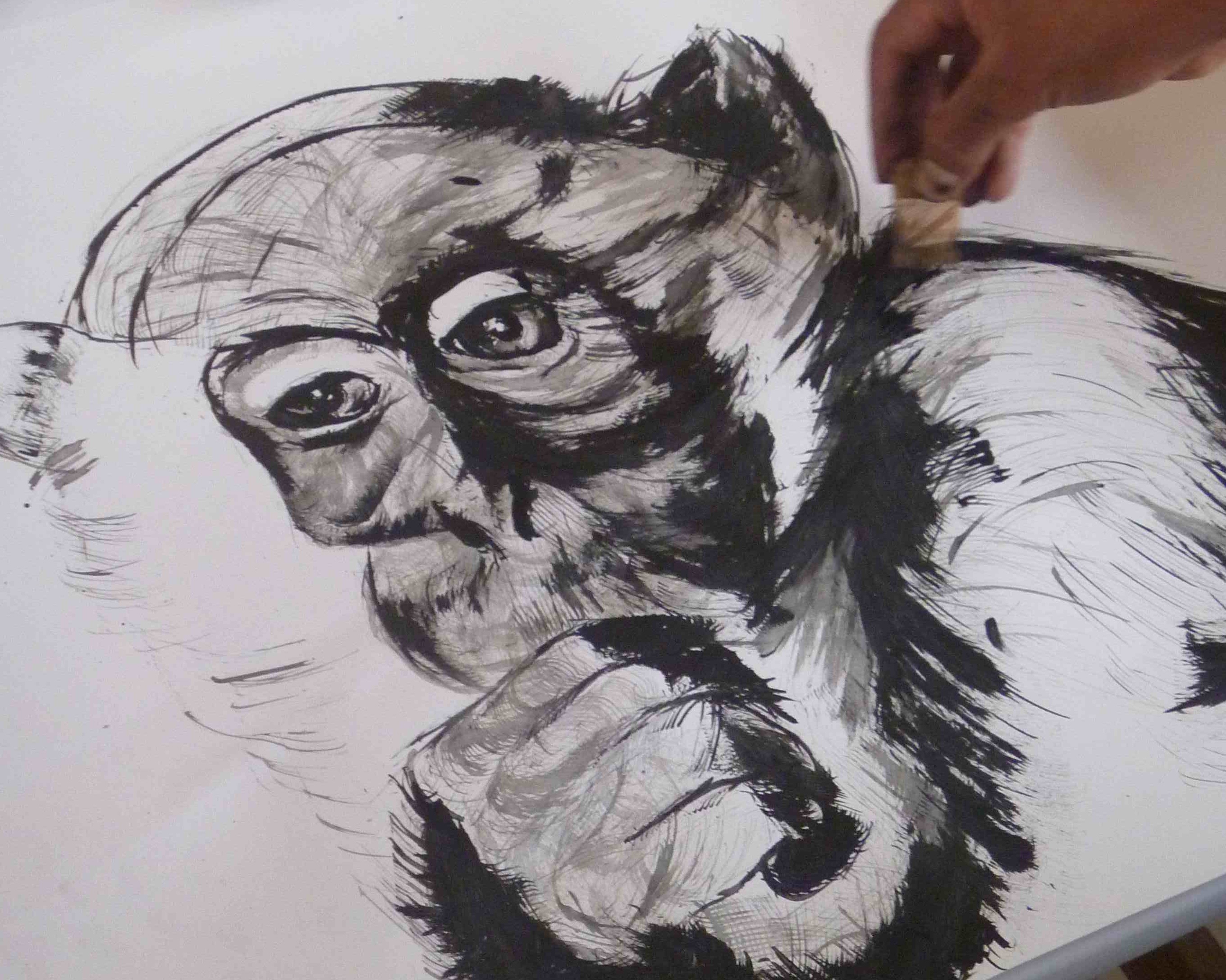
Monkey face drawn with a comb and diluted acrylic by Lazaro.

This week I taught a 3-day experimental drawing workshop at UABJO, University Benito Juarez, Oaxaca. I love the rainy season here in the mountains of southern Mexico. The workshop was in conjunction with the Kutztown Print exhibit that opened with much fanfare and mescal.

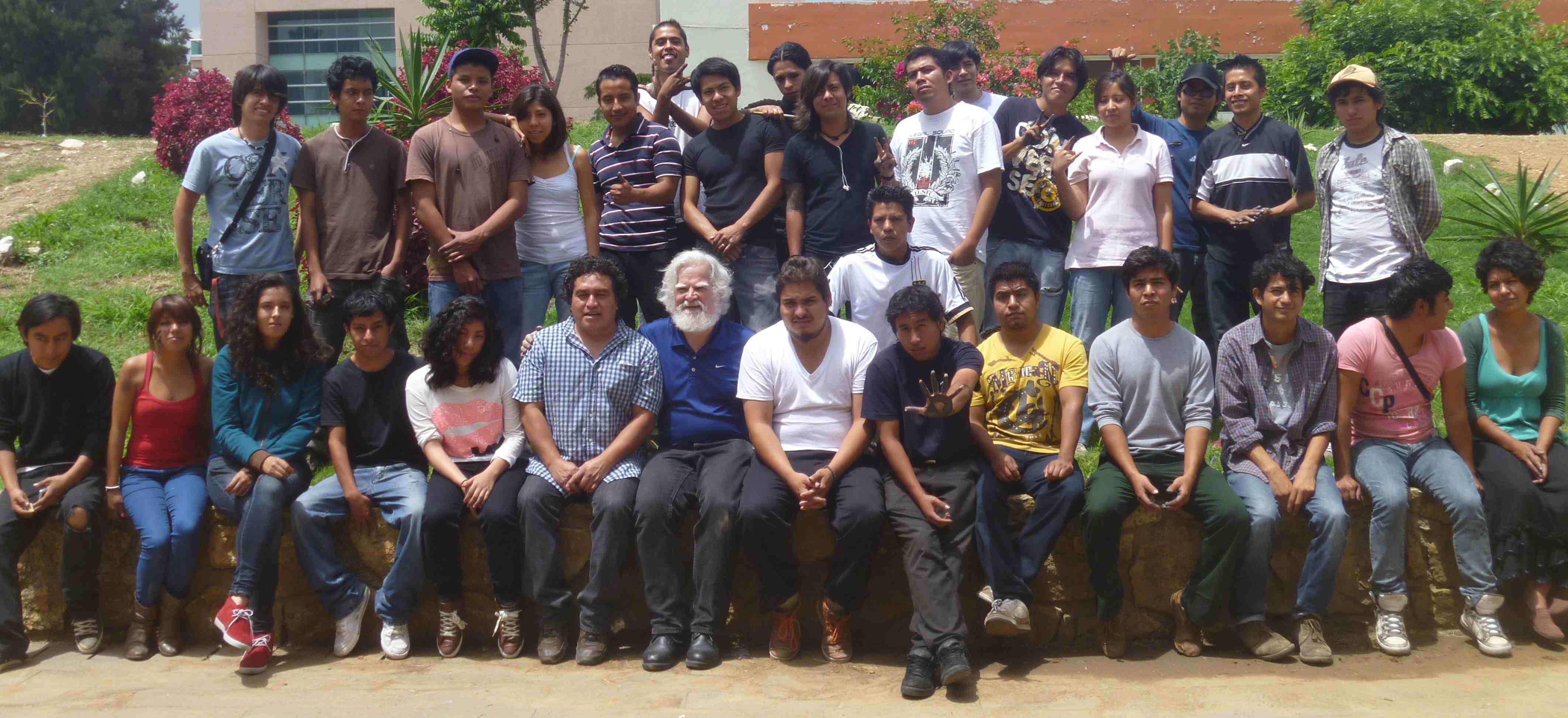
Students at UABJO. Left of me is my co-teacher, Maestro Memo Rito.

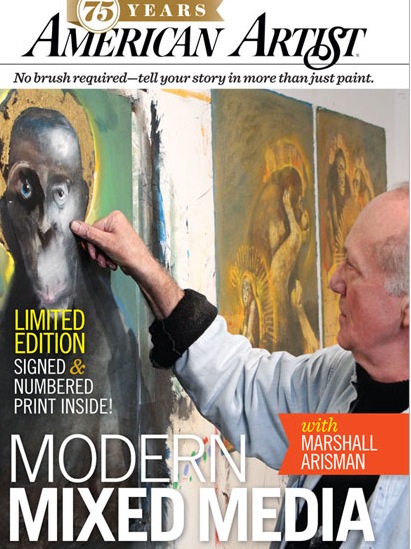
Fortunately, I got help from my old Maestro from the School of Visual Arts, Marshall Arisman, chair of SVA’s MFA Illustration program. Months ago, during a busy Spring semester Maestro Miguel Angel Ojeda at UABO asked me to teach a summer workshop. Without much thought, I picked a topic: Experimental Drawing. Thank heavens, I recently bought Marshall’s DVD, Modern Mixed Media.

The video is far superior to most how-to paint or draw videos. Marshall shows his process of internalizing his subject matter through sculpture, drawing, and painting. I must say I had to improvise with materials. Marshall uses paper-mache, india ink applied with bits of cut comb, and oil paints. He even uses gold leaf and a powdered pastel painting product that comes from a Kutztown-based business, PanPastels.

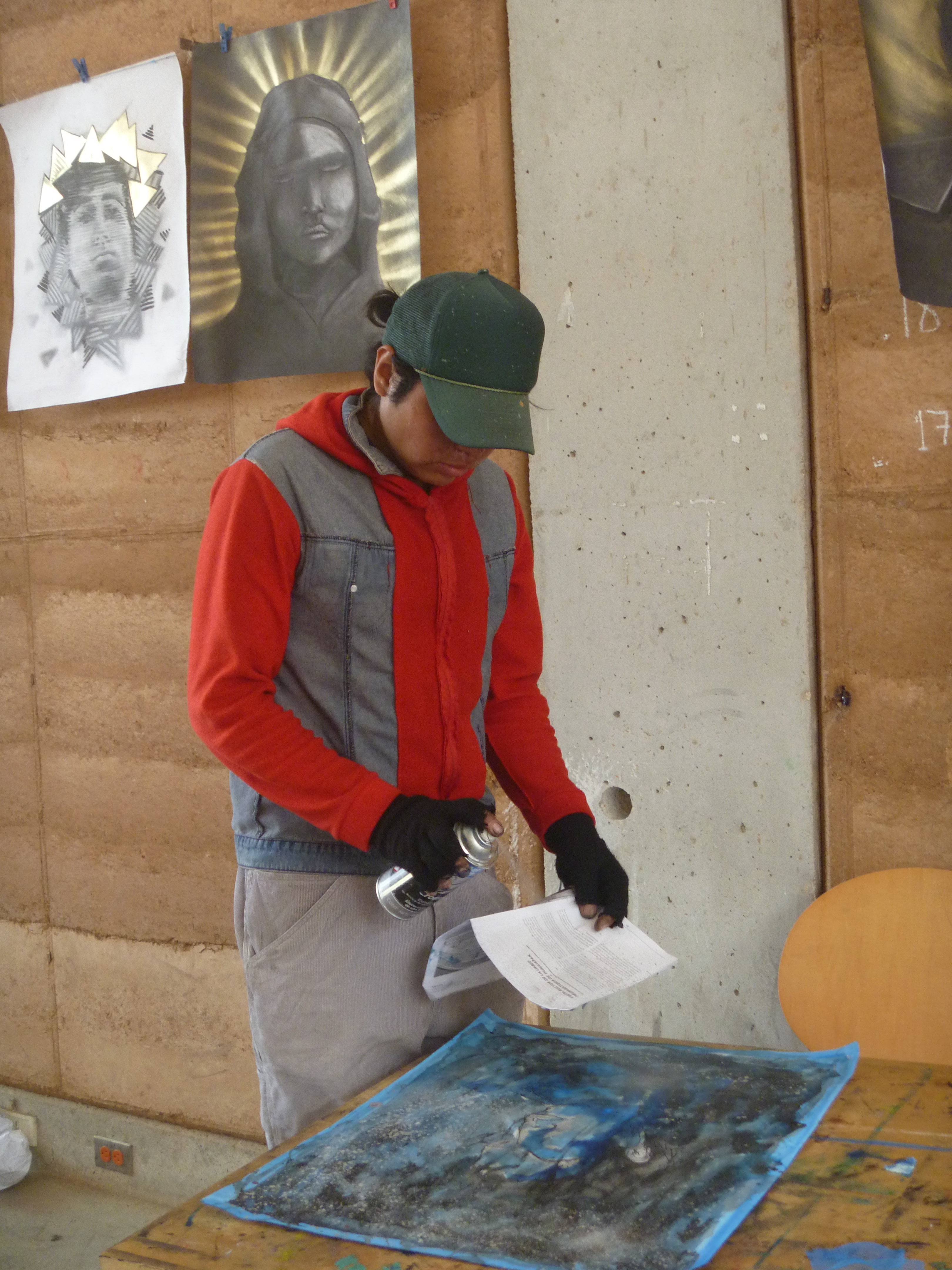
Oaxacan student at work using a piece of comb to draw.

I had one sample of PanPastel to share. Paper-mache, -they got plenty, but gold leaf is out of the question. Here in Mexico, even india ink is a luxury item for art students. The india ink I carried down leaked in my luggage on the plane (stuff happens), so we substituted diluted acrylic paint. The class was over-enrolled, so I went to the Oaxaca’s central market to get some more combs.

Carter at work.

The Oaxacan students watched portions of Marshall’s sacred monkey drawing demos each morning with rapt attention. Then we adjourned to the gallery for our drawing workshop. We substituted powdered graphite for PanPastels to recreate Marshall’s subtractive drawing exercise. The results were, of course, far less colorful, but we managed to explore the process. For our gold leaf halos, Cesar Chavez lent a can of gold spray paint from his graffiti supplies.

We had a great mix of students, from teaching assistants to street artists, and the results were amazing. For me, it was a wonderful experience. Artists and teachers are held in high regard here in Mexico. Oaxaca, in particular, is a mecca for the graphic arts. I was interviewed on radio, TV, and both daily newspapers. If you read Spanish or want to view a slide show of the workshop check this story in Noticias.

By the way, this is not the first time Marshall Arisman saved me. Long ago, when I applied to SVA’s MFA program I didn’t have my Bachelor’s degree. Marshall let me in on one condition: that I complete my Bachelor’s pronto. He changed my life, for the better.

KU Print Show travels to Oaxaca, Mexico

Good news from Mexico! Our shipment of 28 prints arrived safely in Oaxaca, Mexico from Kutztown, PA. The self-portraits in a wide variety of media (including woodblock, etching, serigraphy, and lithography) will be exhibited at Benito Juarez University in the month of July. The prints are by Kutztown University faculty, students, alumni, and friends.

Self-portrait, a Lithograph, by Prof. James Rose

Sending prints to Oaxaca seems odd, like sending flowers to Longwood Gardens. Oaxaca has a great tradition of printmakers from Rufino Tamayo to Rodolfo Morales. Living artists Damian Flores, Shinzaburo Takeda and the ASARO collective continue the tradition. Oaxaca’s best known printmaker is Francisco Toledo. His IAGO, Institute of Graphic Arts of Oaxaca, is the largest public print collection in all Latin America, and a mecca for printmakers.

The Resurgence of Printmaking in the U.S.

Kutztown’s printmaking studio is part of a bigger picture. In recent years many U.S. universities tossed their printing presses to make way for computer labs. Today there is growing interest in traditional printmaking. Young artists are rediscovering the pride and joy of working with their hands. By the way, for dispatches from the trenches of contemporary printmaking there is no better source than Printeresting, and a Kutztown grad, Jason Urban, is one of the creators of that site.

Fortunately, Kutztown University’s printmaking studio thrives under the leadership of Prof. Evan Summer. Evan has won international acclaim for his etchings. The studio is also equipped for lithography taught by Prof. James Rose. Evan opens the studio to visiting artists whenever he can. In 2011, Cesar Chavez of Oaxaca came to demonstrate Oaxaca-style woodblock printing. Cesar was impressed by the artwork he saw and suggested this exhibition to continue the artistic exchange.

This slideshow requires JavaScript.

There are prints by KU Professors Evan Summer, James Rose, Miles DeCoster, Kevin McCloskey, and Elaine Cunfer. More are by grads and current students. Pennsylvania is not that different from Oaxaca in one respect. Rare is the artist fortunate enough to make a living from her art. Some KU printmakers are teachers. Others work in shops or offices. Our most recent grads may still be looking for meaningful work. However, all maintain a passion for self-expression through the enduring medium of printmaking. And we are grateful to Cesar Chavez and the Escuela de Bellas Artes, UABJO, for this opportunity to share our art with the people of Oaxaca.

Near Oaxaca?  Visit the exhibition at UABJO, University of Benito Juarez Centro Cultural on Avenida Universidad. Opening Reception: Friday July 6, 7pm. Free and open to the public. The exhibition runs to the 19th of July. If you are not in Oaxaca, you can get an idea of the variety and quality of KU prints from the slide show above.

Sweet Salvation

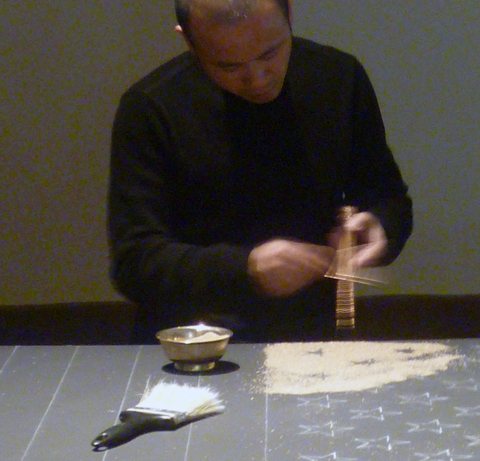
Jiawei Gong made an American flag from sugar at the Reading Public Museum. This art work, created in early June, will be on view until July 8. Tibetan monks traditionally use colored sand to create mandalas, often composed of circular shapes based on Buddhist cosmology. Jiawei is not a Tibetan monk, he is a Chinese-born Professor of Fine Art at Kutztown University. This is not a traditional mandala, nor a traditional stars and stripes. The 50 stars are white sugar. Dark and light brown sugar replace the blue field and red stripes.

Jiawei’s tools are authentic. He briskly runs a metal rod along a long fluted copper funnel filled with sugar. The right level of vibration sends sugar grains spilling consistently from the funnel’s tip. Jiawei allowed visitors, including me, to try our hand with these tools on a second platform. His wife Wen assisted him ably, but I found the process is not as easy as it looks.

Jiawei Gong assisted by his wife, Wen, working on Sweet Salvation.

I asked Jiawei about the meaning of the work. He told me to look at the words on the wall. I looked at the museum wall expecting to see a statement.  “Sweet Salvation” -is all it says on the wall. Jiawei, I think, wants each viewer to come away with their own meaning. Sweet.

More of Jiawei Gong’s work can be found at www.jiaweigong.com

Invite to Type Book Launch

Kutztown University Prof. Denise Bosler wrote our most popular guest post, Making it as an Illustrator.  She also knows a heck of a lot about typography and wrote the new book, Mastering Type, published by How. How is hosting her webinar, a virtual book launch, for Mastering Type on Tuesday, June 19 at 3pm. It is free, just register here.

I got an advance copy of the book. It is profusely illustrated with great work from designers around the world. For me it is exciting to see the inclusion of so many fine designs by Kutztown grads. There are award-winning works by star graduates: Jason Santa MariaSean CostikRoss Moody; and Amanda Geisinger.

Award-winning Middletown Lumber logo by Sean Costik

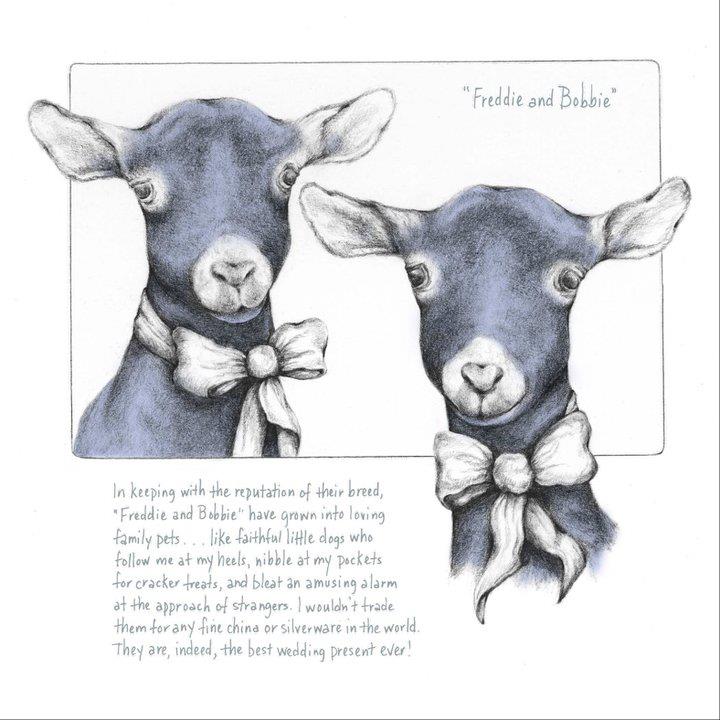
There is also art by recent grads including Cheryl Sheeler. The image below is from Cheryl’s visual essay on a most unusual wedding present – a pair fainting goats. This image was used in the book to demonstrate how hand-lettering can be an intrinsic part of an illustration.

Artwork © 2011 Cheryl Geiger Sheeler

If you can’t make virtual book talk, well, get the book, Mastering Type: The Essential Guide to Typography for Print and Web Design. There is a free online excerpt here.

STAN MUNRO Artist & Toothpick Engineer

I met Stan Munro at the Reading Museum. He is an interesting guy. He was seated in the center of the museum’s lobby with a case of toothpicks and a container of Elmer’s glue. He was building the Eiffel Tower.

Stan Munro at the Reading Museum, sketch by Kevin McCloskey.

Families came to watch him work. Sometimes Stan handed wide-eyed kids wooden nickels he had individually handcrafted from toothpicks. Kids love his work. When Stan was in 5th grade at Wayland Elementary School in upstate New York, his art teacher gave the class a toothpick assignment. They were challenged to build a protective tower for an egg. Not everyone took the assignment as seriously as Stan. His tower, he says, “was basically a three-story pagoda form, about ten inches tall, built with lots of triangles, strong shapes.”

Maya Temple, Chichen Itza, Yucatan, Mexico

Some kids balanced books on top of their egg holders. Around the room eggs were cracking as Stan worked on. He finished his pagoda and placed it on the floor beside his desk. Stan put a book on top of his tower and it didn’t even creak. Stan piled on all his 5th grade textbooks. It still held. Then came an “aha moment.” With help from classmates Stan lowered his overturned desk onto his toothpick pagoda. It held. The crowd went wild.

King Hassan II Mosque, Casablanca, Morocco (detail) by Stan Munro

That was over 25 years ago. Stan still remembers that moment as the highlight of his school career. Stan did not study toothpicks in college. He went on to become a journalist. He married a doctor, the love of his life, Suzi. One day, Suzi became very ill. She became bedridden with a rare kidney and liver disorder. Suzi was put on a waiting list for organ transplants. She was able to stay in their home much of the time, but needed specialized hospital equipment in the house, including a dialysis machine. Stan gave up his jobs to stay by Suzi’s side.

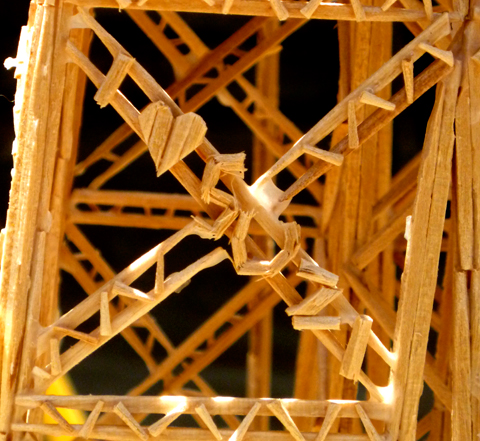
Sometimes he got frustrated. What could he do? Suzi had heard the story of Stan’s pagoda many times. She asked Stan to build her a toothpick tower of her favorite skyscraper, New York’s art deco masterpiece, the Chrysler Building. Stan remembers this as the most difficult thing he ever built. By trial and error Stan found the right sort of toothpicks (square with round ends) and the right sort of glue (Elmer’s).

“I ♥ Suzi.”

Stan also rediscovered the path of his life. He began building toothpick towers from around the world.  “Towers are easy,” he says. Next he began creating toothpick temples, sacred buildings, from all cultures. Somewhere on every piece Stan leaves his mark, not his signature, but “I ♥ Suzi.”

The Vatican by Stan Munro and The Raising of Lazarus by Tintoretto.

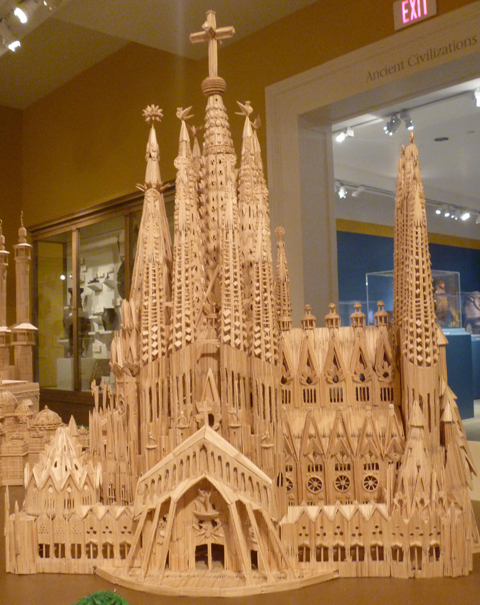
Stan told me he is most proud of his version of Barcelona’s Catholic cathedral, Sagrada Família, the Sacred Family. The architect Antoni Gaudí worked on this church from 1883 until his death in 1926. The actual Sagrada Família is still under construction. It may not be completed for years. Stan based his finished toothpick cathedral on Gaudí’s original sketches, even though present-day architects have been accused of altering Gaudí’s vision.

Toothpick World opened last week and will be on view at The Reading Public Museum through the end of 2012. There are toothpick towers and temples throughout the museum. The Reading Museum is to be applauded for the brilliant placement of the toothpick St. Peter’s Basilica in front of Tintoretto’s Jesus raising Lazarus. It is inspiring to see the myriad houses of worship side by side. The Little White Wedding Chapel in Las Vegas stands beside Mecca’s Grand Mosque. Jewish, Muslim, Protestant, Catholic, Baha’i, Maya, all coexist peacefully in Toothpick World. Watching Stan build the tower in the lobby I noticed how he controlled his breathing for the delicate placement of each gluey toothpick. His measured breathing is a sort of meditation. His towers, especially his temples, are visible manifestations of his meditations. Is it too much of a leap of faith to call these towers visible prayers?
Stan Munro’s Sagrada Família, Barcelona, Spain, original by Gaudí.

Stan is clearly a storyteller, a visionary, an educator, and a business man with a plan. Toothpick World, LLC, is a traveling exhibit corporation. I asked Stan if he thought of himself as an artist. “Artist? –No,” he said, “I call myself a toothpick engineer,” and he handed me his card.
Stan Munro’s business card.

In my book, Stan Munro is an extraordinary artist. By the way, he can travel more now because Suzi is doing much better. She got double organ transplants at the Mayo Clinic, and her surgeons say that her recovery is nothing short of miraculous.

For more info visit: www.toothpickworld.com

Take a Line for a Walk

“Whereas Picasso, Matisse, even Mondrian and Kandinsky concentrated on abstracting from perceived reality, Klee began with a point, extended it into a line and famously took it for a walk wherever it wished to go.” Bridget Riley from an essay quoted here in the London Times Educational Supplement.

Robin Landa, a design professor at Kean College in NJ sent me a copy of Taking A Line for a Walk: A Creativity Journal. It is designed by Modern Dog. It is got me thinking about the nature of blank books.

Blank books and sketchbooks like the famed Moleskine, for example, are not cheap. Walk into a Barnes and Noble and in the Remainders area you will find novels and nonfiction books for a fraction of the price of sketchbooks. These are hardcover books, tightly bound, some with high quality rag paper, – unread, unopened books. Some of these may be brilliantly written, but the publisher misjudged the market for the title, or the marketing department didn’t support the release. I’ve seen folks gesso the pages of printed books to turn them into blank books.

The Reader Experience as User Experience

Taking a Line for a Walk is a ‘not-quite blank’ book. It has just enough inspiration on each page that the reader, or user, in this case, is not faced with the paralysis a blank page can bring. There are prompts from great artists and designers like Stefan Sagmeister. Notebooks are very personal things, even before you make a mark in them. If you enjoy taking cues from other creative types, or if you prefer going in the total opposite direction from creative prompts, this might be the book for you.

WILCO buys Brian Shaw’s Art for Gig Poster

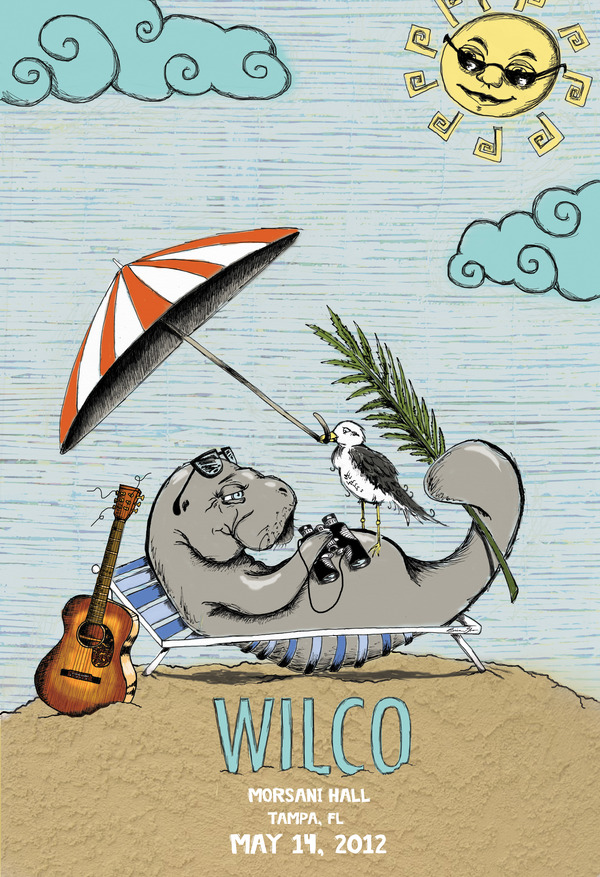
Brian Shaw graduated a few weeks ago, winner of the 2012 Don Breter Memorial Award for most improved illustration student. He drew a series of gig posters for his senior illustration class. He asked me how he might get them in front of the eyes of Wilco, one of his favorite bands. I didn’t know, but Scotty Reifsnyder, a successful illustrator and KU alum did a poster for Wilco once, so I asked Scotty to take a look at Brian’s work.

Brian writes, “This opportunity was a dream come true for me. Not only did I get to illustrate for a band, but for one of my all time favorites, WILCO! I never in a million years thought I’d get this lucky. I owe all my thanks to Kevin McCloskey and Scotty Reifsnyder for helping to set up this opportunity! Scotty was extremely encouraging and offered very helpful information to point me in the right direction. Perhaps the most helpful tip was to be patient and determined! Though you may not find the work right away, keep trying and eventually something will present itself.”

Wilco printed 145 limited edition, 18 by 24 inch, prints, all signed by Brian. Brian was paid a flat fee of a few hundred dollars and he got to keep the first 15 prints for sale. When those run out, they are available for purchase from WILCO’s store for $25.

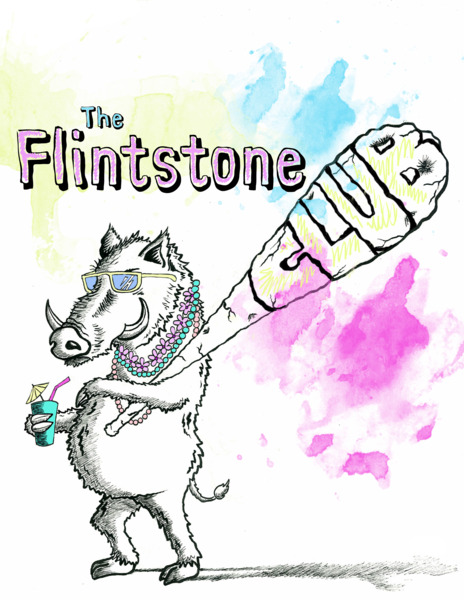
Rock gig posters are a natural fit for Brian, “When I’m not drawing, I’m playing drums in my band, The Flintstone Club.” To see more of Brian’s illustration and design work, or to contact him about buying a signed print, visit his web site. 

Artwork for his own band, The Flintstone Club, © 2012 Brian Shaw