Amanda & NICK win an Emmy!!!

WE WONNNNNNN AN EMMMMMMMYYYYYYY!!!

SpongeBob© Copyright 1999 Viacom International Inc.

I hate Facebook posts with multiple exclamation points !!!  It should be up to the reader to decide how excited to become by reading an exclamatory sentence. Yesterday Amanda Geisinger, a Kutztown grad and Interactive Designer at Nickelodeon posted: WE WONNNNNNN AN EMMMMMMMYYYYYYY!!!  OK, OK, I am willing to make an exception for major awards. Amanda has every right to be excited. She helped create the EMMY award-winning NICK App!!!

Nick app screenshot.

Amanda by Amanda
Amanda by Amanda

I last saw Amanda by chance on a Bieber bus to NYC in April. I asked her if she was still working with Spongebob. She told me yes and that she had just begun making her first app. When I heard the NICK App won an Emmy I wrote to ask for details.

Amanda writes: “Yup, this is the app I mentioned, ha! Our team is pretty big; the design team has about 20 members, and Nick Digital {which includes departments like ad sales, digital marketing, content and programming, engineering, product development, production, etc.} is maybe 130-ish in total. My team that started on the initial style guide {which has evolved dramatically} was pretty small, but the endeavor was so large that pretty much everyone has participated in the development in a significant and meaningful way. A lot of us are still involved in the daily content updates. We also enlisted the help of an outside vendor, Fantasy Interactive.”

NickSwipe

So Nickelodeon Digital’s EMMY is for: Outstanding Creative Achievement In Interactive Media – User Experience And Visual Design. I thought EMMY awards were only for TV shows. This is the first year Emmy jurors are celebrating not just traditionally formatted content, but cutting edge “next generation” content such as apps. The EMMY site notes the Nick App goes “beyond a typical app that offers free video viewing and instead offers more interactive content, games, and video — whenever and wherever the user wants it. ”

Special Offer for readers of the illustration concentration blog: the Nick App is available FREE, Here!!! I’m kidding about the special part, the app is free everywhere. In fact, the NICK app has been ranked #1 free entertainment app for the Ipad. It is also available for Iphone, Windows 8 and X-box. Congrats, Amanda.

"Be a Rainbow" detail © Amanda Geisinger
“Be a Rainbow” detail © Amanda Geisinger

Above is a sample of Amanda’s happy illustration style. To see more of her work visit: www.amandageisinger.com

Thieves at Etsy: SpecialPrints

Picture 2

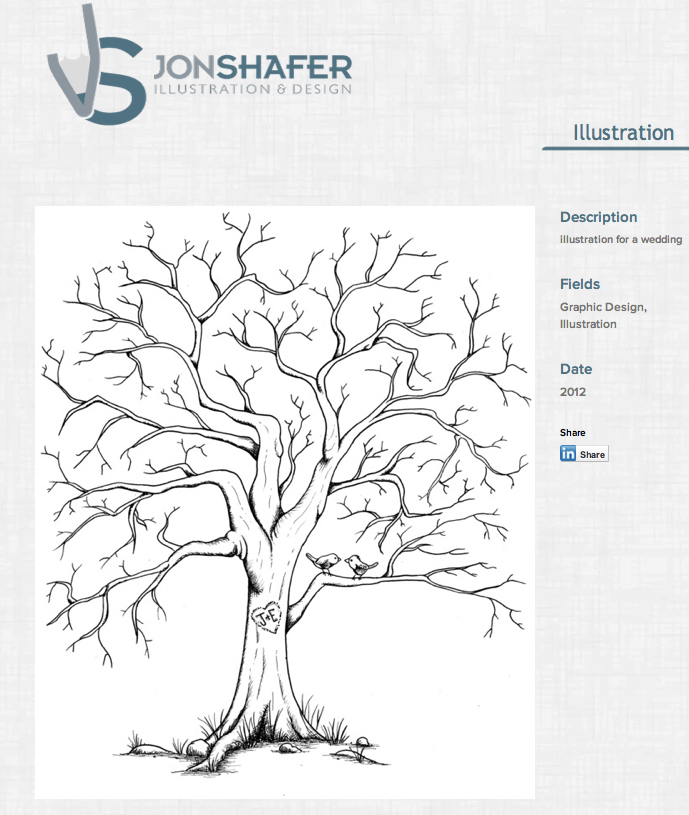
Jon Shafer is a recent KU illustration grad. He found this cute print on sale on Etsy. It seemed familiar because he drew it over a year ago. Below is Jonathan’s original art as featured on his web page.

Original wedding tree art © Jon Shafer, 2012

Jon wrote to SpecialPrints. I asked him to keep me posted. “She said she found it on google and loved it so much she ‘redrew it by hand.” She also claimed the site she got it from did not have anything about copyright listed. She even asked Jon Shafer to send her his Library of Congress certificate of copyright.

Clearly she is in the wrong.  According to the U.S. Copyright office, “Copyright exists from the moment the work is created.” In fact, SpecialPrints went so far to claim copyright to Jon’s original image:Picture 3

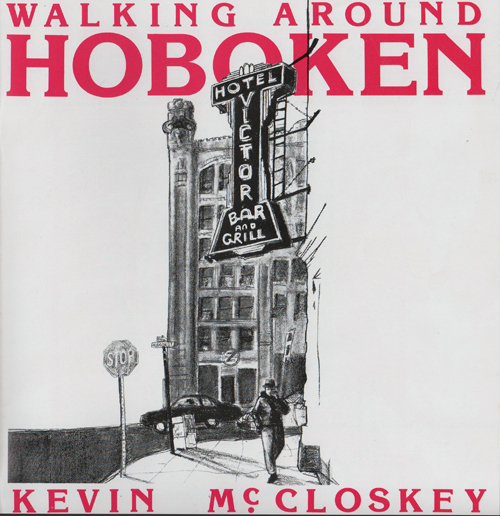
My personal experience with copyright violation ended well. In the 1980’s I lived in Hoboken. I made an illustrated map of the town and included Frank Sinatra’s birthplace. I found my map in a book, The Frank Sinatra Scrapbook, published by St. Martin’s Press. I called the Society of Illustrators to ask for a lawyer referral, they suggested Harry Devlin, son of the illustrator with the same name. I remember Mr. Devlin warning me, “You aren’t going get a house out of this. ” I asked, “Can I get a refrigerator?” He said, “Frost-free!”

 Walking Around Hoboken © Kevin McCloskey
Walking Around Hoboken © Kevin McCloskey 1986

Mr. Devlin got a thousand dollars from the person who infringed on my copyright. In my case, the attorney got one-third of the payment, so I got the diabolical amount of $666. Like Jon Shafer, I had copyright at the moment of creation. If I had gone to the trouble of actually registering the copyright with the Library of Congress, then the offending party would have also been liable for Mr. Devlin’s fees.

To see more of Jon Shafer’s art visit www.jonshafer.com.

FYI: Etsy does have rules against this sort of infringement. They say, in part, “Repeat offenders will have all material removed from the system and Etsy will terminate such Members’ access to the service.

Free factual info on copyright from the U.S. Copyright Office is here.

UPDATE  8/23/13: 

Sent by Jon Shafer:  Just to follow up a little. That lady took it down. For now at least. I contacted Behance about how this link is getting to my image. After countless emails. They’ve established it’s going into their image folder and finding it. But on my end if I delete or modify it. The link still goes to it. So you might want to warn your illustrators. To water mark everything or take angled shots of work. Not perfect scans. Even on their websites unfortunately.


Opportunity Knocks: Grab Bag for Illustrators

art © 2013 Alabaster, previous SAW min-grant awardee
© 2013 by  Alabaster, previous SAW mini-grant awardee

The Sequential Arts Workshop, SAW, in Gainesville, Florida is once again offering two mini-grants of $250 to artists working on a comic or graphic novel project. True, this is not a lot of money, but if you need to buy time to work on your art every cent helps. What I like about this grant is that the runners-up get honorable mentions with pithy advice from the experts at SAW. To apply and view past awardees, see SAW, here. The image above is by Alabaster who is working on a project called Mimi and the Wolves.

head2

Are you an illustrator, designer, app developer, hand-letterer who breaks the rules? Here is an opportunity to strut you stuff. KU Prof. Denise Bosler is doing her second book for HOW, it is called Creative Anarchy. Submit your best rule-breaking designs here.  She’s looking for zines, T-shirts, custom type, under-the-radar marketing, -you name it.

That reminds me. When I was kid I studied art with a teacher in her basement studio in Elizabeth, NJ. She had two rules for artists. 1. Never use a ruler. 2. Never make a head larger than life-size. This was around 1960. The next big movements is art were OP Art ( rulers!) and Pop Art  (think Warhol’s oversized portraits.) So, break those rules!

Collage illustration © Stephen Knezovich
Collage illustration © 2013 Stephen Knezovich, see below.

Looking to launch a career as an illustrator, but haven’t got that first publication? Check out Poets & Writers’ expansive list of literary magazines. There are hundreds of listings.  Some are university related, many pay only in copies, but this is a way to build your portfolio. The P&W site can be searched using the subgenre: Graphic/Illustrated. I’ve just done that, and after a few dead ends, found a magazine that I’ve heard good things about, Creative Nonfiction. I clicked through and interestingly enough Creative Nonfiction includes an interview with writer and collage-illustrator, Stephen Knezovich.

supermag_coverlo

GRANTS ARE NOT JUST FOR “FINE” ARTISTS

At one time, art grants were not worth the trouble of an application if you identified yourself as an” illustrator.”  The prejudice may have  evolved since there is/was a market for illustration, so grant moneys were reserved for the fine arts. That’s changing. Pittsburgh illustrator Jim Rugg has gotten several grants including a Creative Development Grant from the Pittsburgh Foundation to pursue his illustration and design experiments. His latest project, Supermag, above, has been getting rave reviews.

IS YOUR PASSPORT IN ORDER?

The College Art Association has an Opportunities page that includes Grants, Residencies, and Calls for Entries for exhibitions. You need not be a CAA member to access the site. How about an Artist’s residency in the U.S or abroad? Nowadays “graphic artists” are considered for these opportunities. Places to look include Mira’s List. Mira’s web site is a bit dormant, but you’ll get her latest updates via her Facebook page: www.facebook.com/miraslist.  Two other searchable sites for grants and residencies are ResArtis and Trans Artist.

8699705514_cf238ebe99_b

Lastly, if you are a printmaker… And, in my opinion, all illustrators should become familiar with the basics of printmaking. You can search the term “Call for Entries.” Check the links page on McClain’s Printmaking Supply Company web site. I just entered an International Print Exchange at La Calaca PressDeadline extended to Sept. 30. The exchange and exhibition honors Mexican illustrator Jose Guadalupe Posada’s centennial. 2013 is the 100th anniversary of his death, not birth, but this death centennial celebration makes sense as Posada is so closely associated with the Day of the Dead. He created Catrina, Mexico’s most iconic calavera (these skeleton characters are also called calacas.)  I will leave you with my entry in the La Calaca Print Exchange, a silkscreen print of Posada as puppet.

Feliz Cumpleanos Posada, silkscreen on paper © Kevin McCloskey, 2013

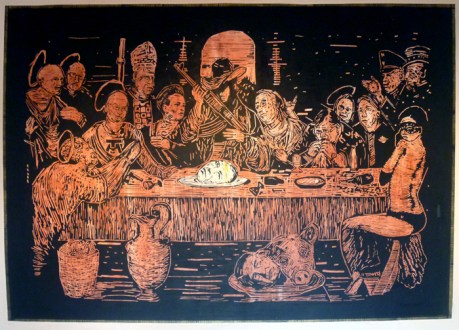
“The Last Supper” by Yescka, Oaxaca

Yescka has a grand mural on a full wall in the Museum of Contemporary Art in Oaxaca. It’s his take on the Last Supper re-imagined Mexico style with Narco-trafficers, cops, politicians and a stripper. I knew him when he was running around pasting his work to walls without permission, risking a beating or arrest.

The Head of Benito Juarez, detail from the Last Supper, stencil and paint.

I met Yescka in 2007 in Oaxaca, and know his real name. He asked me what I thought of his street name of Yescka. I said to English speakers it might sound rather feminine, like Jessica. He laughed and shrugged. I asked if it came from an indigenous language, maybe Zapotec or Mixtec? He told me he made it up from ‘calles’ (streets) backwards. I said calles backwards, sellac, would sound like “Sayack.” He told me it wasn’t exactly backwards, but syllables reversed.  At the time Yescka was one of the younger members of the ASARO collective. He was often in the company of a beautiful young European woman, or two.

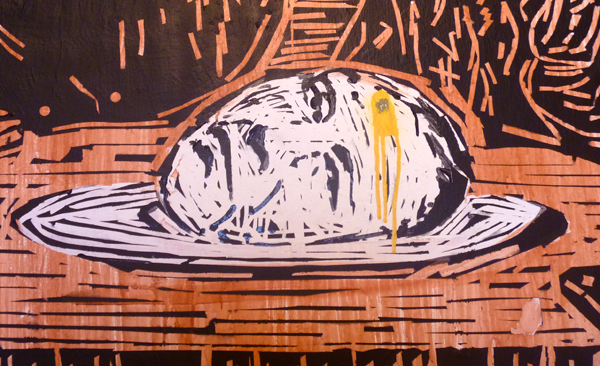
Marcha, 2007, detail, woodblock print, ASARO, attributed to Yescka

ASARO, the Assembly of Revolutionary Artists of Oaxaca, is a collective founded in 2006. ASARO’s art belongs to Mexico’s long tradition of revolutionary public art. Back in 2006, they sold woodblock prints for 100 pesos, roughly $10, in Oaxaca’s public square. ASARO’s real passion, however, was the work they give away.

Stencil graffiti, ASARO, 2007. Oaxaca cathedral

Overnight they cut stencils of an arrested comrade, the next morning her portrait was sprayed all over the walls of the historic city. They would print 3ft. tall woodblock prints of goose-stepping police monsters on tissue paper. By dawn a chorus line of mutant policemen would be pasted on walls of the cathedral or Governor’s Palace. I was lucky enough to spend time with ASARO in their studio. I remember meetings where heated discussions took place. Yescka would calmly weave around the room, always painting, sketching, making collages and popping into the conversation. He made some of ASARO’s most distinctive political prints. In those days, they were unsigned.

Taller Siqueiros, Yescka's studio and gallery, Calle Porfirio Diaz, Oaxaca.
Taller Siqueiros, Yescka’s studio and gallery, Calle Porfirio Diaz, Oaxaca.

As ASARO’s fame grew Yescka began doing more personal work. He travelled to Art Basel, to Munich and Oakland leaving a trail of street art along his route. Today he has his own studio in Oaxaca, Taller Siqueiros, named in honor of the radical 20th century Mexican muralist.

Masked Grafittero, Azompa
Masked Grafitero, Azompa, 2009

AZOMPA, 2009.
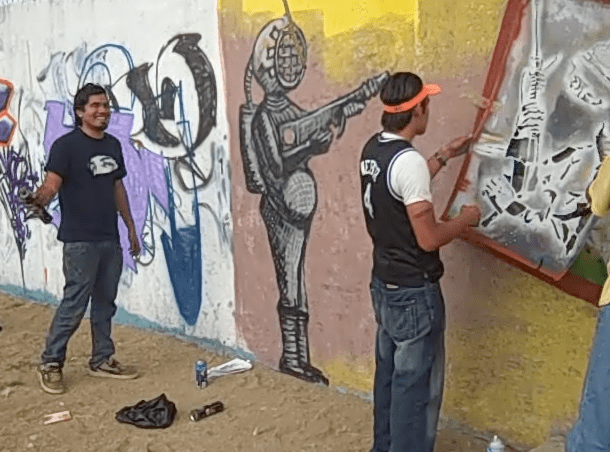
One day in the town of Azompa, near Oaxaca, collectives from across Mexico came to paint murals on the walls of the municipal basketball court. Azompa was once a small village known for green clayware; today it’s an overcrowded suburb of Oaxaca City. There was a screamo punk band playing at one end of the ballcourt. The lead singer had a head like a bull and wore tire chains over his shoulders. The municipal police roared up in pick-up trucks. Ten blue uniformed police jumped from the truckbeds brandishing clubs; some had sidearms and rifles. They told the crowd of maybe 100 that event was over. The muralists, grafiteros, stopped in mid-stroke. The punk band fled the stage. Yescka who had been stenciling at the far end of the basketball courts, strode through the crowd and took the band’s microphone.

Yescka with ASARO stencil crew in Azompa

The gist of what Yescka said was, “If our music disturbed our Azompa neighbors, we apologize, but WE WILL NOT STOP PAINTING! We will NEVER stop exercising our sacred rights to free expression guaranteed under the Mexican Constitution!” He pumped his fist in the air. “Viva Mexico! Viva la Revolucion! The Revolution Continues!”

The crowd roared in agreement. Yescka went on to say that he was thankful so many important “observers” from Mexico City from other countries were filming the event and nodded to me and cluster of French hipsters with telephoto cameras. Yescka’s speech saved the day. The police commander got on his walkie-talkie. Then he told his men to stand down. By nightfall, there were 20 new murals extending for over 100 yards along the cinderblock walls of Azompa’s ballcourts.

For more info on ASARO: Princeton University’s Library has a great collection of ASARO prints. I wrote about that collection here. If you’d like to know more about ASARO, I have several essays at Commonsense2.com. ASARO maintains a blog, that is occasionally updated. Yescka is on Facebook as Yescka Guerilla Art, here.

New Street Art in OAXACA

Reflejos de Huida, stencil, 2013, Lapiztola.

MACO,The Museo de Arte Contemporaneo de Oaxaca has an exhibition of street art on its walls. Does street art belong in a museum? Well, MACO’s Hecho en Oaxaca spills over into the streets. The artists came from all over the globe, Swoon, The Date Farmers, How and Nosm, MOMO, Retna, Saner, StenLex, and Vhils. Oaxacan artists Yescka, Dr. Lakra, and Lapiztola round out the show curated by Pedro Alonzo.

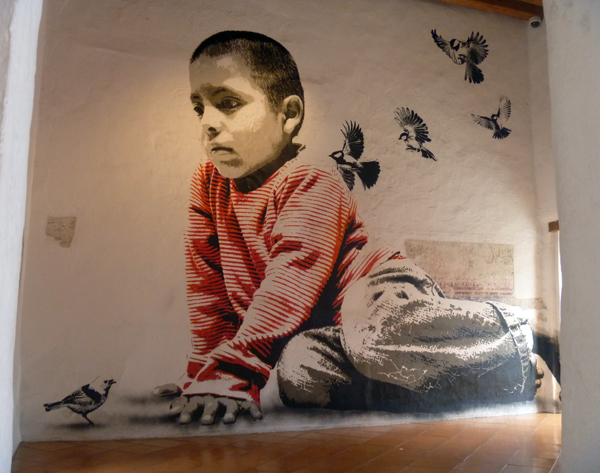
Lapiztola Collective's birds seem escape onto the street
Lapiztola Collective’s birds seem escape onto the street.

I am fond of Lapiztola’s work. I’ve met them, in fact they once let me hitch a ride home with them from a birthday party in the hills. Their stencils are always crisp graphic statements, often they relate to musical themes. I was not familiar with L.A. artist Retna. Retna’s blue wall at MACO (below) titled “Somos los ninos de las manos manchadas” translates as “We are the children of stained hands.”

Art by Retna, 2013 Acrylic.

His work resembles Arabic calligraphy. I thought Retna also painted the front of ASARO’s studio, Espacio Zapata, home to a gallery and the cafe,”Atila Del Sur.”  A reader informs me it is the work of Sanez.

Retna, Espacio Zapata, Studio of  ASARO collective, # 519 Porfirio Diaz. Van artist unknown.
Wall by Sanez, Espacio Zapata, Studio of ASARO, # 519 Porfirio Diaz. Van artist unknown.

Dr. Lakra has an untitled mural in the exhibition. It looks to be inspired by Hollywood, Bollywood and cheap whiskey. In Lakra’s case, I prefer his simpler ‘dragon woman’ mural on a wall near Espacio Zapata.

Dr. Lakra, untitled, acrylic and spray paint.
Dr Lakra, Street mural, Porfirio Diaz. Oaxaca.
Dr Lakra, Street mural, Porfirio Diaz, Oaxaca.

Swoon’s project is among the largest artworks in the museum. Like many old public buildings in Mexico the museum was once church property until it was seized by the government. Swoon worked around fragments of painted wall decoration which may date from the 17th century. She turned a high-ceilinged room into a temple of intense female figures. To borrow a phrase, the walls reflect both “agony and ecstasy.” Overall, her imagery evokes a suggestion of hope. I first saw Swoon’s work on a wall in Braddock, PA. She is an inspiring artist.

Swoon, detail, showing fragments of colonial wall decoration.
Swoon, detail, showing fragments of the colonial wall decoration.
Wall by Swoon at MACO, Oaxaca.

Swoon’s outside murals were on prime real estate in the historic center of Oaxaca. I was told the building houses Dr. Lakra’s painting studio. Her works are woodblock prints on kraft paper which are pasted to the walls with wheatpaste. In some places they call these works “throw-ups.” The street artist can unroll the work and throw it up on a wall in a matter of minutes.

Oaxaca Street Art by Swoon, complete with a museum label on right edge.

I will leave you with an image that includes art by Swoon, but it looks to be a collaboration with Retna and perhaps the blue skull is by Dr.Lakra. Next post I will share work by my old friend Yescka.

Oaxaca Street art, Swoon, Retna, and maybe, Dr. Lakra.

Felt Art at CASA, in the state of Oaxaca

20130715-144414.jpg In 2006, when all hell broke loose in Oaxaca, and the streets were filled with tear gas, Jesus ‘Chucho’ Martinez was a founding member of ASARO, a radical printmaking collective. Today he works 6 days a week in what may be the most beautiful location for an art workshop. CASA’s Taller de Fieltro, the felt studio, is located in the power room of an old textile mill near Oaxaca. One entire wall is open to the mountain view.

20130715-150214.jpg CASA or the Center for the Arts at San Augustin was founded in 2006 by Maestro Francisco Toledo to be Latin America’s first center for ecology in the arts. The 1883 factory was lovingly restored by architect Claudina Lopez Morales. It has galleries and classroom spaces surounded by reflecting pools and breathtaking views. Even if there is no exhibition it is worth the 20 minute taxi ride from downtown Oaxaca. For those who read Spanish, more info on CASA can be found here.

20130715-151901.jpg Below is a photo of Alejandra Salgado mixing pure white and blue wool for a felt painting. The taller is working with noted artists including Guillermo Olquin, Irma Palacios, Francisco and Miguel Castro Lenero, Paloma Torres and Jan Hendrix. Also participating is the always outlandish Dr. Lakra, who I wrote about once before. Hey, I just realized Dr. Lakra rhymes with Oaxaca.

20130715-153734.jpg Chucho told me they use the finest lamb’s wool including that from Merino sheep. In keeping with CASA’s code the dyes must be nontoxic. They keep a color chart of over ninety different hues that they mix like paint pigment to match the artist’s palette.

20130715-154421.jpg
Below Chucho and a colleague work out the material list based on the color charts. Despite the lovely surroundings, clearly this must be a demanding job, working with such important artists.

20130715-170918.jpg Here is detail from Dr. Lakra’s project, a tattoed man. Then following is Lakra’s larger work. Following that is glimpse of Oaxaca artist Guillermo Olquin’s art. All copyright on the images belongs to the original artists. I close out this post with a sampling of the remarkable views surrounding the workshop.

20130715-171923.jpg

20130715-172028.jpg

20130715-172120.jpg

20130715-172518.jpg

20130715-172617.jpg

20130715-173156.jpg

20130715-173311.jpg
I believe these remarkable felt artworks will be exhibited in Puebla, Mexico in the near future. When I learn the details of the exhibition, I will update this post.

NOTE: I am blogging from Mexico with my Ipad. It is wonderfully portable, but has its disadavantages. I have trouble adding the accent marks that should appear on some Spanish names. I also can’t caption the photos as easily as I might from a laptop. Sorry.

A Printmaker in Puebla Named Victor Hugo

20130709-080225.jpg
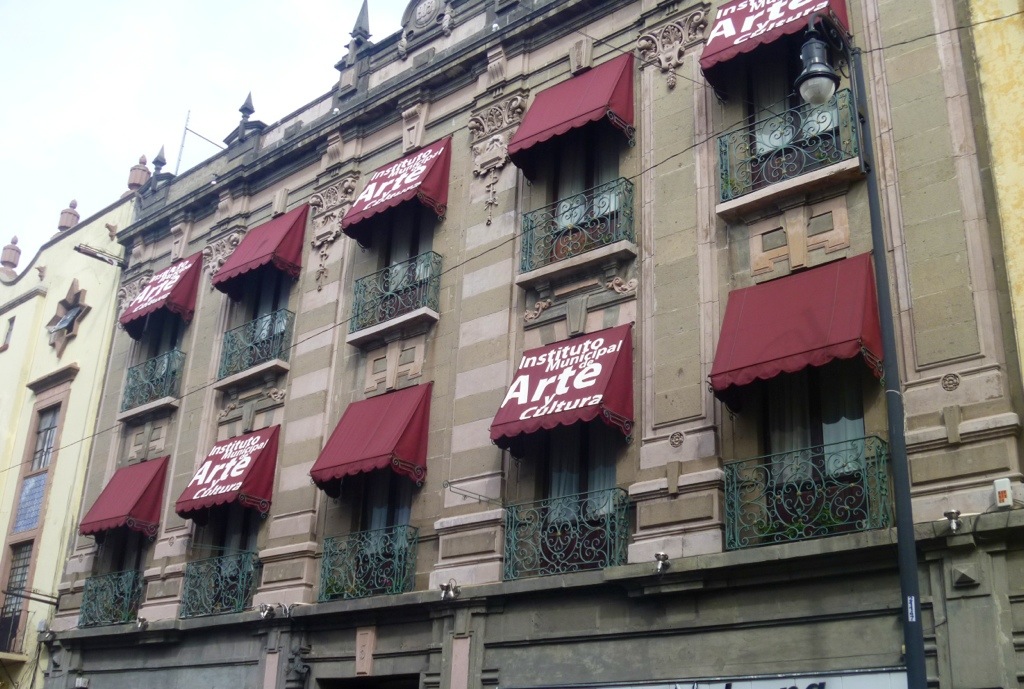
Passing through beautiful Puebla on my way to Xalapa, I stopped to see a one-man exhibition of prints. The artist who I knew as ‘Lukas’ invited me to view his Peregrinajes (Pilgrimages) at the Municipal Institute of Art and Culture. The gallery space does double duty as a classroom. When I entered, the floor was covered with student prints set out to dry. The Gallery Director, Domingo Castillo, apologized, but it is good to see so much artistic activity in the city-run institute.
LUKAS?
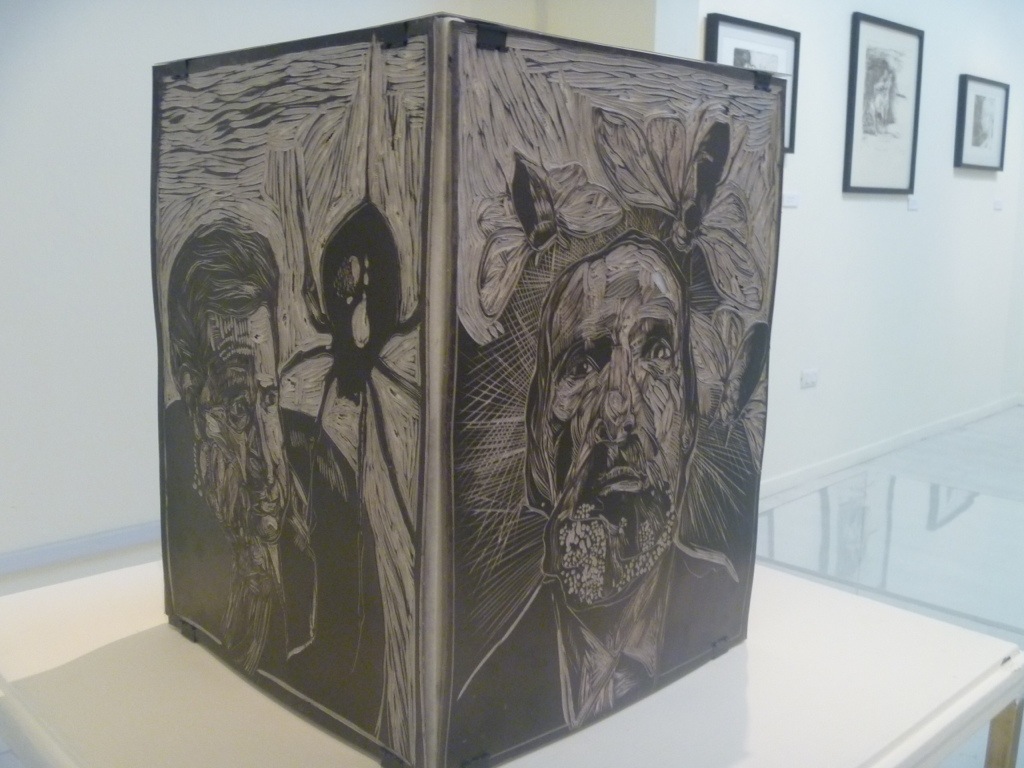
As it turns out, Lukas is his Facebook name, his real name is Victor Hugo Mereno Terrez. Considering the literary references in much of work, his birth name suits hims. There were over 20 works in the show, linocuts, wootcuts, etchings and lithos. He brought even more work to show me, sketches and works in progress carved in plywood and drawn on metal. He shared a process new (to me) Silocografia, a dry form of lithography done on metal. Below is a detail from one such print, La Derrota de Quiron.

20130709-085209.jpg He draws quickly with an ordinary ballpoint on sheet metal. I’ve used a litho pencil on a metal plate, but this ballpoint technique in Victor’s hands retains the remarkable vitality of his drawings. I asked him where he studied. He told he was an autodidact, meaning self-taught. He studied philosophy and letters at college. He has, however, since studied printmaking at tallers, teaching studios, across Mexico including with Maestro Bulmaro Escobar Ramirez and Maestro Per Anderson at La Cieba Grafica.

20130709-094724.jpg
Detail above from a large print, Logos. Additional examples from the work of Victor Hugo Mereno Terrez appear below. Visitors to Puebla interested in prints should visit the Municipal Institute Gallery and also the famed Museo Erasto Cortes, devoted to the art of printmaking.

20130709-100802.jpg

20130709-101035.jpg

20130709-101206.jpg Lukas, I mean, Victor Hugo, is devoted to the printmaking media. He has an upcoming exhibition in the Ukraine and prints in groups shows throughout Mexico. His future as an artist looks bright. If you want to contact him here is his nom de plume, and Facebook name: http://www.facebook.com/lucas.volturno:

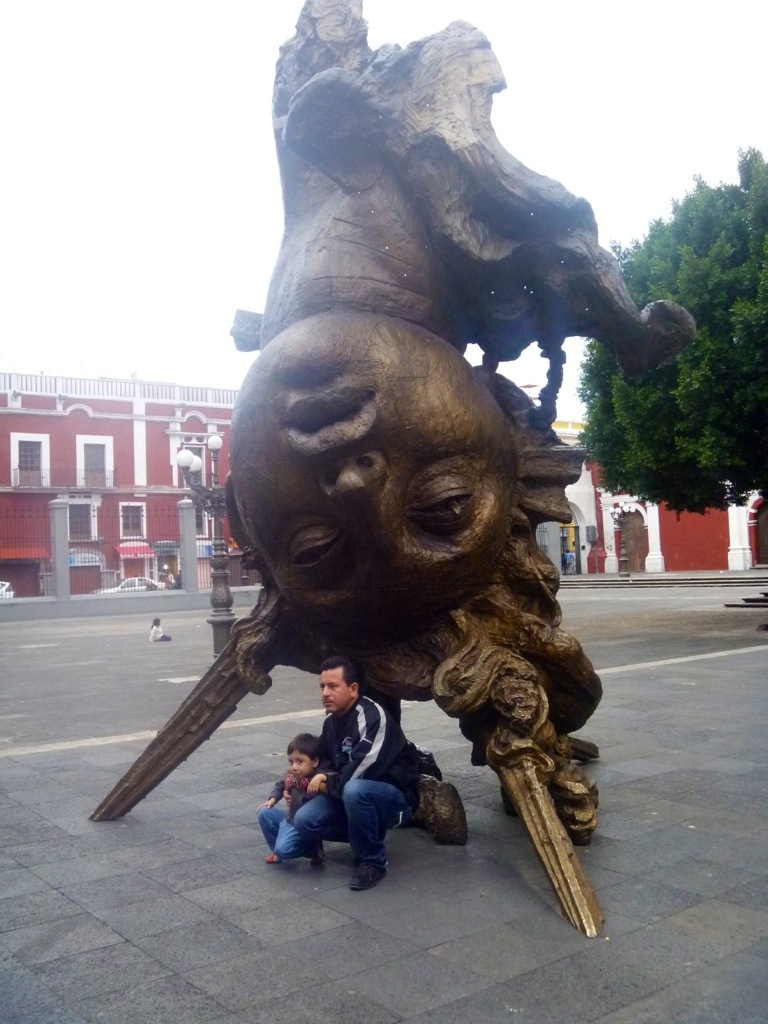
20130709-101839.jpg Finally, to show one more reason to visit Puebla. Pictured below is one of three massive bronzes by the Mexican sculptor, Javier Marin. This one is called Female Head, Chiapas. It stands in the plaza San Geronimo, and is enormously popular with visitors.

20130709-102342.jpg

Muralist Carmen Cereceda worked with Diego Rivera

20130705-213016.jpg
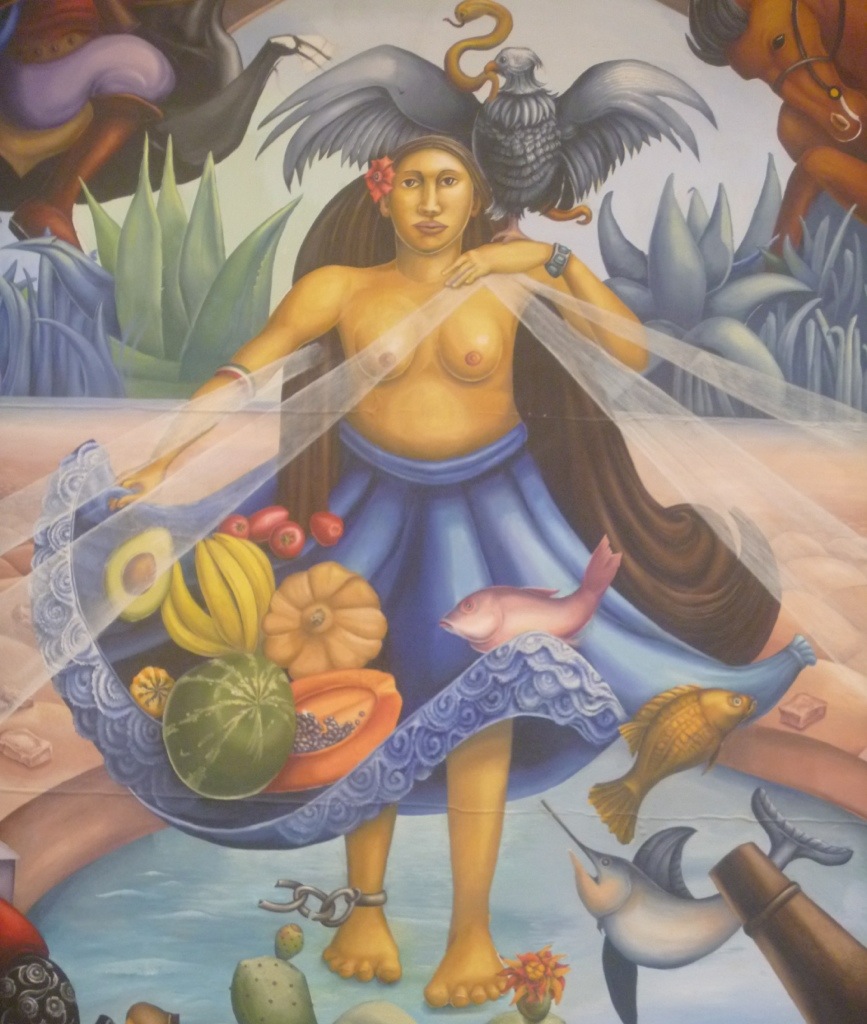
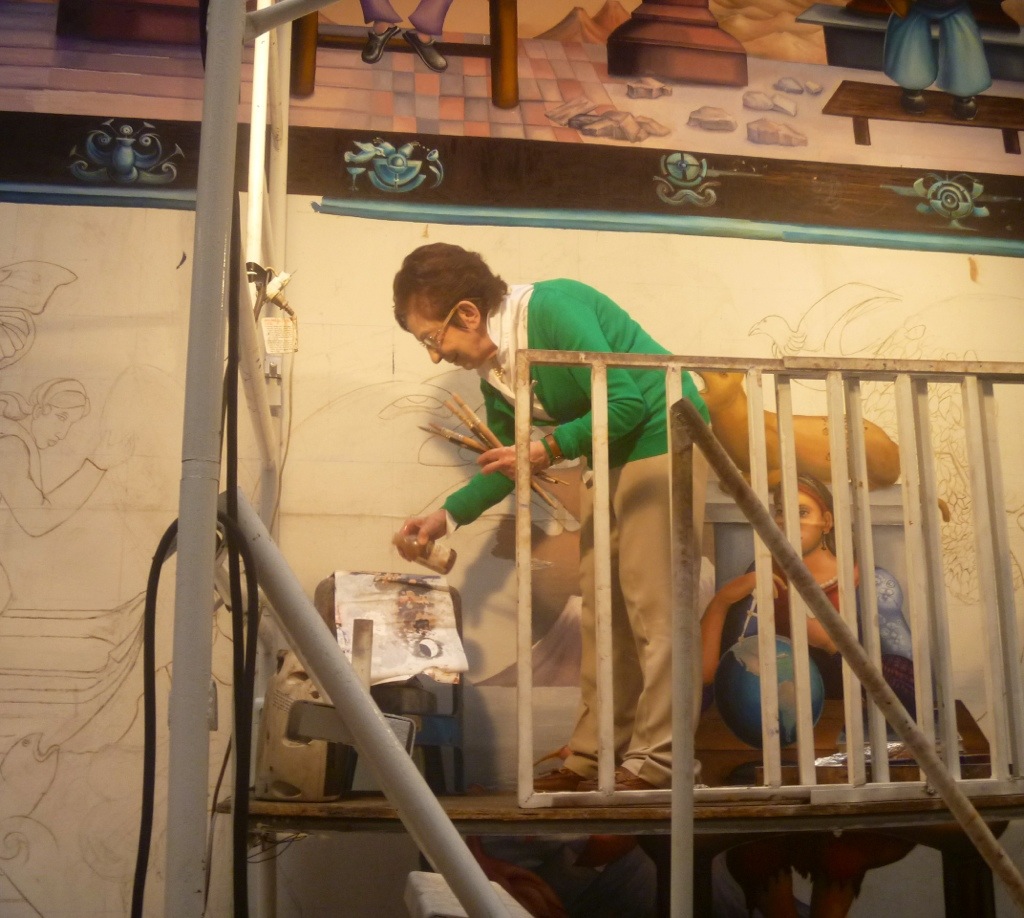
Carmen Cereceda carefully climbed up the metal scaffold in the lobby of a Mexico City office building. From a brown bottle she poured the solvent liquin on her palette of oil paints from the day before. She mixed a middle sepia tone and with long brushes began to paint the face of the sun. She is working on the third and final panel of her massive mural in the SAGARPA building. SAGARPA is Mexico’s Department of Agriculture.

20130705-213135.jpg
By chance, I have a friend named Diego Dobler who works for this office. He arranged permission for me to see Maestra Cerrada’s work-in-progress. Cerrada worked as an assistant to Diego Rivera in the 1950’s. She has since painted murals in Canada, Chile, Cuba and Mexico. She is a lively little woman with a clear voice and bright eyes. I noticed she was wearing green eye shadow to match her sweater. I told her I found it amazing that she worked with Diego Rivera. “Amazing? Why?” she laughed. “He was quite the man. I worked in his studio for four or five months. Not on an actual mural; he was doing research and working on preliminary drawings. There were five of us. Two young men, three young ladies. He treated us like princesses; the boys- he would yell at them, ‘Flojo!’ You know what that means?- ‘Lazy.”

20130705-214559.jpg
When I spoke of my love of Mexican art, she reminded me, “I am not from Mexico. I was born in Chile. Chile may be far in geography, but it is very close in culture to Mexico.” She told me after Mexico’s War of Reform, President Benito Juarez was running the country from a carriage; the capitol moving from place to place. Some people in a small Chilean fishing village said that’s not right and began collecting money. The idea spread to Santiago, and these Chileans raised a good deal of money and personally came to present it to Juarez.

“Then when we had that terrible dicatator, Pinochet, in Chile. Educated people found him unbearable and they fled in exile. Many came to Mexico. The highly educated were given positions here, at UNAM, the university. So Mexico and Chile are close.”

20130705-222115.jpg
The Three Energies is the title of the section she is working on. She pointed out the symbols for wind, solar, and water power. She noted that many murals glorify petroleum, but she wants no part of that. She celebrates only the renewable and clean. The final section will show what she calls the primary energy: young people, educating themselves in revolutionary ways to tranform man, consciousness and society.

20130705-231125.jpg

20130705-231205.jpg
My photos don’t do justice to her mastery of the mural form. To see more visit Carmen Cereceda Bianchi on her Facebook page. While you are there, you might ‘like’ her and her work. I do.

TROKA: Mexico’s IRON GIANT fights Religious Superstition!

Image
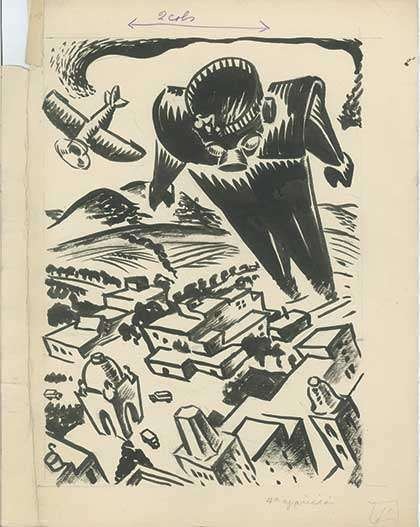
MEXICO, 1930. Before Iron Man, before Iron Giant, Mexico had TROKA. These illustrations come from the Vanguardia en Mexico exhibition at MUNAL, Museo Nacional de Arte, Mexico City.

20130701-165005.jpg
The original illustrations were done in india ink by Julio Prieto in 1934. The quality of Prieto’s brushwork is evident in mural-sized reproductions of his artwork in the exhibition space. Visitors can don headphones to listen to the original TROKA radio dramas aimed at children.

20130701-172459.jpg The listening station is stylishly designed with wood and brass fittings to evoke the 30’s. Museum-goers seem transported by the experience.
According to the wall notes TROKA was the creation of author German List Arzubide. The giant android possessed the logic and intellegence to combat ‘religious superstition.’ …In 1939, a TROKA pantomime dance was created in which popular nursery rhymes and children’s folksongs were rewritten with rational messages. I’m paraphrasing, Spanish speakers can read the full details below.

20130701-173712.jpg In the 1930’s Mexico was deeply divided over the issue of religion. One little-known event that bogles the mind occured in Guanajuato. A Mexican Air Force pilot bombed the statue of Christ atop a mountain there. Some said it was pilot error. The faithful of Guanajuato built a much bigger statue which remains a pilgrimage site to this day.

20130701-180349.jpg Portrait of German List Arzubide by Jean Charlot, 1923. List was a true revolutionary, he rode and fought alongside Emiliano Zapata in the Mexican Revolution. He died in Mexico City in 1998 at the age of 100.

20130701-181554.jpg
The exhibition continues at MUNAL until August 4. Viva TROKA!

New Mural for Kutztown Library

This article originally appeared in “The Gonser Gazette” -the Friends of  Kutztown Community Library’s newsletter.

Mural design superimposed on a photo of the Kutztown Community Library.

The Kutztown Community Library was selected once again this year to participate in Kutztown University’s “Designathon” for non-profit organizations.  Janet Yost, Lisa Schnell, and I presented Kutztown U Communication Design students the tasks of creating a new mural for our library’s outside wall and a brochure to be used for promotion of a new  upcoming children’s program.

The students, with guidance from several professors, had twenty-four hours (non-stop, no sleep) to complete the designs which included some very specific requests on our part.  This was all done with no fee to our library.  Their finished designs are simply fantastic as you will see when the final painting and printing are completed this summer.

KU CD Mural Design Team
KU CD Designathon team after 24 hours non-stop work. Kelly Arsi, Sean Miller, Torrey Smith, Ryan Gaylets, Prof. Elaine Cunfer, Margariete Malenda, and Zack Fogleman.

Wonderful as their work is though, I am even more impressed by the KU students themselves. They were polite and patient as they listened to our needs, enthusiastic about the process, and not the least bit daunted by the responsibility put before them.  And worn out as those artists should have been at the twenty-four-hour deadline, they quite happily presented their finished products to us.  They eagerly awaited our approval, which we gave them whole-heartedly.  Some of them actually offered to help paint the mural for us this summer…..even though they will have already graduated.

In a world where there seems to be so much bad news, these KU students are the good news.  They are well on their way to understanding how important it is to willingly donate time and energy to make a community a better place.  I am happy to know that they, and so many just like them, will be an integral part of the future.  Thanks to all of you dedicated parents and educators who have given them to us.

– Mary Jo Johnson, President Emeritus, Friends of the Kutztown Community Library

Mural detail showing homage to Keith Haring.

Editor’s Note: The break-dancing silhouettes pay homage to the style of Keith Haring, Kutztown, PA’s best-known artist. Turns out his parents are active Friends of the Kutztown Library, and the Harings gave their blessing to this use of imagery based on Keith’s signature style.