Kris Harzinski of the Hand Drawn Map Society will be coming to Kutztown University, Weds. Sept 28, Sharadin 120, 7:30 pm. Event is Free, open to the public & sponsored by our AIGA, American Institute of Graphic Arts chapter. Kris is a Philly-based designer and illustrator. In 2008 he founded the Hand Drawn Map Association, or HDMA. He collects maps that he finds, or that folk send to him and he wrote a book about these curious items for Princeton Architectural Press. I wrote about the HDMA and showed some of this quirky collection including a wild map of Pittsburgh in an earlier blog post, here.
The Hand Drawn Map Association (HDMA) is an ongoing archive of user submitted maps and other interesting diagrams created by hand. Right now Kris is soliciting more maps and wants your mail. A notice on the website states, “In an effort to help increase the physical archive of the HDMA, all postal mail contributors will receive a free HDMA button as a thank-you.” Of course, If you come see him you can show him your map and save the postage.
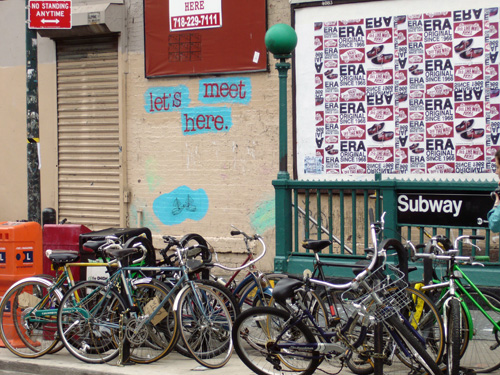
The New York Times 6th Floor Design blog recently featured artwork by Zoe McCloskey which should be familiar to graphic designers. In the image above Zoe takes individual block printed letters to spell out “Lorem ipsum dolor sit…” The Times’ Hilary Greenbaum calls it “the most popular sentence in the world that is not meant to be read.”
To read more about Lorem ipsum, click the link above. You will find a link there to web site, Lipsum.com. To see more of Zoe McCloskey’s wheat-pasted street art check www.zoemccloskey.net. Zoe got an email from the Times’ blog asking to use her image to illustrate this story. Of course, she was delighted. Not everyone is as nice as the NY Times about asking permission to use your artwork.
Everyday graphic designers swipe images without attribution. You can do some things to protect your images. Don’t put images on the web at a higher resolution that 72 dpi. That way, at least you know your work is not likely to be reprinted.
Let people know you care about where your art goes.
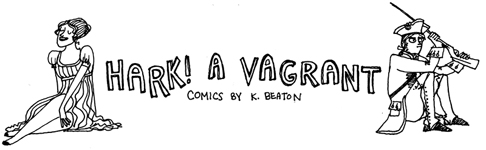
If you have a website, or blog, a place where you put lots of images, let folks know in writing how you feel about them using your work. For example, a student recently pointed me toward a charming historical web comic,Kate Beaton’s Hark A Vagrant. Here’s how Beaton deals with reader’s questions about re-using her artwork.
harkavagrant.com @ 2011 Kate Beaton
Q: Can I use one of your comics for this paper I’m writing/class I’m teaching/blog post I am writing? A: Sure! If you’re not making a profit on it and you cite me correctly, why that’s just fine!
Q: Can I use one of your comics as a basis for this script I’m writing/in my book/my online app/some other enterprise? A: That’s trickier, you may have to talk to my agent, but write to me anyway and outline your ideas, and we can work out fees and rights of use and that sort of thing.
Q: Can I use a drawing for a tattoo or can you draw me a tattoo? A: Oh dear, I am really uncomfortable with this idea! Get an anchor on your bicep, not a fat pony on the small of your back.
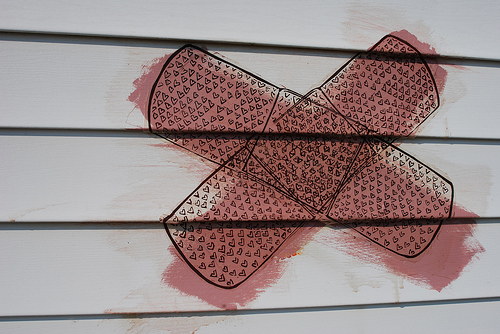
Zoe’s most photographed artwork was from New Orleans’ Lower 9th Ward in the wake of Hurricane Katrina. She pasted bandages over a house that was destroyed by Katrina. More images can be found here. Even though Zoe and other street artists are essentially putting their work out there for free, it still isn’t right to swipe the work without attribution.
“Even if you are just making a neighborhood flyer or obscure blog entry, images can spread like wildfire these days. It’s always the right thing to give credit when due.” – Lincoln Cushing.
Design historian Lincoln Cushing has written extensively about swiping art on his docspopuli.org website. He is particularly angry, rightly so, when artists make money from the swiped images with no respect for the original creator. As he puts it, “don’t contribute to our own historical amnesia.” Here is his essay on Best Practices for using the Graphic Artwork of Others. I recommend it. Cushing shows some practical examples of ways to credit the original artists, even if you can’t contact them, or don’t even know their names.
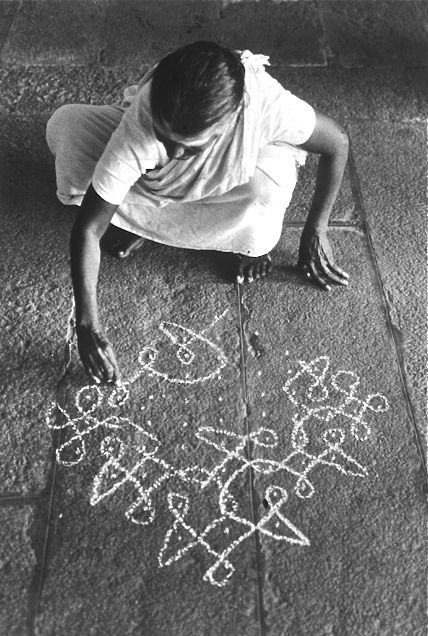
Kolam images from NCC Gallery announcement for Bruce Wall & Josh Miller's exhibit.
The images above are from a postcard that appeared on my desk a few weeks ago. I’d never heard of the Indian art form called Kolam, even though I spent some time in India long ago. Luckily, or perhaps due to good karma, I was able to attend the opening of a remarkable exhibition devoted to Kolam at Northampton Community College.
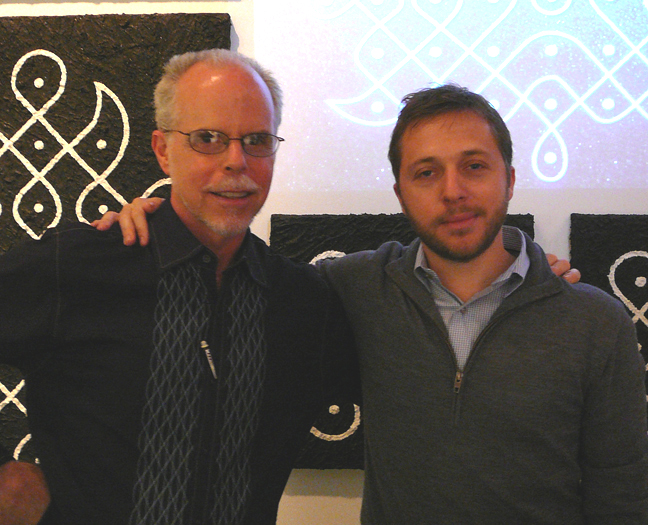
Northampton Professors, Bruce Wall, Fine Arts, and Josh Miller, Communication Design
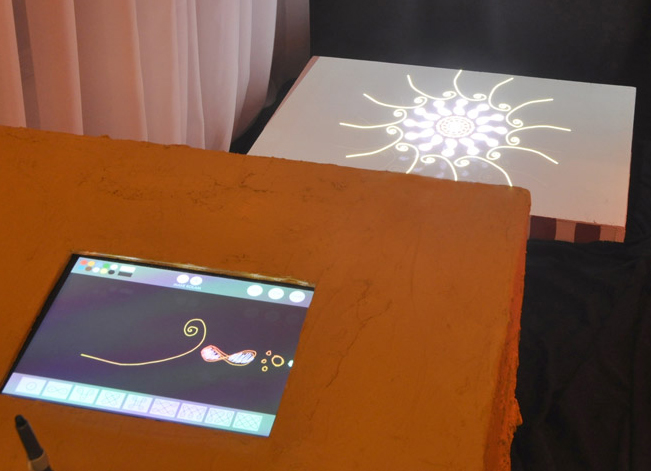
The Art of Indian Kolam is a collaboration between two NCC profs, Bruce Wall and Josh Miller. In 1980, Bruce Wall was awarded a Fulbright grant. Along with his wife, KU Prof. Rhonda Wall, he traveled to Tamil Nadu in Southeast India to document these ephemeral geometric folk designs. Josh Miller, who teaches web design and motion graphics, is responsible for several magical high-tech interactive aspects of the exhibition. Most notably, Miller engineered an interactive computer program that permits gallery-goers to design their own digital Kolam.
The Virtual Kolam drawing station, photo from exhibition website.
These new designs are uploaded instantaneously to an electronic wall display and digitally archived. This aspect of the exhibition is clearly a hit with the art students. Miller had said he had hoped for 40 or so viewer-generated digital Kolam, that number has been long surpassed, and several hundred designs have already been uploaded.
We missed his lecture but Bruce gave us a shortened version. Kalom are ritual designs drawn daily outside rural households. What looks like chalk is, in fact, a finely ground rice flour mixed with spices. Like the PA German hex signs we see in Eastern Pennsylvania, Kolam are more than simply decorative. The designs protect the household from bad karmic vibrations. Also like hex signs the designs, whether simple or complex, are constrained by a traditional geometry.
Villagers take the daily ritual quite seriously. Wall met a couple of Frenchwomen who had rented a small house in Tamil Nadu and agreed to their landlady’s one rule, -they were to create a Kolam daily. These two woman apparently were perfectionists and embarrassed by their failed attempts at Kolam. After a few days they gave up trying. The Indian landlady ran into the house waving her arms. She screamed, “You must make the Kolam! You must.” The Frenchwomen came up with a culturally appropriate work-around. They hired a young neighbor girl to make their Kolam.
This is a fascinating exhibition about a little known art form. If you are in the area, do check it out. If you are not nearby, check out the excellent interactive website.
The Art of Indian Kolam exhibit runs through October 23. The Gallery, Communications Hall, Northampton Community College, Bethlehem Township, PA. Weekdays: 8am -10 pm & Saturdays: 9-5.
Update: The Awesome Happening announced below already happened. It was a sunny morning in Kutztown. St. John’s PreSchoolers, Kutztown Elementary students, and lots of KU students joined Dallas Clayton for a morning frolic on the lawn. Dallas was a hit. He gave away, by my count, something like 180 of his Awesome books! We didn’t even give him gas money, Let’s hope his generosity boomerangs back at him a hundred times over. We’ve added one photo of the event above, and will add more soon.
Does the name Dallas Clayton ring a bell? KU illustration student Janaya Buck is a big fan. When she heard about the L.A. writer / illustrator’s Awesome Back to School Tour she invited him to visit Kutztown. You are invited, too, this Weds, Sept 14 at 11. The official room is SH 209, opposite the dean’s office in Sharadin. The classroom may not be big enough, in which case we will spill out into Sharadin’s awesome atrium. If the atrium isn’t big enough, we will spill out onto the lawn. If the lawn isn’t big enough we will go dance in the awesome fountain.
Dallas Clayton's book tour stopped at Borders, perhaps a bit late.
Clayton self-published his first children’s book, The Awesome Book. It was so successful Amazon decided to partner with him. Now he has another book, The Awesome Book of Thanks. Both are available for free on the internet. If you buy a book, he donates a book to a bookless child in a hospital or shelter somewhere in the world. This buy one, give one, philosophy is contagious. First, there was Tom’s Shoes, then the retro eyeglass site Warby Parker sent over 50,000 pairs of glasses to needy people worldwide. Now Dallas Clayton is doing it with books. I’ve never used the word paradigm, and I’m not going to start now, but something is happening, and it may be, um, awesome.
From what I see of Dallas Clayton he is in sync with the New Sincerity Movement. “New Sincerity ” according to Wikipedia, “is a term used in music, aesthetics, film criticism, poetry, literary criticism and philosophy, to describe art or concepts that run against prevailing modes of postmodernist irony or cynicism.”
Clayton’s illustration style is charmingly simple: it reminds me a bit of the great Shel Silverstein. So, unless you are a postmodernist cynic, please join Janaya Buck in welcoming Dallas Clayton to Kutztown’s campus.
Sharadin Gallery will soon have a new name, The Marlin and Regina Miller Gallery. I once proposed that after “Gallery” the words “of Art and Design” be added, to be more inclusive of design. Oddly enough, that modest proposal was met with fierce resistance from some faculty.
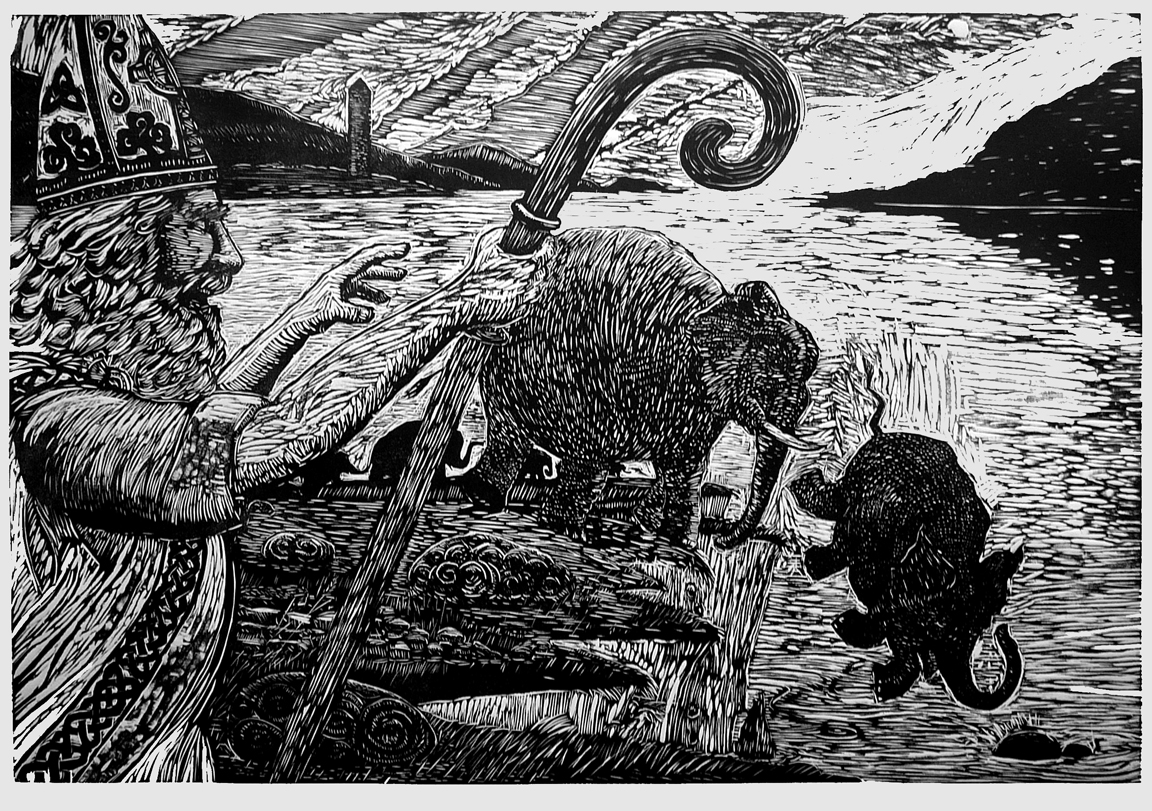
The 2011 KU Faculty Exhibition includes works of art and design by my colleagues in Communication Design, Art Education & Crafts, and Fine Arts. I have three works in the show. You can see my large woodblock print of St. Patrick, carved in St. Louis at Evil Prints, and printed in KU’s printmaking studio. Prof. Elaine Cunfer will also be exhibiting a print done on KU’s etching presses this year.
Special thanks to Prof. Evan Summer for graciously permitting us to use that studio space. You may be aware Prof. Summer was awarded KU’s 2011 Arthur and Isabel Weisenberger Faculty Excellence Award. His printmaking class has always been a popular art elective for aspiring illustrators. He deserves the honor and we are looking forward to seeing his new etchings.
Grand Opening: Sept. 8, 4-6pm
The (former) Sharadin Art Gallery will officially be dedicated and renamed The Marlin and Regina Miller Gallery in honor of the donors who contributed to the Sharadin Arts Building renovation. The public is invited to the Miller Gallery’s opening reception and dedication ceremony on Thursday, September 8, 4-6 P.M. Light refreshments will be served. Hope to see you there.
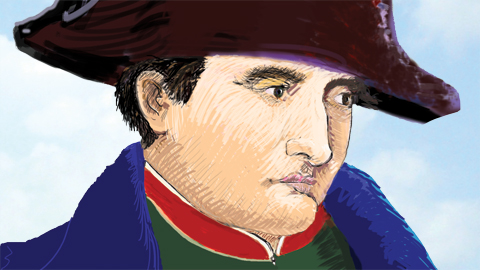
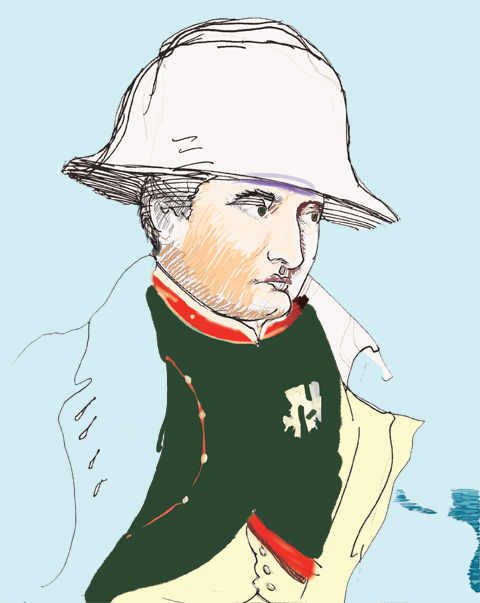
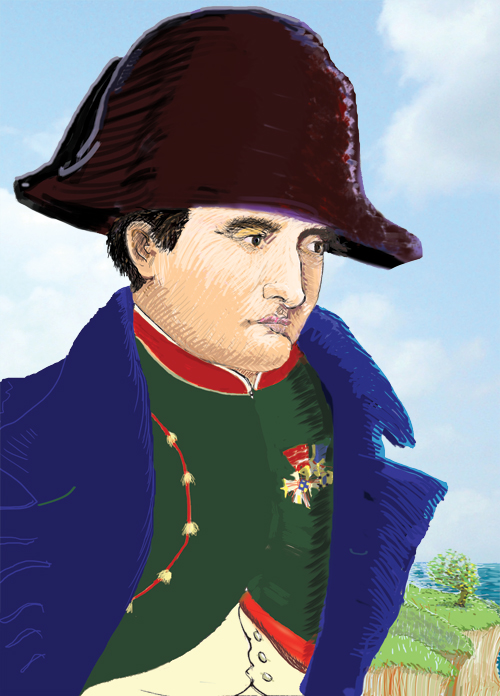
Got a Bamboo Fun Tablet by Wacom ($199) and have been experimenting with drawing and painting in Photoshop CS5. For this portrait of Napoleon, I began with a single reference image, an old print I bought in England over twenty years ago.
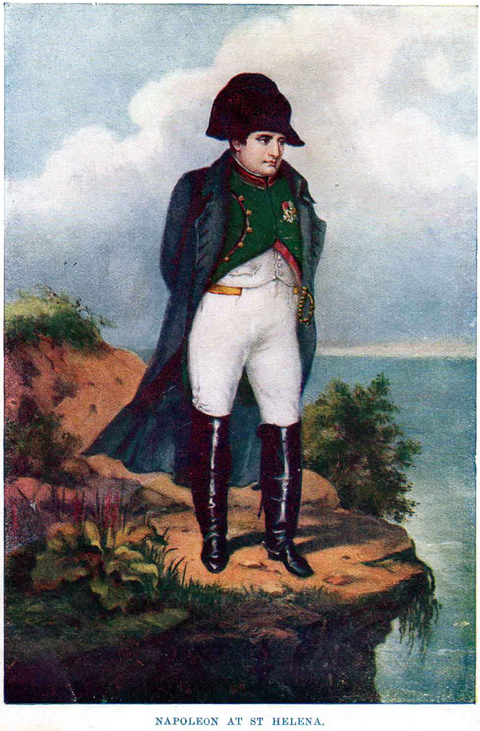
I was in a used bookshop in Greenwich and found it in a box of loose prints and asked how much. The bookseller glanced over his bifocals and said, “10 pence.” I would have paid twice that. It’s a lovely little example of a printing process called chromolithography. Apparently, it is an illustration separated from an old book, circa 1900.
The original print depicts Napoleon in exile at St. Helena. In a rather surreal pose the general stands alone, his face in the wind, dangerously close to the cliff’s edge. One detail that strikes me as most peculiar is that Napoleon is carrying a sword. I don’t know much about how he was treated during his forced exile on St. Helena, but that detail seems unlikely. The uncredited illustrator has successfully captured the psychology of the forcibly retired Emperor, lost in thought. He has a pensive, ‘It is what it is’ look that I hoped to capture.
A Xerox Machine Made of Meat?
Today, many illustrators would use the scanned print as their base layer of their Photoshop rendering. There is nothing legally wrong with that. The print’s copyright has surely expired. Still, I am old-school, and chose to draw it by hand and eye to make the image mine. I recall Art Speigelman’s injunction against tracing to a class full of aspiring cartoonists, “Draw! You are more than a Xerox machine made of meat!”
I inked directly over my quick pencil sketch. Without even erasing the pencil, I scanned my crude image and made it the base layer in Photoshop. I poured in a blue background. This gave me an idea of the sky’s tone, but more importantly the light blue is far easier on my eyes than a bright white screen. I started sketching in the skin tones with a Photoshop brush and within an hour my ink sketch was totally covered.
Now, I know Photoshop has a feature for rendering clouds, Filter -> Render -> Clouds. I found a nifty photoshop cloud tutorial here thanks to Michael Skora. I tried the exercise a few times, but found my Photoshop clouds didn’t have the ephemeral beauty of real clouds. Rather than swipe someone else’s super cloud photo via Google image search, I looked through my Iphoto files of my recent trip to the Yucatan. I was on top of Maya pyramids with unobstructed sky views, but most of my pictures were snapshots of friends. I found one with lovely clouds against a pale blue and cropped out the people.
Notice part of a friend's hand shows in lower left of my cloud shot.
I placed the cropped cloud photo on a layer below Napoleon. I applied Photoshop’s Brush Stroke (Angled Strokes) so the sky appears less like a photo and more like my digitally painted Napoleon portrait. This might sound like I’ve gone over to the dark side to become a Xerox machine made of meat. However, I used my own photo-reference, and in my mind, the portrait is the essence of this picture.
Notes: Since I posted this I find myself looking at the sky more. With Hurricane Irene we had some quite dramatic clouds here in Kutztown. Kutztown Cemetery is one of the few places in town without utility poles blocking the sky. I spent some time on the hill in the graveyard capturing clouds with my digital camera. I may update this image with more spectacular clouds.
Xerox is a registered trademark of the XEROX CORPORATION.
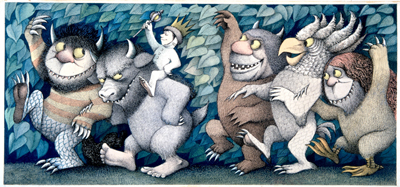
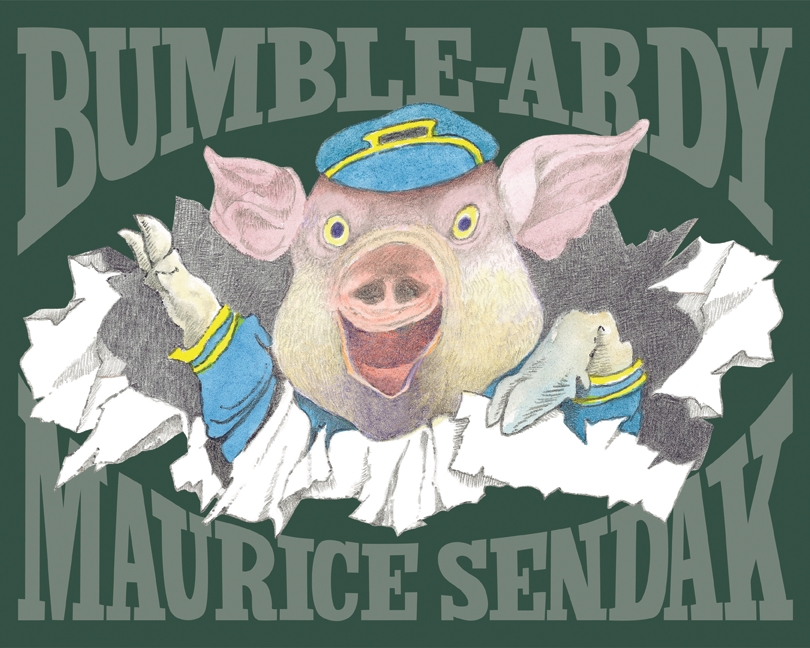
Rohrbach Library is having a Maurice Sendak exhibition,”In a Nutshell.” Best known for his 1963 book Where the Wild Things Are, Sendak created over 90 remarkable illustrated books. He is still working and has a new book, Bumble-Ardy, coming out this fall. There are a number of local events associated with the Sendak show. Here is a website with more info. I’ve highlighted some of the noteworthy FREE events below.
Sept 1: 7:00 pm. Opening Reception. Rohrbach Library. Illustrated talk by Patrick Rodgers, Sendak scholar and Curator at Philadelphia’s Rosenbach Museum. Rodgers has interviewed Maurice Sendak and has many stories to tell about the great man.
Still from Spike Jonzes' film, Where the Wild Thing Are (2009, Warner Bros.)
Sept 9: 6:30 pm. Free movie, a feature film based on one of Sendak’s most-beloved books at the Louisa Gonser Library. Note: this local public library is in Kutztown, but not on campus. It’s near Young Ones. Enjoy the 2009 Spike Jonze film and a chance win a copy of Sendak’s new picture book, Bumble-Ardy. Kids of all ages welcome.
Sept 24: 10:00 Am-Noon. Rohrbach Library. Rumpuspalooza for Kids! Games, crafts, treats, KU Performing Arts Series tix, the Scholastic Book Fair, and a big Wild Thing—all part of KU’s Family Day.
Author 'Lewis B. Montgomery' is a pseudonym for Kutztown's Mara Rockliff (right)
Oct 5: 7:00 pm. Rohrbach Library. Children’s Publishing 101: Meet Kutztown resident and author Mara Rockliff along with illustrator and KU BFA Grad, Amy Wummer. Editor Juliana Hanford will also be there. This is the creative team behind the popular Milo & Jazz Mysteries. They will offer an inside look at how kids’ books are made. Bring your questions about illustrating and writing for the children’s publishing industry.
In a Nutshell runs from Sept 1 to Oct 14. KU Librarian Bruce Jensen has created a special web library guide about Sendak and the exhibition. It has extensive links to interviews and essays about Sendak.
John Esh is an award-winning 2002 BFA grad. Twice he has won top honors at Gen Con. He recalls that it was in Joe Lacey’s Illustration class that he first learned of the Gen Con art show. Gen Con bills itself as,”the original, longest running, best attended, gaming convention in the world. The Gen Con Art Show is the premiere showcase for fantasy, sci-fi, horror, and gaming art. ” The attendance for the event in Indianapolis topped 36,000 in 2011. John Esh’s artwork, pictured above, was singled out for a blue ribbon and one of the highest awards at the recent convention.
John Esh at his booth at Gen Con 2011
His oil painting, Sleeping Beauty, was awarded the Juror’s Choice Blue Ribbon by Jeff Miracola, Artist Guest of Honor. Miracola is a well-respected illustrator whose clients include Wizards of the Coast, Hasbro, and Advanced Photoshop Magazine. Sleeping Beauty was produced by painting thin oil paint glazes on illustration board, a technique John learned from the fantasy artist Donato Giancola when he visited Kutztown’s illustration classes.
John also attended Gen Con in 2005 and won that year’s Juror’s Choice Prize for a watercolor based on the Beowulf saga from guest juror, Jeremy Canford. Canford was art director for Wizards of the Coast, responsible for Magic the Gathering and the Dungeon’s & Dragons gaming franchises. John recalls that the Beowulf painting was originally produced for Prof. Martin Lemelman’s senior illustration class at Kutztown. By the way, Martin Lemelman has his own illustrated blog at http://www.twocentcomics.com.
John Esh thinks of himself as himself a “fantasy fine artist,” since he doesn’t work in the gaming industry as an illustrator. He enjoys the freedom to choose his subject matter and sell high-quality prints based on his original artwork. Anyone interested in his artwork is welcome to contact John Esh via email: artmanesh@gmail.com. Congrats to John on his well-deserved success. Hopefully, he will keep us posted about future exhibitions and awards.
Note: The Illustration Concentration Blog has had over 30,000 hits in the past year. Thanks for reading. If you are an illustrator, especially one with a Kutztown connection, please don’t be shy. Keep us informed about your success!
I asked Ashley McDevitt, a 2011 grad, how she got her dream job so fast in today’s tough market?
OK, so it all started when I went to the Portfolio Review. I heard from Prof. Bosler and Prof. Cunfer about a few of the people coming that I should pay attention to, one of them being Kathy Davis. Kathy Davis, Paper Magic, and Hallmark where the three people on my list. So that evening I met three of Kathy Davis’s senior designers, one of whom was a fellow KU alumni. I immediately wrote down their names, collected business cards, and within two days had handmade thank you notes in the mail.
Fast forward: two weeks later and I got my first call from Kathy Davis. My first interview was over the phone with the head of licencing, HR and creative director, the second was at the studio to show my portfolio and then finally I met Kathy Davis. I didn’t know until when I came in for paperwork that Vallerie Berstecher and Laura Mounts had also been hired on as well. My first day was July 5th and I’ve been here ever since.
Which KU classes were most helpful to you, as far as getting a job?
I’d probably have to say Professor Bosler’s Self Promo class was the most helpful, with Portfolio a close second. But then again, all my classes were useful because they got me a job I like, in the field I was trained for, just 3.5 weeks out of school. But I’d say Self Promo gave me probably the biggest confidence boost to go out into the working world guns blazing. Prof. Bosler spelled everything out, –both pros and cons. I was still scared out of my mind, but at least I knew what to do.
What can you tell us about out your new job? What sort of materials do you use, for example?
Software wise, we use CS4. We don’t simply use the computer, but we still utilize watercolor, hand-drawn type and calligraphy that are staples of Kathy Davis’s art. This is also one of the things that I really enjoy about the company, too; there’s still this appreciation for these media. Kathy works with American Greetings and we use their resources to print/distribute our cards. We have a small staff of about 20, but everyone is easy to ask questions of, and we work as a cohesive team. I think that one of the best things about working here is that people will be able to buy cards I worked on at places like Target and Walmart!
Also we have a small gallery in the studio that every month each designer takes turns showcasing their work. We also have creative meetings to show inspirations we have come across both past and present. We have an inspiration wall, as well, that a designer gets to put together themselves each month.
Editor’s note: Ashley McDevitt won the 2011 Kutztown C.D. Senior Illustration Award. She can’t share any of the Kathy Davis projects she has worked on, but the artwork on this page is from the portfolio that helped her land her dream job. More of Ashley’s illustration work can be seen here on her web site. My question about how she got the job was not meant to express surprise at her well-deserved success, but to advise other illustration students. Ashley’s responses were edited for length.
In 2011, I traveled by bus through the Yucatan and Belize with a number of American scholars. One of them understood the language of the Maya. Mark Van Stone is an author, calligrapher, designer and illustrator. He is also a world-class Maya epigrapher, meaning he can read and write Maya glyphs.
Mark Van Stone astride the great Pyramid at Lamanai, Belize.
He came to calligraphy late in life after finding his computer engineering degree led to rather boring jobs. He studied the Book of Kells at Trinity College in Ireland. He mastered medieval European letterforms and Egyptian hieroglyphics. He also studied Arabic and Japanese calligraphy, but his favorite writing system is that of the ancient Maya. He studied with the legendary Linda Schele at University of Texas. He currently teaches art history at Southwestern College in California.
Dr. Van Stone was one of my favorite colleagues and traveling companions on my Maya world tour. He explained to me that many Maya glyphs are ideograms, compact illustrations, like the apple on my computer, but others are phonetic devices representing sounds or syllables. It is only in the last thirty years that experts, like his late mentor Linda Schele, figured out the sounds and meanings for most of the glyphs.
Dr. Van Stone humored me and wrote Kutztown in Maya glyphs. As we know, there is more than one way to pronounce ‘Kootztown’, so he came up with two variants.
Using a flash light to increase readability of glyphs at Lamanai.
Mark Van Stone has an amazing amount of energy, both intellectual and physical. At more than one of the archaeological sites we visited, we were told we wouldn’t have time to see all the glyphs. He didn’t accept that. He would race up and down pyramids and jungle trails to document every known glyph at the site. I’ve read his two books pictured above. Reading Maya Glyphs, which he co-authored with Michael Coe is the best introduction to the subject. His latest book,(which he was good enough to send me in electronic form) is a lively collection of illustrated essays about the so-called Maya prophecies about 2012.
In the PBS NOVA documentary, Cracking the Maya Code, it is Mark Van Stone’s hand that draws the glyphs that appear on-screen. One of his most amazing calligraphy jobs was drawing the scribbled pages for the giant pirate’s book in Disney’s Pirates of the Caribbean. You never know where calligraphy might lead you!